
 Priyanka Tiwari
 Share
Share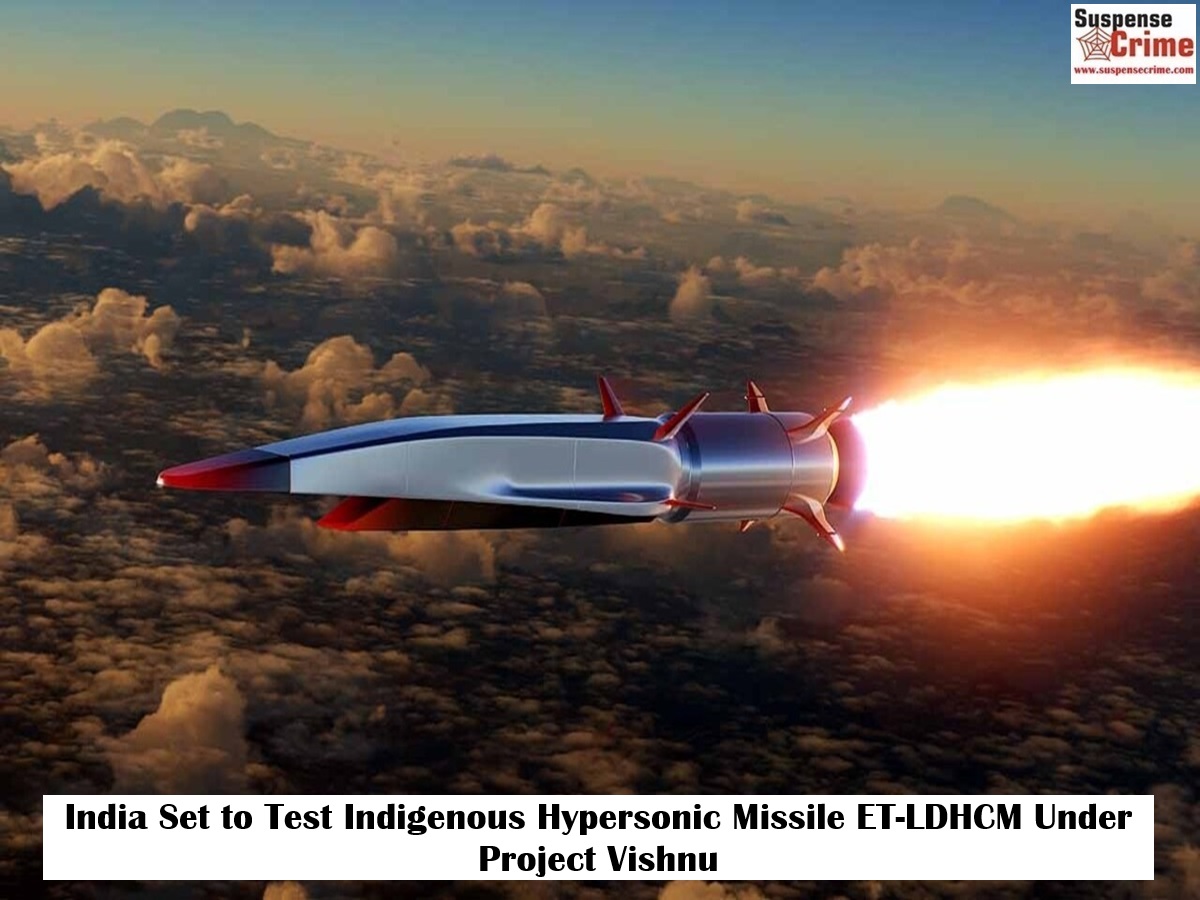
Suspense crime, Digital Desk : In a landmark development for India's defense capabilities, the country is set to test the Extended Trajectory-Long Duration Hypersonic Cruise Missile (ET-LDHCM) off the coast of Odisha. This ET-LDHCM system is an advanced weapon system formulated under the DRDO's classified initiative, Project Vishnu.
This project is expected to change the balance of power in South Asia by providing India with a decisive advantage over its neighbors.
Highlights of the Project
- The hypersonic weapon systems' maximum speed is expected to be Mach 8 (around 11,000 km/h).
- It could travel up to 1,500 km, allowing for deep precision strikes into rival countries.
- It could carry 1,000-2,,000 kg payload of conventional or nuclear warheads.
- It could perform maneuvers that would allow it to evade radar detection.
The missile’s hypersonic speeds, along with mid-course maneuverability, make interception by current air defense systems impossible.
Advancing India's Scramjet Technology
Moreover, the missile's advanced scramjet engine which uses atmospheric oxygen as fuel allows for sustained hypersonic flight makes its interception nearly impossible.
This milestone is achievable by completing a 1000 second ground test, confirming the propulsion system’s hypersonic capabilities.
In contrast to standard ballistic missiles, the ET-LDHCM:
Operates at sub-low altitudes
Permits mid-course adjustments
Employs heat and oxidation-resistant materials, withstanding temperature up to 2000 degrees Celsius
Multi-Platform Launch Capability
One of the key benefits of ET-LDHCM's versatility is its multi-platform launch flexibility:
Land-based systems
Airborne systems
Maritime vessels
Enhanced operational strategic strike capabilities allow engagement across diverse terrains and missions, including targeting:
Command and control centers
Radar facilities
Naval warships
Hardened bunkers
Strategic and Economic Implications
Following a successful long-range test in November 2024, this marks India's second hypersonic milestone within a year.
Upon deployment, analysts predict ET-LDHCM will:
Bolster India’s deterrent posture
Shift the military balance in Asia
Augment efficiency across all three defense services
Aside from military uses, advancements in hypersonic technologies could serve to expedite:
Satellite deployment
Aerospace industry
Logistics for disaster response operations
The initiative also aids India’s defense manufacturing network, involving MSMEs and private companies, which has stimulated domestic innovation and employment.
India's Tactical Edge in Geopolitical Relations
The ET-LDHCM's deployment is expected to strengthen India's strategic advantage, offering unprecedented speed, survivability, and flexibility for various missions. India intends to integrate these systems fully within the Army, Navy, and Air Force to remain responsive to evolving threats in an unstable geopolitical landscape.
Read More: Sona Valliappa Group launches SCALE, India’s first integrated campus for GCCs and students