
 Priyanka Tiwari
 Share
Share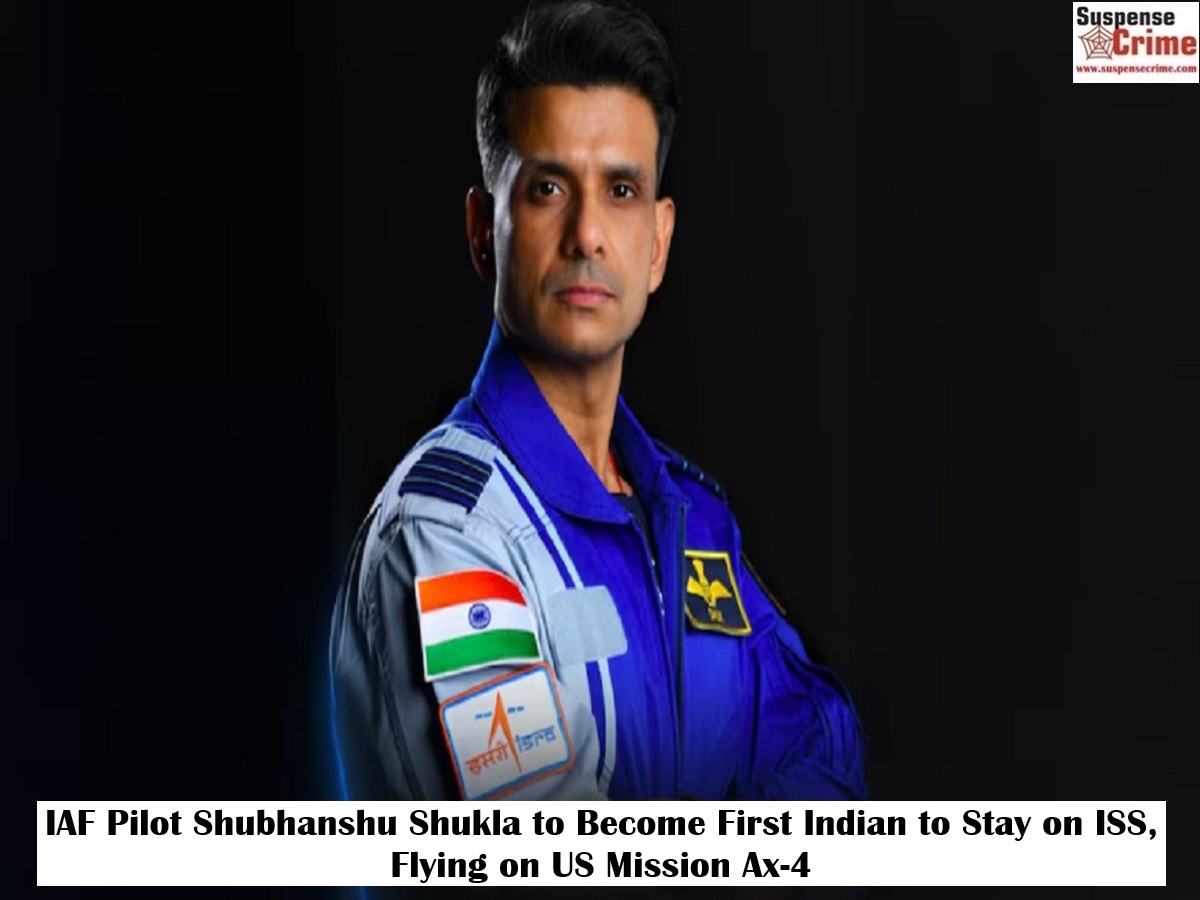
Suspense crime, Digital Desk : Just shy of 40 years since IAF Squadron Leader Rakesh Sharma went to space as an Indian national, Group Captain Shubhanshu Shukla is set to be the first Indian to live on board the ISS. His mission marks a growing sign of India's prominence in human space exploration. Shukla is set to launch on a SpaceX Falcon 9 rocket for the Axiom Mission 4 (Ax-4) flight.
His spaceflight will serve as a pivotal testament to India's rise on the global stage. This will make Shukla the second Indian to go into space on a commercial US mission.
India’s Expanding Human Spaceflight Ambitions
Shukla’s participation in Ax-4 aligns with India’s broader vision:
- Gaganyaan Mission: India’s first human spaceflight project.
- Bhartiya Antriksh Station (BAS): The planned Indian space station.
- NavIC: India’s indigenous satellite navigation system.
India exhibits proven expertise in moon and mars missions, earth observation, and small satellite launches.
This mission adds to the knowledge base of India, especially in areas that the country lacks experience in, such as continuous flight control monitoring, crew-machine interaction, and vital statistic tracking during spaceflight.
Global Teamwork and Crew Training
Shukla is part of a four-member crew for Ax-4:
Commander: Peggy Whitson (USA)
Pilot: Group Captain Shubhanshu Shukla (India)
Mission Specialist: Sławosz Uznański-Wiśniewski (ESA/Poland)
Mission Specialist: Tibor Kapu (Hungary)
Prior to this mission, Shukla, along with three other Indian Air Force pilots, completed spaceflight training in Russia. His familiarity with American and Russian spacecraft will provide useful insights during the development of India's spacecraft modules.
Scientific Contributions from Indian Research
Shukla is scheduled to spend 14 days on the ISS, where he will conduct several research projects with ISRO and NASA, as well as ESA, which focuses on the following topics:
Cyanobacteria growth and biochemistry in microgravity
Molecular resilience in extreme environments
Seed germination and crop growth in space
Impact of screens on vision and cognition in space
Microalgae metabolism in microgravity vs. Earth
Skeletal muscle degradation and countermeasures
Effects of spaceflight on six crop seed varieties
These objectives aim to enhance India's competencies in long-duration missions and biological research in microgravity environments.
Information Exchange and Benefit to the Nation
The mission goes beyond providing tangible outputs in science. It also includes:
Providing real-time training for astronauts
Consulting on the Indian crew module design
Managing anxiety from potential launch delays
Establishing the round-the-clock Flight Director system for India
Shukla’s training will enable smooth transitions for future Indian astronauts to indigenous missions.
A Catalyst for India’s Youth and Innovation Ecosystem
Apart from scientific advancement, Shukla’s mission holds optical and emotional significance such as:
Motivating the future space workforce
Bolstering India's international partnerships
Showcasing India’s preparedness for greater engagement in space
Shukla serves as an example of how early inspiration can be harnessed to benefit the nation, having been motivated by an airshow during his school years.
Planning Further: Collaboration with Industries and More Missions to ISS
Prior to the decommissioning of the ISS, some experts strongly advocate for more Indian missions. This would:
Strengthen the knowledge base for BAS
Set up the infrastructure for a Moon mission
Facilitate collaborations with private sectors such as pharmaceuticals for space-based research
Read More: SP MP blames burning of dead bodies and Holika Dahan for pollution, Giriraj gets angry