
 Priyanka Tiwari
 Share
Share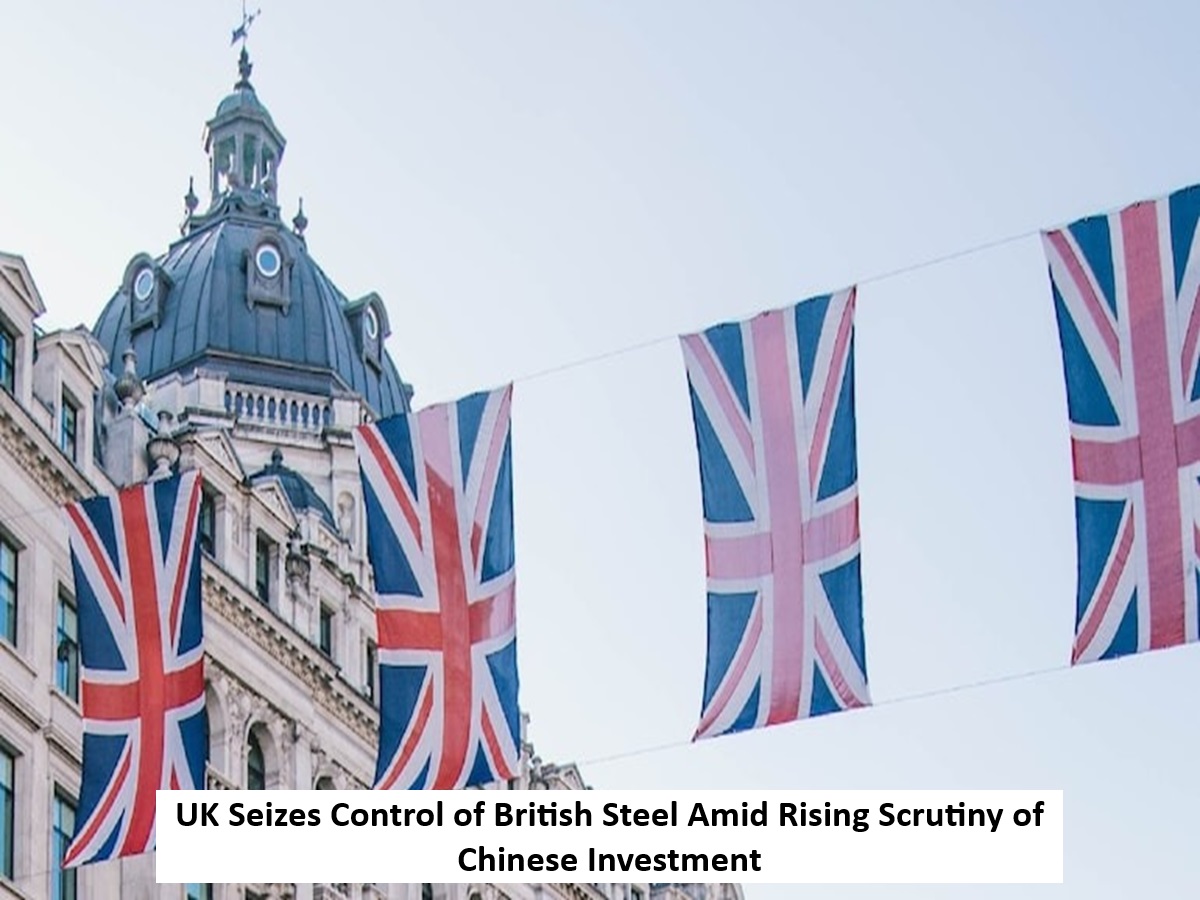
The UK government's decision to regain control of British Steel from Chinese owner Jingye represents a profound change in the UK's policy towards overseas investment. It has been reported that the move is an effort to address security concerns and protect critical supply chains.
Such actions are reigniting considerations of the level of Chinese investments into the UK. Beginning in the year 2000, Chinese companies, predominantly state-owned enterprises, have invested in excess of $100 billion into strategically important British industries such as energy, technology, transport, and real estate.
Strategic Sectors: Energy, Transport, And Telecommunication
Data from the American Enterprise Institute (AEI) reveal that close to 33% of Chinese investments in the UK focus on strategic sectors. Chinese control of the following sectors has raised concerns:
Nuclear energy facilities
Telecom infrastructure
Transport terminals
Almost 20% of major Chinese deals since 2005 have been focused on the UK’s energy sector, including wind farms, gas networks, and utilities. Although these investments were deemed security risks, in hindsight, they are now perceived as essential infrastructure needing protection.
Key Chinese Investments Within UK Infrastructure
Notable Chinese ownerships contain:
China Investment Corporation holds 9% of Thames Water
10% Stake in Heathrow Airport
A minority stake in Hinkley Point C nuclear plant by China General Nuclear (CGN)
Their plans for further investment in the Bradwell nuclear project in Essex are almost certainly going to be blocked by the British government which shows a shift in policy regarding Chinese energy involvement.
The intersection of Private Equity and Real Estate
Aside from the state sponsored ventures, Chinese private equity has been more active in:
Real estate in the UK
Auto manufacturing
Notable investments include Geelys investment in LEVC, the maker of London black taxis as well as its ownership of Lotus Cars. Nevertheless, such investments have sharply declined due to low returns and strained capital controls in China.
Decline in FDI Indicates a Global Investment Shift
The amount of Chinese FDI into the UK dropped by 97% in comparison to its peak in 2017. This decline is in line with broader trends in the US and EU. Analysts cite:
More strict UK screening procedures.
Capital export limitations from Beijing.
Discontented investors regarding property returns in the UK.
Existing Agreements Cause Policy Multi-dilemmas
The pre-existing infrastructural investment policies in the UK allowed foreign investments to flow freely, thus rendering it particularly vulnerable to these legacy Chinese deals. The new oversight frameworks complicate the management of older deals.
“The UK has historically attracted more infrastructure investment from China than most OECD countries and has been most exposed to China’s predatory investment strategies,” said Armand Meyer of The Rhodium Group. “The challenge is to spiral backward from the unbundle contractors bound by new supervision frameworks.”
A New Era of Investment Focused in the UK?
This might be the first signals indicating a shift towards redefining the UK's foreign investment strategy, with the intention to enhance economic patriotism and minimize strategic reliance on certain foreign nations. This episode symbolizes moves of a wider geopolitical narrative where the West is on one side, and China is on the other.
Read More: World Bank Approves 700 Million Dollars for Pakistan to Boost Economic Stability and Public Services