Russia Just Tested a Missile That Can Circle the Entire Planet - And the World Should Be Paying Attention
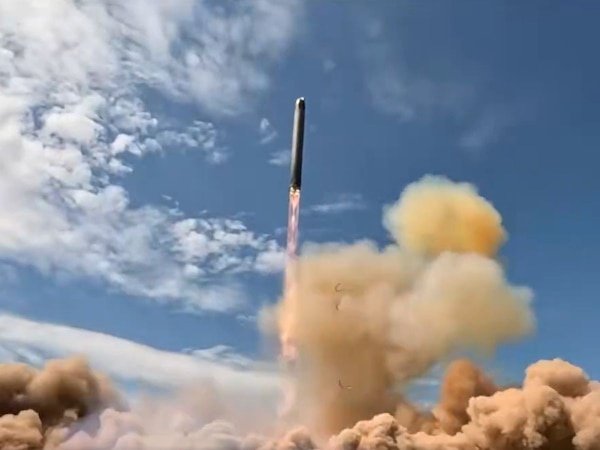
A knock on the door. Sharp commands. Officers shouting orders. Then the camera captures a missile tearing through the sky with a roar that feels like it belongs to a different era of warfare.
Except this isn't from the past. This happened just hours ago.
Russia's Foreign Ministry released a 42-second video announcing that President Vladimir Putin had been personally briefed on the successful test of the Sarmat missile — one of the most formidable weapons ever built by any nation on Earth.
35,000 Kilometres. Let That Sink In.
The number that's stopped defence analysts in their tracks is the range — 35,000 kilometres.
To put that in perspective, the circumference of the entire Earth is roughly 40,000 kilometres. The Sarmat's sub-orbital flight path of 35,000 km means this missile can travel almost all the way around the planet before it strikes its target. That's not a missile range. That's a weapon that can lap the globe.
The Sarmat's standard intercontinental range is already approximately 18,000 km — enough to reach virtually any point on the planet from Russian territory. But the 35,000 km sub-orbital capability takes it into an entirely different category of threat.
Why This Changes Everything About Missile Defence
Here's what makes the Sarmat genuinely alarming from a strategic standpoint — it isn't just the range, it's what that range allows the missile to do.
Most intercontinental ballistic missiles follow a relatively predictable arc over the North Pole, taking the shortest possible route to their targets. Missile defence systems around the world — including America's — are largely designed around detecting and intercepting weapons travelling along that well-known trajectory.
The Sarmat doesn't need to take the shortest route. It can fly over the South Pole. It can take an indirect path across any part of the globe. It can approach a target from a direction that existing radar systems and interceptor networks are simply not positioned to cover.
In plain terms: current missile defence infrastructure struggles to track it, predict its path, or intercept it in time. That's the whole point.
How Does It Compare to What America and China Have?
To understand just how significant this capability gap is, here's a quick comparison with the most powerful ICBMs currently held by the two other major nuclear powers:
China's DF-41 — considered Beijing's most advanced ICBM — has a range of approximately 12,000 to 15,000 kilometres.
America's Minuteman III — the backbone of the US land-based nuclear deterrent — has a range estimated at between 10,000 and 13,000 kilometres.
Both are powerful weapons by any conventional measure. But against the Sarmat's 35,000 km sub-orbital range, they're operating in a fundamentally different league. Russia's missile can reach anywhere on the planet via multiple possible routes, while the others are essentially limited to direct-path targeting.
What This Means Geopolitically
Russia has been developing the Sarmat — officially designated RS-28, and nicknamed "Satan II" in Western defence circles — as a direct response to advances in Western missile defence technology. The entire design philosophy is built around defeating interception systems before they can react.
The timing of this test announcement, with Putin personally informed and a video immediately released publicly, is also a deliberate signal. Russia isn't quietly testing this weapon — it's making sure the world knows it exists, it works, and it's operational.
Whether this shifts the balance of nuclear deterrence in any immediate practical sense is a matter for defence strategists to debate. But as a statement of military capability and geopolitical intent, Russia has just made one of the loudest announcements in recent memory.