
 Priyanka Tiwari
 Share
Share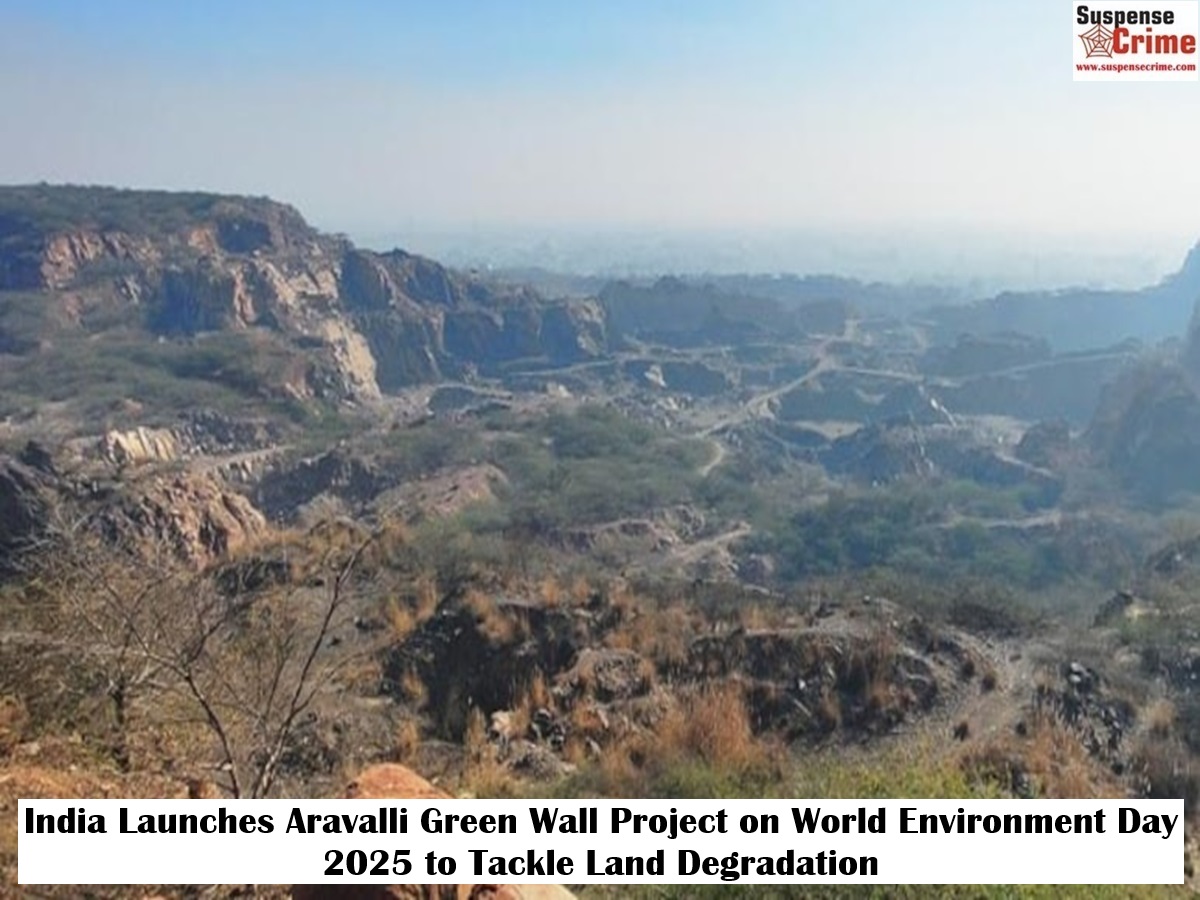
Suspense crime, Digital Desk : India has launched the Aravalli Green Wall Project as a large-scale ecological restoration initiative targeting the Aravalli mountain range on June 5, 2025. This region suffers from land degradation due to deforestation, mining, urbanization, and climate change. The Aravalli mountain range spans across four states covering 700 km and serves as a natural barrier against sandstorms from the Thar Desert.
What Opened My Eyes To The Condition Of Land In India
India is facing severe land degradation challenges.
- The country's land is degraded by 30%.
- Facing desertification is 25%.
- The forest cover is 24.62% which is less than the required 33% mandated by the National Forest Policy.
The alarming reality is that around 40% of the world’s population suffers from land degradation. In addition, more than $577 billion every year is put at risk when it comes to crop production due to loss of pollinators.
India's Wildlife Protection Act (1972), Forest Conservation Act (1980), Biological Diversity Act (2002) and Compensatory Afforestation Act (CAMPA 2016) showcase legislative efforts towards biodiversity sanctuaries. India Action Plan to Combat Desertification (2022) aims at restoring 26 million hectares of land by 2030. Integrated flagship programs incorporate Namami Gange, Yamuna Action Plan, and NPCA for the complete spectrum of aquatics. Restoration still remains fragmented and reactive rather than regenerative.
European Union’s NRL serves as global guidance. The law, which comes into effect on June 17, 2024, sets actionable milestones such as:
- Adding forests, wetlands, rivers, lakes, grasslands to restoration targets
- Reversing biodiversity decline by 2030
- Planting 3 billion trees and reversing the decline of pollinators
- Submitting National Restoration Plans by September 2026 which the European Commission will supervise
This initiative falls under the EU Green Deal which aims at increasing the region's resiliency to climate change, ensuring food security, and sustainable development.
Global Restoration Frameworks and Initiatives
The following international frameworks facilitate the advancement of Nature Restoration:
IUCN Red List
Ramsar Convention on Wetlands
CITES
CBD (Convention on Biological Diversity)
UN Decade on Ecosystem Restoration (2021-2030)
As part of the Kunming-Montreal Global Biodiversity Framework 30% of ecosystems are proposed to be restored by the year 2030. The issue of having no binding legal commitments or enforceable standards still poses a challenge around the world.
Why Ecological Restoration Is Now a Global Imperative
An increase in biodiversity loss and climate change emerges as a reason to prioritize protection. This involves:
The restoration of forests, wetlands, and river systems
The establishment of policies that make regeneration the priority
Community-based approaches to conservation
Nature being recognized for its inherent value, rather than for its utility to humans.
A country like India would benefit from adopting a National Framework on Ecosystem Restoration, which would concentrate on biodiversity mapping, local governance, and inter-agency collaboration.