Ziya
Ziya Share
Share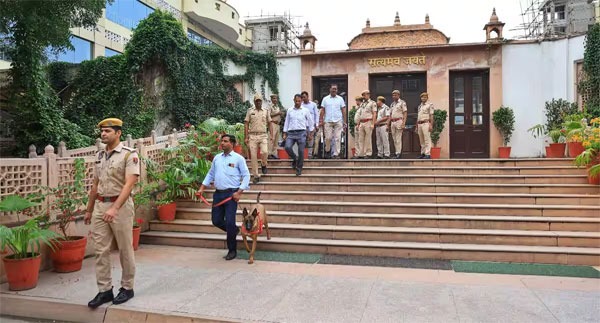
For the judges, lawyers, and staff at the Rajasthan High Court Jaipur Bench, the sound of a "bomb threat" is becoming an alarmingly common routine. On Friday morning, the court was hit with yet another threat ts 10th in less than four months.
However, this time, the stakes were higher, as the threat specifically targeted a high-profile visit from the Chief Justice of India.
The Threat: "Cancel the CJI's Visit"
The threat arrived via email on Friday morning. The sender didn't just warn of an explosion; they made a specific demand: "Cancel the CJI’s visit. Evacuate the High Court by 12 PM. RDX bombs have been planted in the premises."
This created an immediate state of emergency because the Chief Justice of India (CJI), Justice Suryakant, was scheduled to be in Jaipur on Friday to inaugurate a cyber security seminar.
The Response: A Race Against Time
Police, along with Bomb Disposal Squads (BDS) and Dog Squads, rushed to the scene. The entire court complex was cordoned off and searched meticulously for about an hour and a half.
Result: Like the previous nine times, no explosives or suspicious items were found.
Outcome: After the premises were declared "clear," court hearings finally began around 11 AM—roughly half an hour late. Extra police forces remain stationed at both the court and the CJI's event venue.
A Pattern of Psychological Warfare
This is the latest in a relentless string of threats that began on October 31, 2025. Since then, the court has been targeted on several dates, including five times in December alone. In 2026, threats were received on February 6, 17, and 19.
While the threats have consistently turned out to be hoaxes, the judicial cost is mounting. Each threat forces a shutdown of work, delays hearings for common people, and drains massive administrative resources.
The Cyber Challenge
The police are investigating a complex digital trail. Early reports suggest the email was sent using a VPN (Virtual Private Network), making it difficult to pinpoint the sender’s location.
Cyber security experts warn that while VPNs change IP addresses to hide a sender's identity, law enforcement can often trace back the original user by coordinating with VPN service providers for log data. The Jaipur Police Cyber Cell is currently working on tracing these digital footprints, with the possibility of involving central agencies if needed.
The Bigger Picture
The focus on the CJI's visit suggests that the sender is well-aware of high-profile judicial movements. For now, the "Cyber Security Seminar" that Justice Suryakant is attending seems more relevant than ever—proving that digital threats are now a primary front in modern security challenges.