
 Priyanka Tiwari
 Share
Share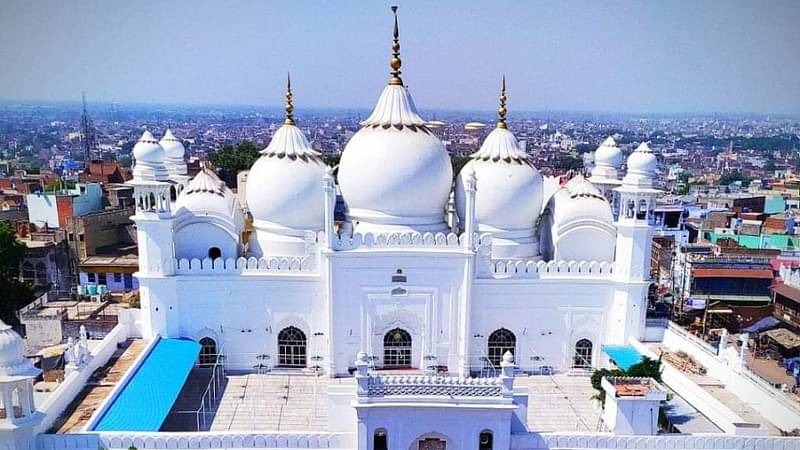
Aligarh’s Jama Masjid has been in the spotlight recently due to ongoing debates regarding its construction, ownership, and land status. A legal case has been filed, with Mughal descendants claiming it as their ancestral property, while some Hindu leaders argue that it was built on government land. Regardless of the disputes, the mosque’s grandeur and intricate gold embellishments make it a significant historical and architectural landmark. Let's explore its history, architectural significance, and the controversy surrounding it.
Historical Background of Aligarh Jama Masjid
Aligarh’s Jama Masjid was constructed during the Mughal period, under the reign of Muhammad Shah (1719-1728). The then-governor of Kol, Sabit Khan, initiated its construction in 1724, and it was completed in 1728. The mosque also holds historical significance as it houses the graves of 73 martyrs from the 1857 revolution. The Archaeological Survey of India (ASI) has conducted surveys on this mosque in the past to assess its historical value.
Who Built the Jama Masjid?
The mosque was commissioned by Sabit Khan Jang Bahadur, the governor of Kol (present-day Aligarh). It is one of the oldest and most magnificent mosques in the region. According to some claims, the mosque was built by the grandson of Abu Isa Anfaadi, the chief architect behind the Taj Mahal.
The mosque features small minarets on its entrance and corners, and it has the capacity to accommodate up to 5,000 worshippers at a time. The structure is a blend of Mughal and Awadhi architectural styles, contributing to its unique aesthetic appeal.
Controversies Surrounding the Mosque
There are multiple claims regarding the origin of the mosque:
Some believe that the mosque was originally a Hindu temple.
Others argue that it was built by a descendant of the Taj Mahal’s chief architect.
The mosque is often referred to as the "Chhota Taj Mahal" due to its striking resemblance to the Taj Mahal.
The architectural design reflects a fusion of Awadhi and Mughal styles.
These conflicting claims have led to disputes over the mosque's true origins and ownership.
Gold Embellishments of Jama Masjid
A significant feature of Aligarh’s Jama Masjid is the extensive use of gold in its construction. Approximately 5 to 6 quintals of gold were used, with 17 domes made entirely of solid gold. Unlike the Taj Mahal, which is only covered in gold, this mosque incorporates solid gold in its structure.
The mosque also includes a designated area for women to offer prayers, making it one of the few mosques in the region with separate prayer arrangements. Built at the highest point in the city, the mosque is strategically positioned to remain unaffected by floods or heavy rainfall.
Mughal Era Architectural Brilliance
Jama Masjid in Aligarh represents a perfect amalgamation of Mughal and Awadhi architectural styles. Small minarets adorn the entrance and corners, adding to its aesthetic grandeur. It is also known as "Ganj-e-Shaheedan" (Colony of Martyrs) due to the presence of graves of 73 revolutionaries from the 1857 uprising.
It is said that the mosque is built at such a high elevation that floodwaters would only reach its steps if the entire city of Aligarh were submerged.
The Ongoing Legal Dispute
The controversy around the mosque has intensified due to legal battles over its ownership and land status.
RTI activist Pandit Keshav Dev, who leads the Anti-Corruption Army, has filed a case alleging that the mosque was built on public land.
Prince Yakub Habibuddin Tursi, a descendant of Mughal ruler Bahadur Shah Zafar, has also claimed ownership of the mosque. He argues that most major mosques in India were built under Mughal rule, and therefore, he should have a legal right over this one.
The case is currently under review in court, with the next hearing scheduled for February 15.
Arguments from Both Sides
Prince Yakub Habibuddin Tursi's Stand
Claims that Aligarh’s Jama Masjid, like many other Mughal-era mosques, was built during the reign of his ancestors.
Argues that he should be made a legal party in the ownership dispute.
Believes that the controversy is an attempt to create communal unrest.
Pandit Keshav Dev’s Claim
Filed a case in the Senior Civil Judge’s court, stating that the mosque was originally a Hindu temple.
Argues that it was constructed on government land, making its existence unlawful.
Named Masjid Mutawalli M Sufiyan as a defendant in the case.
The ownership dispute has taken a legal route, and the verdict is awaited.
_1570701464_100x75.jpg)
_1563449287_100x75.jpg)

_1025409548_100x75.jpg)
_1681775372_100x75.jfif)