Priyanka Tiwari
 Share
Share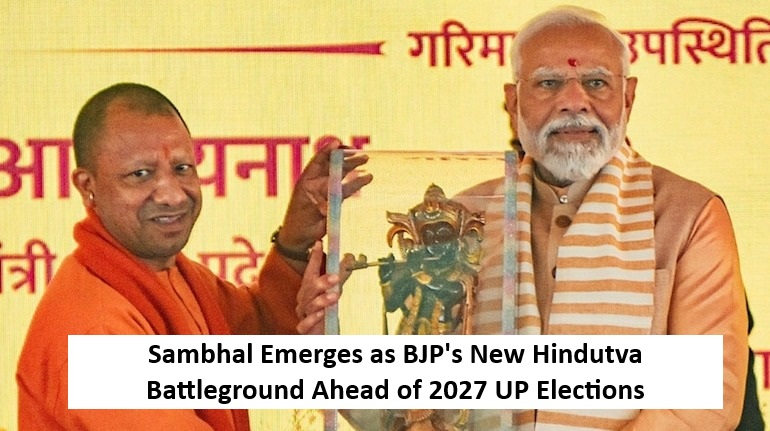
The once-historic and largely quiet town of Sambhal in western Uttar Pradesh is now at the heart of political and communal developments. Over the past year, the BJP has escalated its engagement in the region, marking a strategic shift in its Hindutva-focused campaign in preparation for the 2027 state elections.
From Prime Minister Narendra Modi’s foundation-laying ceremony for the Kalki temple to communal violence following a court-ordered mosque survey, Sambhal has become a high-stakes battleground.
Kalki Temple and Political Shifts
In February 2024, PM Modi laid the foundation for a grand Kalki temple, dedicated to Vishnu’s prophesied tenth avatar. Spearheaded by Acharya Pramod Krishnam, a former Congress leader now aligned with the BJP, the temple symbolizes a strategic effort to consolidate Hindu votes in a region historically dominated by the Samajwadi Party (SP).
Modi declared during the ceremony, “Like Lord Ram, Kalki will impact a thousand years.” The BJP views the temple as a future religious centerpiece, aiming to place Sambhal alongside Ayodhya, Mathura, and Varanasi.
Religious Surveys and Communal Flashpoints
In November 2024, tensions escalated when an Archaeological Survey of India (ASI) survey of the historic Shahi Jama Masjid led to violence, resulting in four deaths and over 20 injuries. The survey was initiated based on claims that the mosque was built over a Hindu temple.
Chief Minister Yogi Adityanath defended the move, citing Baburnama and Puranic references linking Sambhal to Kalki. The ASI later announced a name correction, identifying the site as “Juma Masjid.”
Simultaneously, an old Shiva-Hanuman temple closed since 1978 was “rediscovered” during an anti-encroachment drive. The revival of the temple and recovery of idols near the Jama Masjid have deepened communal tensions, bolstering BJP’s narrative of historical injustice.
Political Implications in Western Uttar Pradesh
Sambhal is a microcosm of Western UP, where the BJP aims to replicate its 2014 Muzaffarnagar playbook by leveraging religious identity to overcome caste-based voting. With its mixed Hindu-Muslim demographics, the region has traditionally favored SP and BSP due to their strong Muslim and Dalit support bases.
However, BJP’s alliance with the Rashtriya Lok Dal (RLD) and electoral success in nearby Kundarki suggest a shifting tide. The party now aims to forge a consolidated Hindu vote by appealing to shared religious sentiment.
Opposition’s Struggle to Respond
While the BJP’s aggressive moves have reshaped the narrative in Sambhal, the opposition—especially SP and Congress—has failed to mount a counter-offensive. SP leader Akhilesh Yadav’s responses have been minimal, and Congress has remained largely absent from the discourse.
Analysts argue that fear of alienating certain voter groups has kept the opposition cautious, allowing the BJP to dominate the conversation around religious identity and historical claims.
Electoral History and Changing Ground Reality
Sambhal’s political history has seen dominance by Congress, SP, and BSP over the decades. SP veterans like Mulayam Singh Yadav, Ram Gopal Yadav, and Shafiqur Rahman Barq have represented the region. The BJP’s only major breakthrough came in 2014 with Satyapal Singh Saini.
Out of five assembly seats in Sambhal district, SP retained four in 2022, indicating enduring support. But with rising communal mobilization and strategic religious projects, BJP is betting on rewriting this political script.
Looking Ahead: 2027 and Beyond
As the 2027 UP assembly elections approach, Sambhal is more than a political hotspot—it’s a test case for BJP’s larger strategy of religious mobilization. If successful, the party could weaken caste-based vote banks and redraw Western UP’s electoral map.
Sambhal’s unfolding developments are emblematic of the broader ideological contest in India, with its future shaped by the intersection of politics, religion, and public sentiment.
Read More: CM Yogi Adityanath Lashes Out at Samajwadi Party in Assembly, Corners on PDA Strategy