Naseeruddin Shah makes Imtiaz Ali’s emotional Partition drama of love and loss impactful.
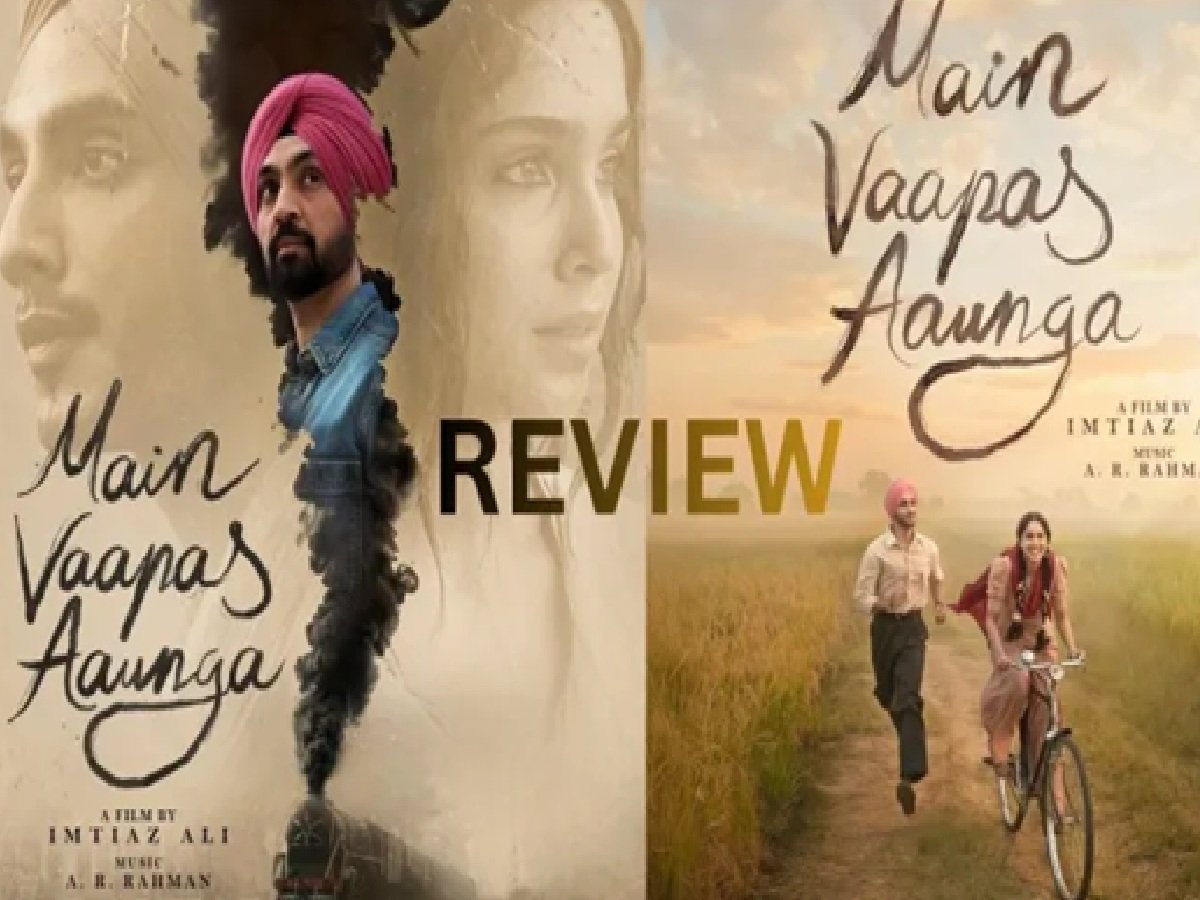
Suspense Crime, Digital Desk : The emotional Partition story of love and loss is brought alive on the big screen through Main Vaapas Aaunga, which stars a phenomenal Naseeruddin Shah in this sensitive drama directed by Imtiaz Ali.
Main Vaapas Aaunga
There are films about love and about loss, and there are films about history. Then there are rare few which manage to stitch all three of these concepts in a single frame, turning it into a highly personal story. Imtiaz Ali's Main Vaapas Aaunga, in that respect, doesn't follow the conventional trope of just another love story based on the Partition; instead, it's a film about memory and loss, nostalgia, and the subtly embedded wounds carried through generations. Anchored by Naseeruddin Shah, Diljit Dosanjh, Sharvari and Vedang Raina's strong performances on all four sides of the film, the movie is an ambitious attempt, sometimes hindered by its own intent, and at other times deeply moving.
Main Vaapas Aaunga: Story
Ishar Singh Grewal, a 95-year-old man played by Naseeruddin Shah, still lives in the memories of Sargodha, his home that he left during the partition of India. The slow decline of his past into reality through the disease of dementia prompts his grandson, Nirvair, played by Diljit Dosanjh, to try and discover the source of the pain which has haunted his grandfather for a lifetime. The film then takes us back in time to Kinnu, a younger Ishar played by Vedang Raina, falling in love with Afsana played by Sharvari against the backdrop of the approaching end of their worlds – partition, and independence.
At the crux of Main Vaapas Aaunga lies the powerful question; what happens to our memories when the place we associate them with vanishes? Rather than depicting the Partition as an historical incident, Imtiaz Ali's venture looks at its lasting effects. It explores grieving, and unfinished stories being carried on by a generation beyond the limits of history.
Main Vaapas Aaunga: Writing and Direction
In many ways, the film feels like a throwback to Imtiaz Ali's older films that were driven by raw human emotions. Even though the film might not have the breezy, effortless magic of a Jab We Met or the depth of a Tamasha, it certainly has an honesty about it that is hard to come by in Indian films anymore. Ali, who is known for making films centered around longing and journeys, carries on the same tradition in this project as well.
Unlike many of Ali's films where the story often takes a backseat to the emotions involved, here we also have a decent amount of focus on the script. The emphasis remains on the human emotions and sentiments involved, rather than on sharp plot twists and turns. It raises the question; what happens after we lose not only our homes but also the locations that harbor our best memories? This is the part which feels like poetry and meanders between time and emotion. Certain viewers might not be comfortable with this style of storytelling, but those who are will find a lot to cherish in it.
The most beautiful aspect in the film for Ali, has always been the portrayal of characters not just as metaphors but as human beings subjected to extreme events in their lives. He does not treat any of his characters as mere narrative devices, and does not allow them to be defined solely by their historical circumstances; instead, they are very human.
Main Vaapas Aaunga: Technical Aspects and Music
The visuals used in the movie are arguably the best aspect of the entire film. Sylvester Fonseca's cinematography has truly outdone himself in this production. The visual palette truly captures the nostalgic, melancholy atmosphere of Punjab. Landscapes are utilized to convey the multitude of emotions felt by the protagonists throughout their lives. From the narrow, bustling street of a village to the golden sunlight in the fields and the silent stillness of a hospital room, each frame is a story in itself.
AR Rahman’s score also serves as a powerful and subtle addition to the film, seamlessly weaving its way through the characters' emotions. The songs, as is usual with Imtiaz Ali's films, have also been an important feature, and they contribute well to the emotional quotient of Main Vaapas Aaunga, creating a sensory experience beyond what's written on the page.
The album itself, just like the film, is special and should be celebrated. Rahman's touch instantly makes your heart ache with the very first song, ‘Dheere Dheere’. However, the feeling intensifies when you hear ‘Voh Nahin’ and ‘Tere Pass Main’; songs which are so well-placed that they make you shed a tear, not just for the characters but for all the people who faced the tragedy in reality.
Main Vaapas Aaunga: Acting
The performances of the lead actors are certainly a huge reason for the film's success. Naseeruddin Shah has perhaps delivered one of the best performances of his career till date. His portrayal of a 95-year-old man afflicted with dementia, desperately trying to hold onto the memories of a lost love, is simply heartbreaking in its authenticity. There isn't a single hint of theatrics, with the actor managing to convey so much pain through mere gestures and fleeting moments of vulnerability. He is a rock for the film even when he isn't delivering dialogues.
Vedang Raina, as the young Ishar, is one of the pleasant surprises. He manages to portray both the innocence and the insecurities of a young lover convincingly and makes his chemistry with Sharvari far more real than it actually appears on paper. There is a sincerity to his act that keeps the audience invested in his journey. Raina is at his best when his eyes convey more than words; his silence speaks volumes.
Sharvari brings a grace and charm to the role of Afsana, a woman who becomes the very heart of Kinnu's young life. She does a brilliant job of showcasing both the innocence and the underlying strength of the character, although at times the role feels underwritten and one wishes we could know her better, rather than through the eyes of Kinnu.
On the other hand, Diljit Dosanjh's Nirvair is a subtle and restrained performance. His character is mostly used as a medium for the audience to learn about his grandfather's life and experiences. While one can see that his storyline lacks the dramatic punch of the Partition plot line, Dosanjh's acting grounds the character, keeping the viewer engaged and never letting them feel disconnected.
Supporting roles played by Rajat Kapoor and Dolly Ahluwalia also deserve a special mention. In one scene in particular Dolly Ahluwalia is absolutely outstanding and her one line 'Veer ji, tusi theek ni kitta,' will echo in your ears for a long time to come.