










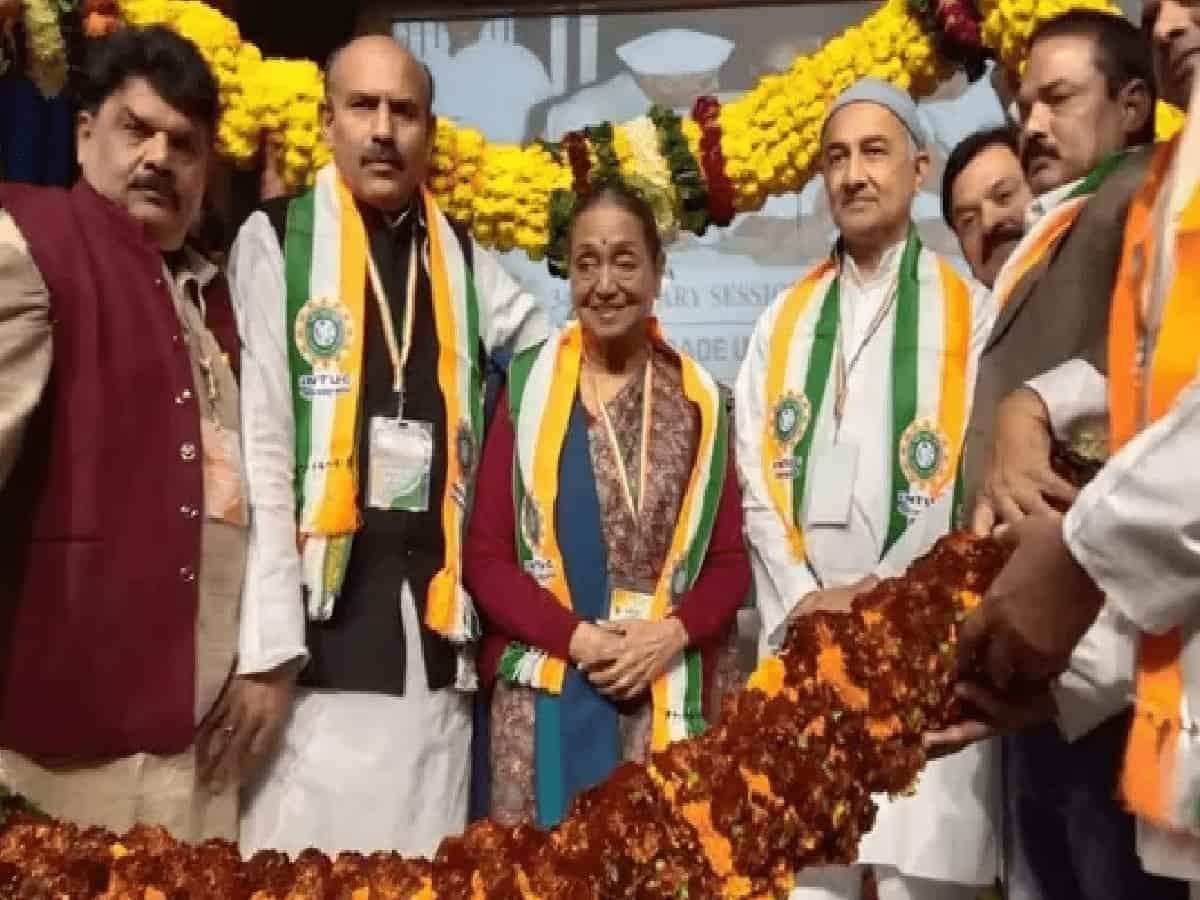
KN Tripathi Elected National President of INTUC at 34th Convention
Senior Congress leader and former Jharkhand Rural Development Minister K.N. Tripathi has been elected National President of the Indian National Trade Union Congress (INTUC) at the labor organization's 34th National Convention in New Delhi on Saturday, November 28, 2026. The convention—convened across November 28–29, 2026—marks a major organizational turning point for the Congress-affiliated trade union federation, pairing Tripathi's elevation with a pre-convention unification in which the K.K. Tiwari and Dadai (Chandrashekhar Dubey) factions formally merged. With that consolidation narrowing the federation's internal leadership matrix primarily to the Tripathi and Reddy groups, Tripathi's election underscores Jharkhand's growing organizational weight in national trade-union politics. Proceedings in the national capital took place in the presence of former Lok Sabha Speaker Meira Kumar, All India Congress Committee (AICC) Secretary Bobby Bhagat, AICC Observer and Delhi Congress in-charge Qazi Nizamuddin, and trade-union delegates representing industrial and unorganized workers from across the country. Across Uttar Pradesh—especially in state capital Lucknow and neighboring industrial and labor hubs such as Unnao, Kanpur, Prayagraj, and Varanasi, where public-sector undertakings, railway unions, leather and textile workers, and unorganized labor groups track shifts within central trade union federations—INTUC's leadership consolidation carries direct organizational significance.
Key Highlights of INTUC's 34th National Convention and Factional Merger
| Organizational Development | Details From the 34th INTUC National Convention (Delhi) |
|---|---|
| Newly Elected National President | K.N. Tripathi, senior Congress leader and former Rural Development Minister of Jharkhand (elected November 28, 2026). |
| Pre-Convention Factional Unification | Formal merger of the K.K. Tiwari faction and Dadai (Chandrashekhar Dubey) faction ahead of the convention. |
| Resulting Internal Alignment | Factional structure streamlined primarily to two major streams: the Tripathi and Reddy groups. |
| Senior Congress Leaders Present | Former Lok Sabha Speaker Meira Kumar, AICC Secretary Bobby Bhagat, and AICC Observer / Delhi Congress in-charge Qazi Nizamuddin. |
| Regional Significance | Elevates a prominent leader from Palamu (Medininagar), Jharkhand—a belt rich in coal, mineral, and industrial workers—to national labor leadership. |
How the KK Tiwari and Dadai Faction Merger Reshaped INTUC's Internal Dynamics
For years, parallel claims and overlapping state units among rival camps had complicated INTUC's institutional representation on tripartite labor panels and diluted its bargaining voice. Ahead of the 34th National Convention in Delhi, senior trade-union negotiators took a decisive step toward unity by merging the K.K. Tiwari and Dadai groups—an initiative hailed by delegates as an important milestone toward restoring organizational cohesion and strengthening worker representation. By bringing those factions under a unified umbrella prior to the leadership election, the convention cleared the path for K.N. Tripathi to assume national command with broad delegate backing.
What KN Tripathi's Elevation Means for Jharkhand and National Labor Politics
In Medininagar (Palamu) and across Jharkhand, Tripathi's rise to the helm of INTUC has sparked celebrations among Congress workers and labor activists. Having previously served as MLA from Daltonganj and held the Rural Development portfolio in the Jharkhand cabinet—as well as key organizational assignments for the AICC—Tripathi brings both legislative experience and deep familiarity with mining, industrial, and rural labor belts. Stepping into the national presidency, his immediate priorities will center on bridging remaining internal divisions across state units, expanding INTUC's membership among contractual and unorganized workers, and mounting a coordinated national campaign to safeguard wages, social security, and statutory labor rights.






