










2 Years of Hemant Soren 2.0: Maiyaan Samman, PESA & Exam Row
As Chief Minister Hemant Soren's coalition government completes two years in office on Saturday, November 28, 2026, its mid-term governance ledger reflects a sharp contrast between flagship welfare delivery, landmark tribal self-governance reforms, and top-three fiscal rankings on one hand, and persistent friction over recruitment exam irregularities and pending budget announcements on the other. Immediately after returning to power, the Jharkhand Mukti Morcha (JMM)-led alliance delivered on its centerpiece manifesto pledge by raising monthly assistance under the Mukhyamantri Maiyaan Samman Yojana from ₹1,000 to ₹2,500, a direct benefit transfer program that currently reaches roughly 5.3 million (53 lakh) women across the state. Alongside notifying the long-awaited Panchayats (Extension to Scheduled Areas) [PESA] Rules with effect from January 2, 2026—empowering Gram Sabhas in Fifth Schedule areas to manage sand ghats and shape local development—Jharkhand earned national recognition in NITI Aayog's Fiscal Health Index 2026, ranking among the top three major states alongside Odisha and Goa with a composite score of 50.5 and outperforming neighboring Bihar, West Bengal, Chhattisgarh, and Uttar Pradesh. Yet even as state budgets expanded from ₹1,45,400 crore in FY 2025–26 to ₹1,58,560 crore in FY 2026–27 and global outreach debuted at the World Economic Forum in Davos, allegations of widespread irregularities in recruitment tests—including the JPSC and JSSC CGL examinations, now under CID investigation—have overshadowed the administration's employment record. Across Uttar Pradesh—especially in state capital Lucknow and neighboring administrative and academic centers such as Unnao, Kanpur, Prayagraj, and Varanasi, where readers closely compare welfare cash-transfer models, NITI Aayog fiscal rankings, and public-service exam integrity across northern states—Jharkhand's two-year scorecard offers an instructive case study in balancing populist spending with fiscal discipline.
Two-Year Governance Report Card: Flagship Schemes, Fiscal Health, and Pending Promises
| Policy Area / Initiative | Current Status at Two-Year Mark (November 2026) | Key Figures & Ground Reality |
| Mukhyamantri Maiyaan Samman Yojana | Implemented & Active | Monthly honorarium hiked from ₹1,000 to ₹2,500; benefiting approximately 5.3 million (53 lakh) women regularly. |
| PESA Rules Notification | Implemented (Jan 2, 2026) | Empowers Gram Sabhas with direct local decision-making rights, including management of sand ghats and village development plans. |
| NITI Aayog Fiscal Health Index 2026 | Top-3 National Performer | Scored 50.5, placing Jharkhand among the top three major states (with Odisha and Goa) ahead of Bihar, UP, West Bengal, and Chhattisgarh. |
| State Budget & Stabilization Fund | Expanded & Operational | Budget grew from ₹1,45,400 crore (2025–26) to ₹1,58,560 crore (2026–27); Budget Stabilization Fund backed by ₹832 crore (2025–26) and ₹1,209 crore (2026–27). |
| Healthcare & Medico City | Partially Operational / In Pipeline | Abua Health Scheme (up to ₹15 lakh cover) active; ₹2,184 crore Medico City in Kanke, Ranchi approved; PPP medical colleges in Dhanbad, Jamtara, Giridih, Khunti under tender; 750 Abua dispensaries cleared by Cabinet but not yet opened. |
| CM Schools of Excellence | Phase-1 Approved | Cabinet approved 100 schools for admissions from 2027–28, against the manifesto target of 500. |
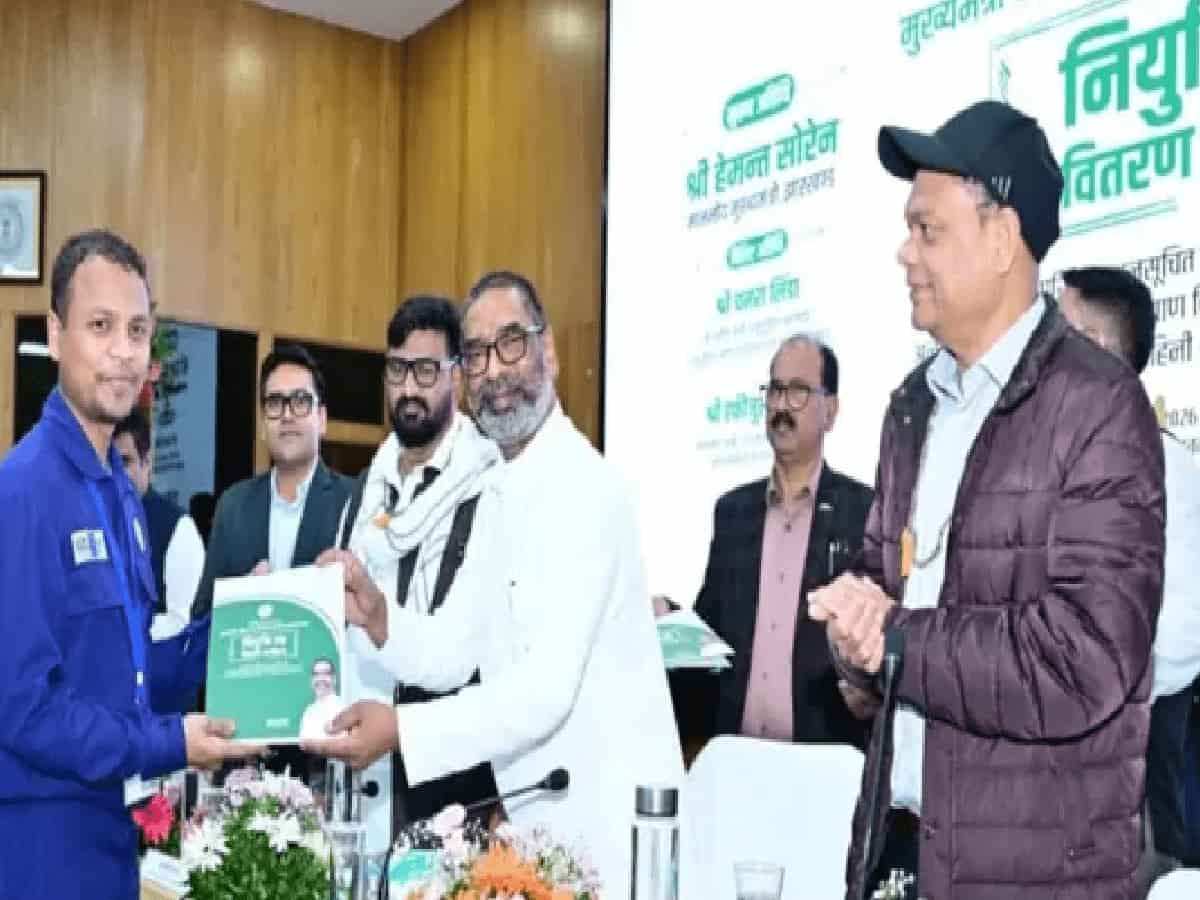
| Employment & Recruitment Exams | Mixed / Under CID Probe | 3,044 trained youth recently handed offer letters (including ~500 placed in the UAE) and 1.5 lakh linked to private jobs, but JPSC/CGL exam irregularities under CID investigation have dented credibility. |
Welfare Delivery, Healthcare Expansion, and Education Upgrades
In social welfare, health, and education, the Hemant Soren administration has pushed several structural initiatives forward while leaving key targets for the remaining three years of its term:
-
Healthcare Infrastructure and Abua Health Cover: Beneficiaries are actively receiving cashless treatment under the Abua Health Scheme (offering coverage up to ₹15 lakh), while procurement is underway for one ambulance per 5,000 families and PET and CT scan machines across all five government medical colleges. The Cabinet has also cleared the ambitious ₹2,184 crore Medico City project in Kanke, Ranchi, initiated PPP tenders for new medical colleges in Dhanbad, Jamtara, Giridih, and Khunti, and approved 750 Abua dispensaries—though those neighborhood clinics have yet to open their doors.
-
Schools of Excellence and University Reforms: While work on the promised 500 CM Schools of Excellence is still scaling up, the Cabinet has approved developing 100 upgraded schools targeting enrollment from the 2027–28 academic year. Separately, the Assembly enacted the Jharkhand University Act, 2026—restructuring university governance and creating a University Service Commission for faculty and staff recruitment—though supporting bye-laws remain pending.
Fiscal Discipline Praise vs. Recruitment Exam Controversies and Unfinished Projects
Economically, NITI Aayog's Fiscal Health Index 2026 commended Jharkhand's debt management and expenditure quality, placing the state in the top tier nationally with a 50.5 score. To insulate state finances against fluctuations in mining royalties, the government also operationalized the Jharkhand Budget Stabilization Fund with estimated allocations of ₹832 crore in 2025–26 and ₹1,209 crore in 2026–27, alongside making its debut at the World Economic Forum in Davos (2026) to court green-industrial and mineral-processing investments. However, on the employment front, even though the government distributed appointment letters to 3,044 skilled youth—nearly 500 of whom secured overseas placements in the UAE—and facilitated roughly 1.5 lakh private-sector jobs, repeated controversies over leaked papers and irregularities in JPSC and CGL examinations (currently being probed by the CID) have fueled sharp student protests. With three years left in its five-year mandate, the government also faces pressure to break ground on stalled budget commitments, including Dr. Bhimrao Ambedkar University in Chatra and five girls' residential schools slated for Dhanbad (two), Palamu, Latehar, and Garhwa.






