
 Priyanka Tiwari
 Share
Share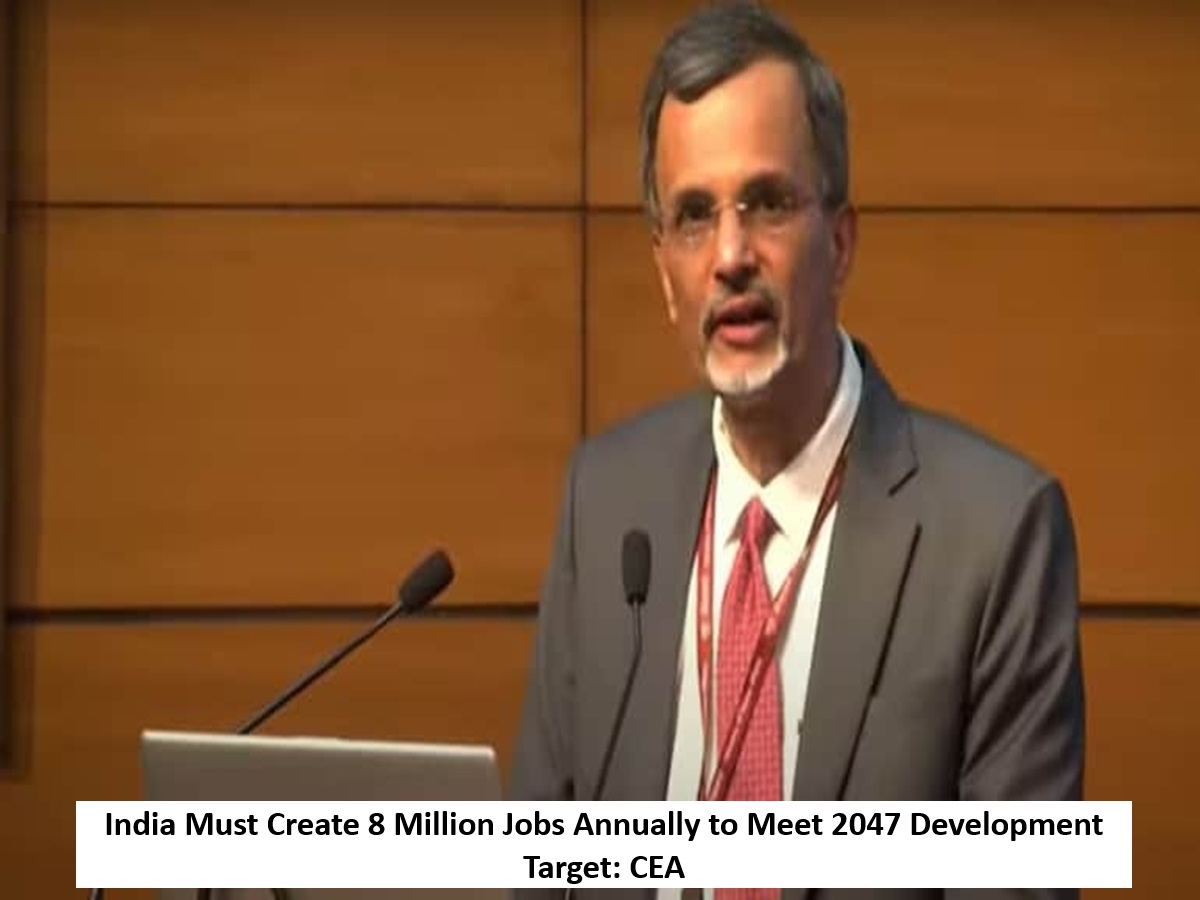
Chief Economic Advisor (CEA) V Anantha Nageswaran expressed that India has to generate minimum 8 million jobs every year for the next 10 to 12 years and improve its manufacturing sector significantly to turn into a developed economy by 2047. He spoke this at the Columbia India Summit 2025 organized by Deepak and Neera Raj Centre at Columbia University.
Nageswaran pointed out that the global environment will very likely remain less congenial than in the past few decades. He mentioned that India has to change with the times by focusing on the country’s economy and jobs. He stated that there should be resilient growth in employment, particularly, at the lower levels in the economy, which increases the size of the manufacturing sector in comparison to GDP. That too, qualitatively, in comparison with China’s manufacturing juggernaut.
The growth of global technology trends in artificial intelligence as well as automation present new challenges for India. Unlike other developing nations, India has to contend with these technological disruptions while needing to create millions of jobs. Nageswaran stated AI has the potential to cut down the availability of entry level positions to IT service jobs.
Significance of Policy Guidance
He emphasized the need for policies that consider both the adoption of technology and the labor force requirements. The transitions related to AI development must occur with the direction of not only engineers but also public sector decision-makers focused on employment and economic growth.
SME Development and Global Market Integration
Under the “Viksit Bharat” 2047 vision, Nageswaran highlighted the need to have a robust small and medium enterprises (SME) sector. He pointed out that most large manufacturing countries have succeeded because they have been able to support viable SME systems that also aid in integrating into global value chains.
Project Investments and Exports
The country has no option other than to increase investment levels or enhance the productivity of current investments with changing global political dynamics. While exports remain important, Nageswaran highlighted that they will not boost GDP growth as was experienced in the early 2000s.
Focus on Infrastructure and Quality
For India to retain its competitive advantage in exports, it needs to enhance the standards of the products, increase the research and development (R&D) activities, and improve the logistics and last-mile connectivity. These upgrades are necessary because growth driven by exports may not be as significant in the coming decades.
Long-Term Growth Prospects
TThe resilience displayed in India’s economy in the post-COVID phase is remarkable, clocking over 8% growth annually in recent years. But this growth is difficult to sustain. Nageswaran remarked that sustaining growth at 6.5% long-term, with sporadic domestic reforms pushing it a little over 7%, would be more feasible.
_1359883337_100x75.jpg)
_1550774716_100x75.jpg)
_518702411_100x75.jpg)