 Priyanka Tiwari
 Share
Share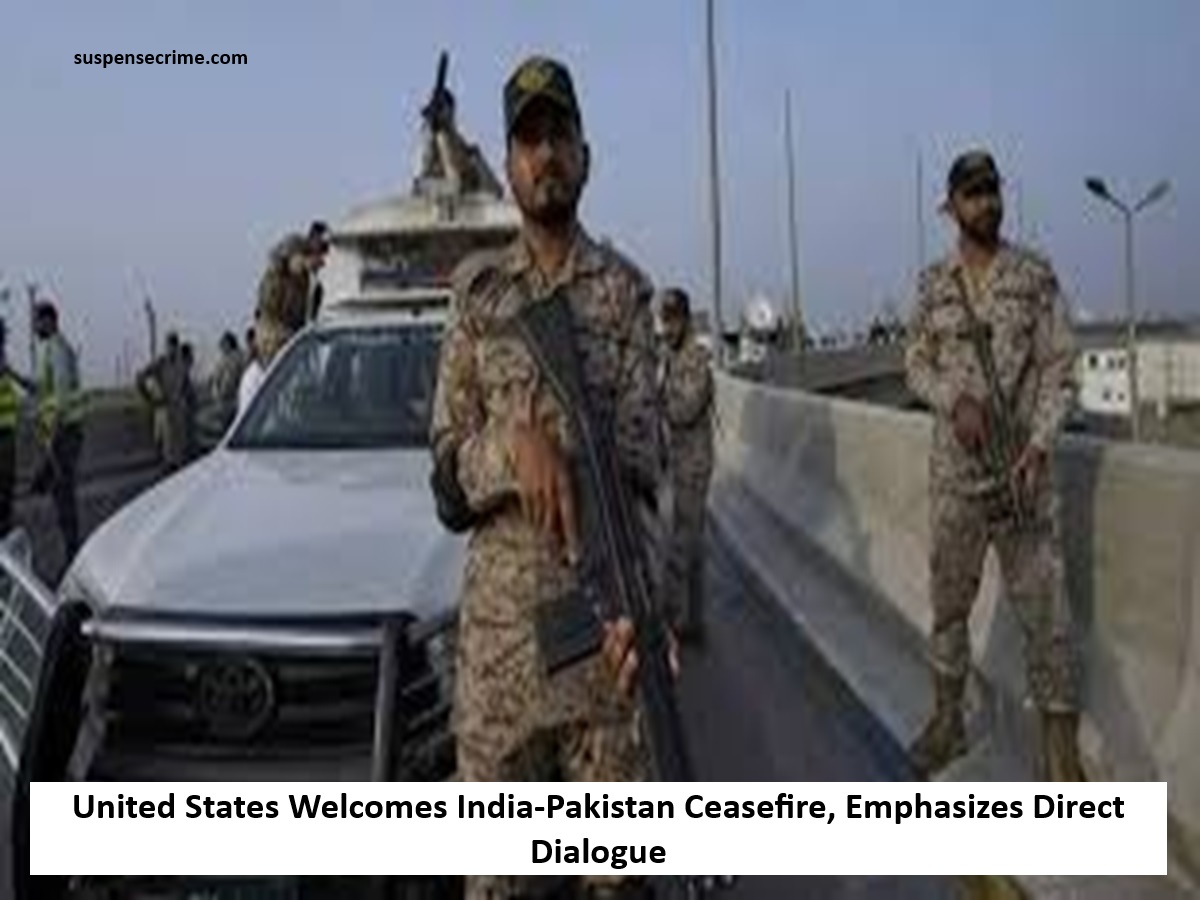
Suspense crime, Digital Desk : In a statement issued Friday morning, the US Government expressed support for the ceasefire India and Pakistan reached after four days of incessant military hostilities. In a statement earlier, US State Department's Principal Deputy Spokesperson, Tommy Pigott, appreciated the development, stating that the US is in favor of sustained peace and they want both countries to communicate directly.
Pigott said, “We’re pleased to see a ceasefire in place. We wish both sides to directly communicate with each other. Recall that President Trump has had a hand in facilitating peace, and we consider this a good sign.”
#WATCH | On President Trump willing to mediate between India and Pakistan to solve the Kashmir dispute, Principal Deputy Spokesperson for the US Department of State, Tommy Pigott says, "... What we are happy to see is a ceasefire. We want to encourage and see direct talks between… pic.twitter.com/tJwIr8hpSj
— ANI (@ANI) May 15, 2025
Cessation of Hostilities Comes After Military Aggression
On May 10 the ceasefire came into effect following culmination of a military spiral up the border. From May 7 India began airstrikes as part of ‘Operation Sindoor’ which was a response to Pahalgam's April 22 terror attack that claimed 26 lives.
On May 8, 9, and 10 Pakistan retaliated with selective strikes at Indian bases which were forcefully counter-attacked by Indian troops. Both countries have engaged in intense fighting before coming to an agreement to stop any further escalation.
Dialogue Reached Through Military Communication Networks
New Delhi relayed that the ceasefire came into effect after the DGMOs (Director Generals of Military Operations) of both countries spoke. Officials maintained that no unrelated parties facilitated the agreement.
Nonetheless, former President Donald Trump has asserted that he was part of the peace efforts. On his personal social media page, he posted, “Proud of the strong leadership shown by India and Pakistan. Their actions saved the lives of many.”
Trump Claims Role in Conflict De-escalation
Trump told the US troops at al-Udeid Air Base in Qatar that he asserted: ”I won’t say I did it, but I definitely contributed to resolving the issue between India and Pakistan last week.” This marks the sixth time Trump stated he assisted with mediating the situation.
Pakistan Shows Openness to Peace Dialogue
On the other hand, Prime Minister of Pakistan, Shehbaz Sharif is ready to open more conversations with India. But he insists that any discussions have to include the Kashmir issue- an area of sore bilateral relations.
India Reaffirms Bilateral Approach on Talks
India continues to assert that discussions with Pakistan must be unilateral. S. Jaishankar, the Foreign Minister, reiterated this point on Thursday, saying, “Any dialogue with Pakistan will be bilateral. That has been our consistent stance, based on national consensus.”
This is in agreement with India’s 1972 Shimla Agreement and 1999 Lahore Declaration, both documents which obligate the two countries to settle differences through direct contact without the involvement of outside parties.