

 Priyanka Tiwari
 Share
Share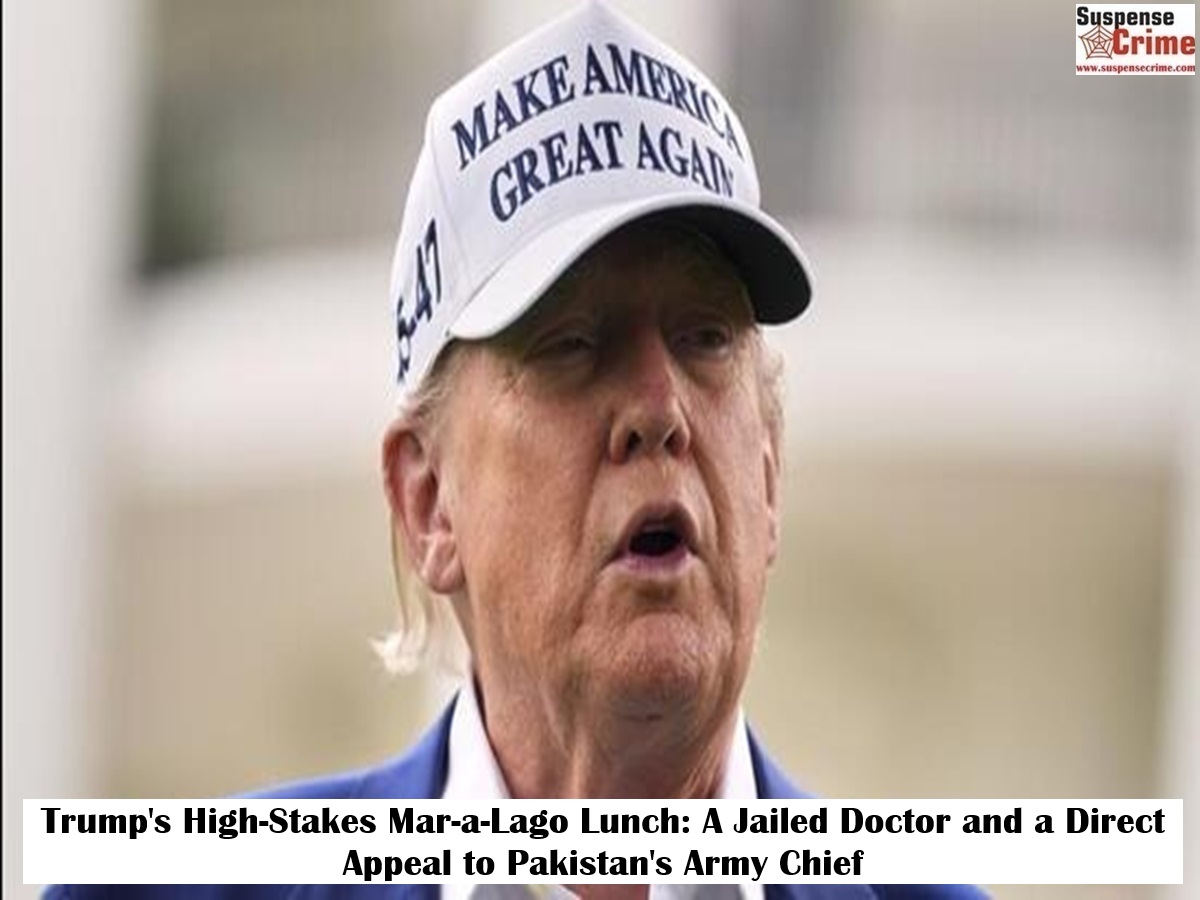
Suspense crime, Digital Desk : In a move that has raised eyebrows in diplomatic circles, former US President Donald Trump recently hosted Pakistan's powerful Army Chief, General Asim Munir, for a private lunch at his Mar-a-Lago estate in Florida. While the meeting itself was unusual, the reason Trump gave for it cuts to the heart of a long-standing issue in US-Pakistan relations.
According to Trump, his primary motivation for the meeting was to discuss a single, critical topic: the release of Dr. Shakil Afridi.
"The reason I had him here was to discuss that," Trump stated, referring to the Pakistani doctor who has been imprisoned for over a decade. Dr. Afridi is hailed as a hero in the United States for running a fake vaccination program that helped the CIA confirm Osama bin Laden's location in Abbottabad, leading to the successful 2011 raid. In Pakistan, however, he is widely viewed as a traitor.
This isn't a new crusade for Trump. During his presidency, he famously claimed he could get Dr. Afridi released "in two minutes" if he really wanted to, a boast he repeated after his recent lunch with General Munir.
The meeting is significant for several reasons. General Munir was in the United States for an official visit, holding high-level talks with current administration officials like Secretary of State Antony Blinken and Secretary of Defense Lloyd Austin. His private detour to meet with Trump, the current administration's chief political rival, represents a notable instance of back-channel diplomacy.
It also underscores the immense power wielded by Pakistan's Chief of Army Staff (COAS). In a country where the military has a profound influence on politics and foreign policy, meeting with the COAS is often seen as more impactful than meeting with civilian leaders.
For Trump, the meeting serves as a reminder that he continues to engage in foreign policy matters, signaling to both allies and adversaries how he might operate if he returns to the White House. Highlighting the case of Dr. Afridi allows him to project an image of strength and loyalty to those who have aided the United States, a theme that resonates with his political base.
Ultimately, the lunch at Mar-a-Lago was more than just a meal. It was a strategic convergence of personal diplomacy, a potential 2024 campaign talking point, and a direct appeal on a deeply sensitive geopolitical issue, all centered on the fate of one imprisoned doctor.

_1412932328_100x75.jpg)