
 Priyanka Tiwari
 Share
Share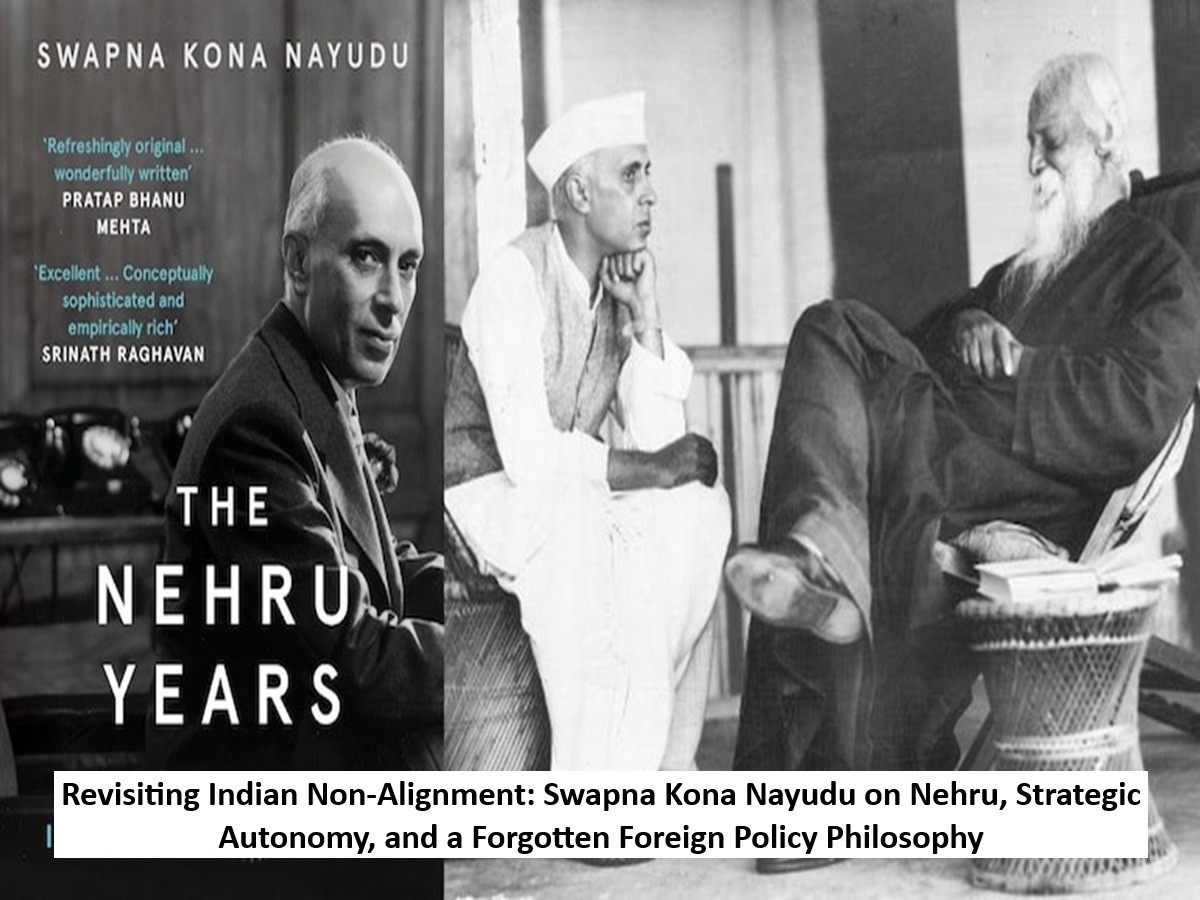
The concept of Indian non-alignment may not come up in contemporary discussions about foreign policy, but Professor Swapna Kona Nayudu of Yale-NUS College argues that its founding ideas continue to be important for analyzing India’s geopolitics. In her latest book, The Nehru Years: An International History of Indian Non-alignment, she situates the idea within a far more complex philosophy and ethics that shaped India’s global posturing rather than viewing it only as Cold War diplomacy.
Non-Alignment Vs. Strategic Autonomy
Strategic autonomy is a term that Kona Nayudu feels does not do justice to the far more complex phenomenon of Indian non-alignment. In fact, it pales in comparison to terms like “multi-alignment.” Unlike the extreme multi alignment policy in practice today, “non-alignment,” she explains, “was not neutrality, nor was it identical to the Non-Aligned Movement (NAM).” Non-alignment does not include the many anti-colonial ethical elements that, for India,, was present in secular postcolonial diplomacy under Nehru.
Why Non-Alignment Emerged When It Did
During the closing years of 1940, India, as a nation on the verge of gaining independence, decided not to align itself with the capitalist West or the communist bloc. According to Kona Nayudu, this phase of India was facing an identity crisis. During this time, Nehru’s India chose to shun ideological commitments and cultivated sovereignty, moral, and multilateral diplomacy through participation in the United Nations.
Non-Alignment as Civil Disobedience
Kona Nayudu has put forth an interesting view of non-alignment as an act of “civil disobedience” in the international arena. This, in her view, means defying the superpower subjugation and not categorizing oneself within global dichotomies. She associates this defiance with Gandhian principles and merges them with the cosmopolitanism of Nehru, invoking Tagore and other anti-colonial intellectuals to describe India’s independent foreign policy as an exercise in world-making, not merely nation-building.
NAM vs. Indian Non-Alignment
The book makes a distinction between Indian non-alignment and the Non-Aligned Movement very clear. India propelled the formation of NAM, but Nehru was rigidly opposed to the idea of a formalized Third Bloc. He never embraced deep-seated ideology and powerful alliances preferring loose structures. He sought freedom and control. “To confuse Indian non-alignment with NAM is to overlook its origins in Indian political philosophy and its resistance to bloc politics,” Kona Nayudu argues.
Why the Cold War Framework Misses the Point
Kona Nayudu argues that the traditional Cold War approach to studying international relations from 1945 onwards is too myopic. In her words, “The context was there, but Indian nonalignment predated and exceeded the Cold War. It was anchored in an anti-imperialist worldview rather than balancing power alone.”
What Strategic Autonomy Misses
When responding to the question of why strategic autonomy is not a contemporary take on nonalignment, Kona Nayudu pointed out that while there are similarities, the current approach lacks strong guiding principles. Strategic autonomy is fundamentally more pragmatic, driven by economic interests and tactical partnerships. Nonalignment, in contrast, was a value-based construct on issues of justice, identity, and moral interventionism in world politics.
India’s Peacekeeping Role: An Overlooked Arena
Her research draws attention to the less discussed aspects of India’s role in the United Nations, particularly peacekeeping, including conflicts in the Congo and Korea. Unlike the dominant narrative that focuses on India’s militaristic confrontations with its neighbors, like Pakistan and China, there is also the narrative of peacekeeping, which represents a different type of engagement on the global stage—one that brings India’s diplomatic ethos to the forefront.
Shifting Focus from Territorial Tensions
While Kona Nayudu observes India’s wars as a part of national memory, she confronts Nayudu to adopt a more comprehensive view towards foreign policy. “It is hard to understand Nehru’s thought without considering his focus on territorial conflicts. How India engaged with the world when its own land was not at stake is equally important,” she argues.
A Review of India’s Participation in the United Nations
With the book, she has offered an alternative narrative of the UN that postcolonial states like India who actively participated by providing new perspectives shaped are equally given importance to. Indian diplomats were not passive bystanders - they actively crafted early international norms regarding sovereignty, decolonization, and development.
A Kona Nayudu Perspective on Academic Work For Non Alignment Policies
While studying at the Centre for Land Warfare Studies (CLAWS) in 2008, she developed an interest in non-alignment which later manifested into academically researching Indian policy. Under the guidance of Brigadier Gurmeet Kanwal, she was looking into the thoughts of the military on peacekeeping. This was a defining experience – she drew from this for her later doctoral research, and subsequently, her book.
A Revival in Interest?
While non-alignment seems to be missing from the primary policy discourse, it did receive a short resurgence with the publication of Non-Alignment 2.0, a book spearheaded by an Indian intellectual collective. However, Kona Nayudu is careful with oversimplifications. “Recycling the word is not the main goal. We have to excavate its origins, boundaries, and purpose.”
Read More: The Sonam Wangchuk Update Why the Government Just Made a Major Move
_480196739_100x75.jpg)



_159681404_100x75.jpg)