
 Priyanka Tiwari
 Share
Share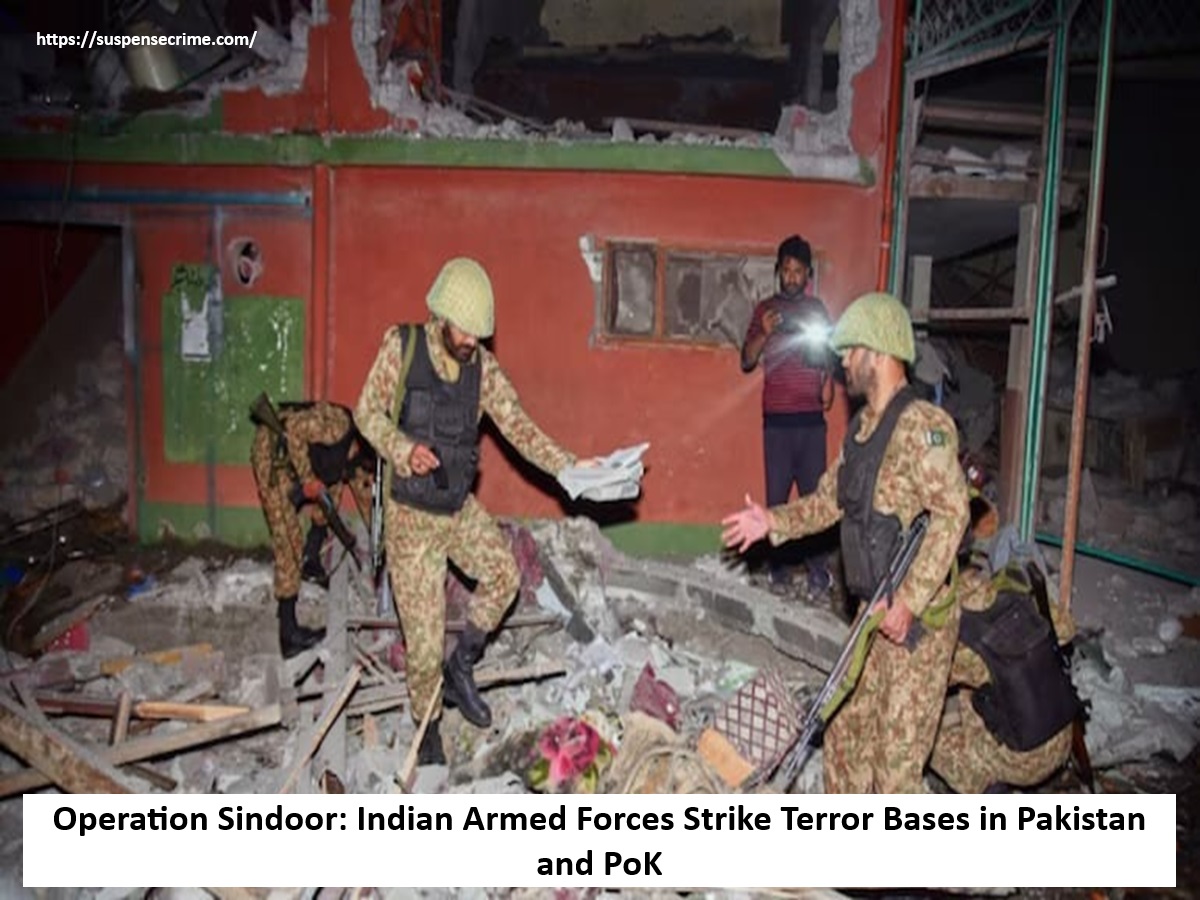
Suspense crime, Digital Desk : The Indian armed forces undertook a coordinated strike on the terrorist infrastructure at nine different regions in Pakistan and Pakistan-occupied Kashmir (PoK) during the early hours of Wednesday. This operation is looked upon as Sindoor and sought to eliminate the sites relevant to terror planning and support activities toward India.
As sources say four of the locations were in Pakistan, Bahawalpur, Muridke, and Sialkot were included. The other PoK were five regions. These targets were classified as operational bases aimed to facilitate the planning and execution of strikes towards Indian civilians and security forces.
Pahalgam Attack Response
The strikes were a result of a terror incident on Pahalgam, Jammu and Kashmir, on 22 April, where out of 26 civilians, a majority were tourists. The suicide attack was later known to be conducted by LeT (Lashkar-e-Taiba) and authorities suspected the terrorist group had financial and logistical support from the Pakistani government.
LeT is a terrorist group based in Pakistan and is centralized under a known umbrella.
Weapons Assigned for Sindoor
With these claims, the Indian armed forces strike stated that during the mission there was the usage of modern day equipped precision weapon such as: `
1. SCALP (Storm Shadow) Cruise Missiles – is an air propelled long range deep strike missile above 250km.
2. HAMMER Smart Bombs – is a precision guided demolishing relic effective to reinforce bunkers fired at within seventy kilometers.
3. Loitering Munitions (Kamikaze Drones) - these serve a dual purpose as drones that perform real-time surveillance as well as target elimination.
According to the Defence Ministry, these advanced systems enabled clean hits without any collateral damage pertaining to Pakistani civilians or military.
Confirmed Terror Targets
The Indian government made it clear that all targets were confirmed terror bases. Civilians and military infrastructure of Pakistan were not involved in any shape or form. These included:
Markaz Subhan Allah, Bahawalpur (Jaish-e-Mohammed): Central base for seniour cadre training.
Markaz Taiba, Muridke (Lashkar-e-Taiba): A vast 200 acre facility for indoctrinaton and planning.
Markaz Abbas, Kotli (Jaish-e-Mohammed): Supplied active members of thile with arms and trained suicide bombers.
Syedna Bilal and Shawai Nalla, Muzaffarabad: LT and JE-run infiltration and training camps.
Markaz Ahle Hadith Barnala(LeT): Logistics and support base for the region.
Sarjal, Tehra Kalan(JeM): Newly recruited volunteers for pre-infiltration training.
Mehmoona Joya, Sialkot (Hizbul Mujahideen): Operational training center for HM despite considerable reduction in activity in Jammu and Kashmir.
Strategic and Political Implications
It is observed that Operation Sindoor marked a shift in India’s proactive defensive policies against cross border terrorism. The initiative underscores the fact that India is capable of targeting terror infrastructure outside its traditional boundaries with precision modern weaponry.
Read More: PM Modi and Kharge’s Viral Moment: A Rare Handshake and Laughter at Ambedkar Tribute Event