

 Priyanka Tiwari
 Share
Share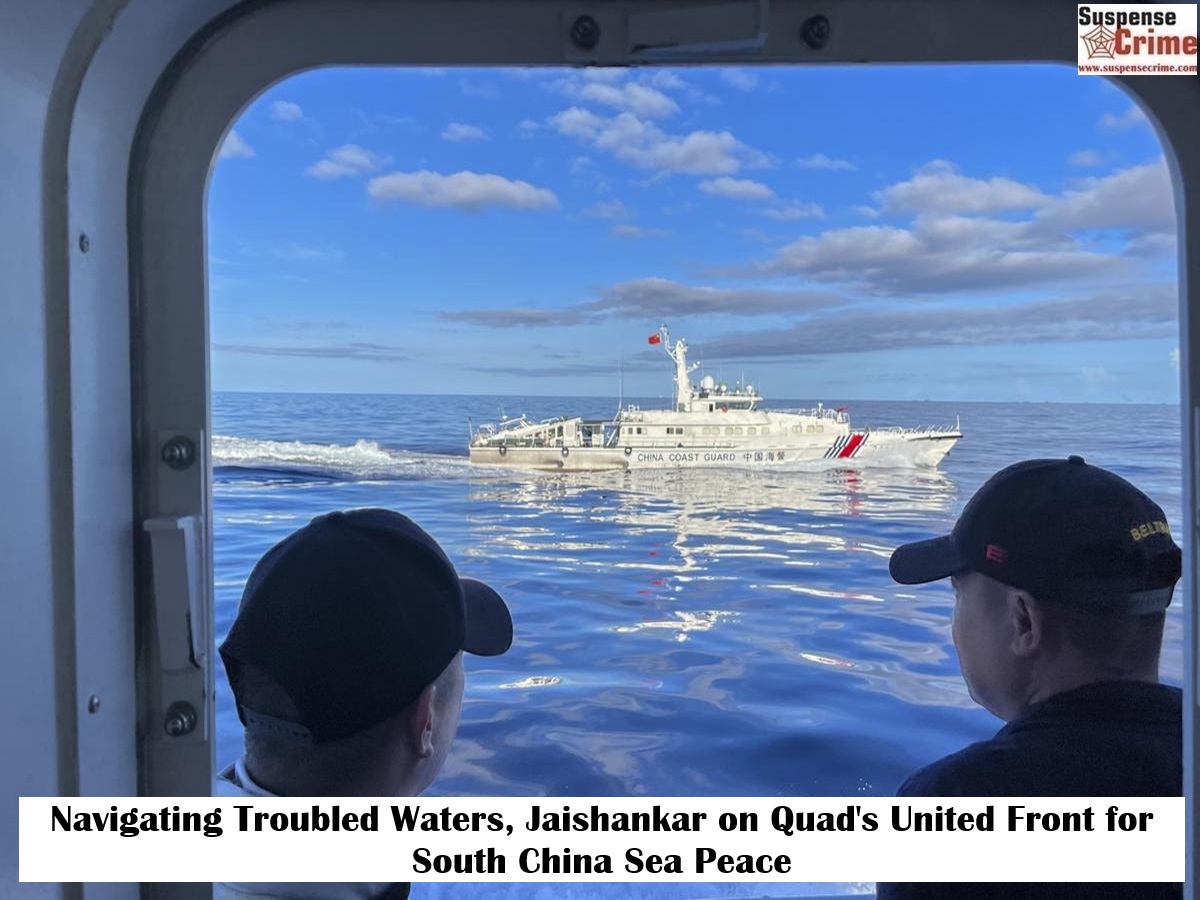
Suspense crime, Digital Desk : India's External Affairs Minister, S. Jaishankar, has squarely put the spotlight on the South China Sea, articulating the Quadrilateral Security Dialogue's (Quad) profound concern over the geopolitical flashpoint. His recent remarks underscore a unified priority among Quad members – India, the US, Japan, and Australia – to ensure the vital waterway remains a zone of peace and international law, rather than conflict.
The South China Sea is one of the most strategically significant maritime regions globally, crucial for international trade and a hotbed of competing territorial claims. Jaishankar's candid statement highlights that the tensions and potential for militarization in this area are not just a concern for immediate claimants but for all nations invested in a free, open, and rules-based Indo-Pacific. The sheer volume of global commerce that traverses these waters makes stability here a collective imperative.
The Quad, often seen as a bulwark for a free and open Indo-Pacific, views the South China Sea as a common priority. Their collective stance isn't about targeting any single nation but about upholding fundamental principles of international law, particularly the United Nations Convention on the Law of the Sea (UNCLOS). This means advocating for freedom of navigation and overflight, peaceful resolution of disputes, and respect for sovereignty, without resorting to coercion or military might.
Jaishankar emphasized that India's position on the South China Sea has been consistent and unwavering. India strongly advocates for a non-militarized environment, ensuring that the critical sea lanes remain open for all nations, unhindered by threats or territorial disputes. This shared commitment to international norms and a rules-based order forms the bedrock of the Quad's approach, seeking to foster a secure and prosperous region for everyone. His clear articulation serves as a powerful reminder of the intricate diplomatic efforts underway to safeguard stability in one of the world's most contested maritime spaces.
Read More: West Bengal Phase 2 Voting Re-Polling Likely as Tape Found on EVM Buttons; EC Issues Strict Warning