Priyanka Tiwari
 Share
Share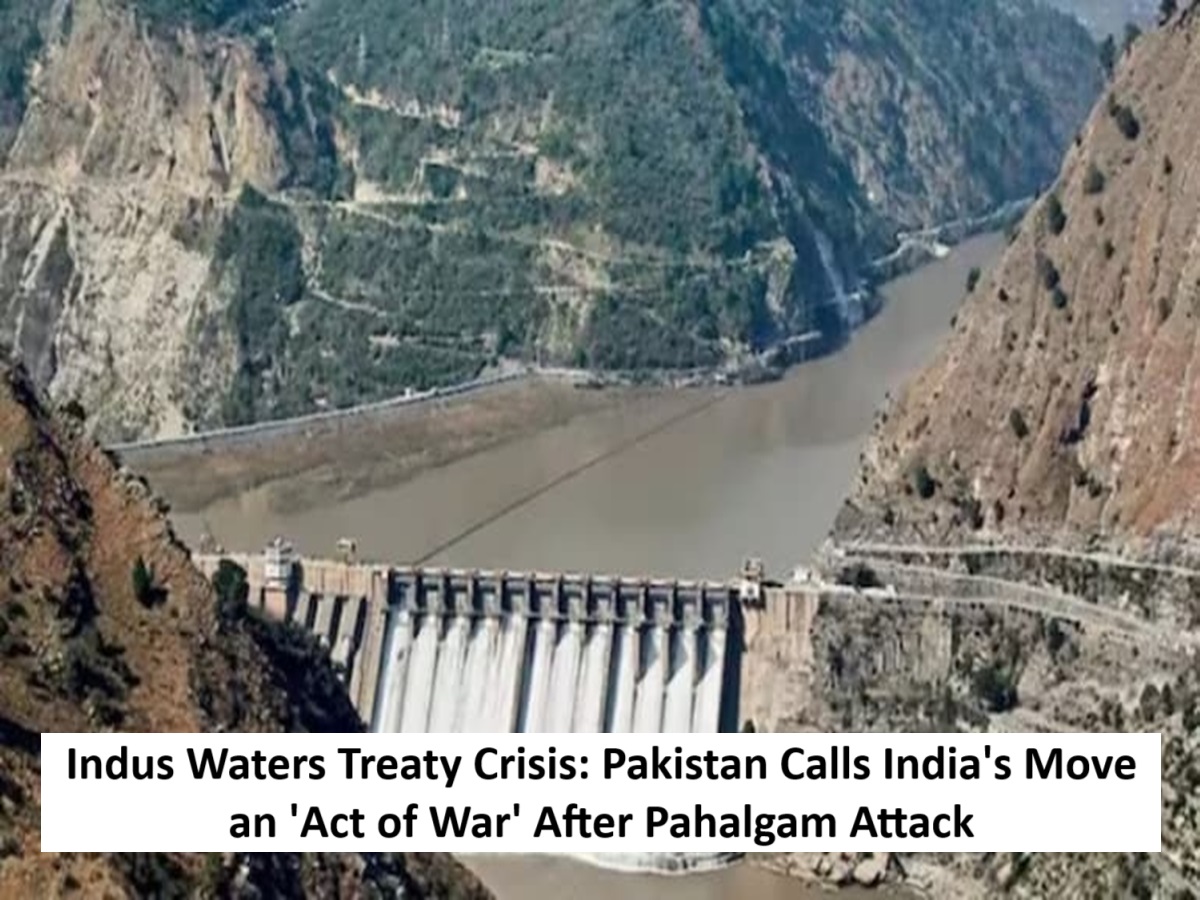
Suspense Crime, Digital Desk : The Pahalgam, South Kashmir terror attack which resulted in the deaths of 28 individuals, led India to place the Indus Waters Treaty (IWT) on hold. In response Pakistan has declared that any diversion of waters planned by India would be an “act of war”.
The agriculture, domestic urban water supply, and the energy infrastructure of Pakistan is centered around the region’s rivers namely the Indus, Jhelum, and Chenab. These river tributaries are essential for the Pakistan region, and currently, Pakistan does not possess supple alternative sources to access.
Importance of the Indus River in History and Culture
The Indus River has held importance for the Indian civilization for centuries. Indian civilizations transacting with Mesopotamia used the Indus River for trade.
Numerous scriptures by the south Indian portrayains and Persian travelers make a mention of the river.
The guru of Sikhism, Guru Nanak, and the Indian religious figure, Buddha, are faithful links to the river.
In classical Sanskrit, Sindhu was referred to as the Indus river. This was later termed Indhu by the Persians and Indus by the Greeks.
India gave rise to the terms India and Indika by their connection with the Indus which further spread across the world starting from 300 BCE.
How the Indus Waters Treaty Divided River Access
IWT took 9 years of negotiations and was signed in 1960 in Karachi (brokered by the world Bank).
Key points of the treaty include:
India got unrestricted access to the eastern rivers of Ravi, Beas and Sutlej (approx. 33 million acre-feet annually).
Pakistan Received rights to the western rivers of Indus, Jhelum and Chenab (approx. 135 million acre-feet annually) which is roughly 80% of the river system's flow.
The World Bank's Role in the Indus Waters Treaty
The world bank got involved in 1951 when President Eugene Black invited both countries for a dialogue.
After signing the treaty:
The world bank financed the Indus Basin Development fund in support of water infrasturcture.
It takes a neutral role in dispute resolution especially with regard in appointing a Neutral Expert with the consultation of both India and Pakistan,
Why the Treaty is Crucial for Pakistan
This Central Basin region is crucial for Pakistan's economy and survival as:
It supports 25% of the Pakistan's GDP
over 80% of cultivated land depends on Indus waters
It serves as a primary source of water for drinking and industrial purposes for major cities like Lahore, Karachi and Multan.
Any change of flow can severely endanger Pakistan’s agricultural industry, urban life, or even put the nation’s food security at risk.
Challenges relevant for the Indus river system include ecological ones like nature’s concerns, and extra issues :
The region has far greater issues to face than politics. When signing the treaty, Himalayan glacier studies were not kept in consideration which is a clear and obvious mistake.
Some of the strongest contributing flows to the Indus river – Himalayan glaciers that account for 60-70% are shrinking in an alarming rate.
A staggering 8 billion tons of ice is estimated to be lost yearly, according to a recent 2019 study.
There’s no doubt that glacial water storage will increase river water in the short run, but for longer terms, it presents a host of issues for billions of people.
_891152136_100x75.jpg)
_934999377_100x75.jpg)
_297632329_100x75.jpg)
_1971369341_100x75.jpg)