
 Priyanka Tiwari
 Share
Share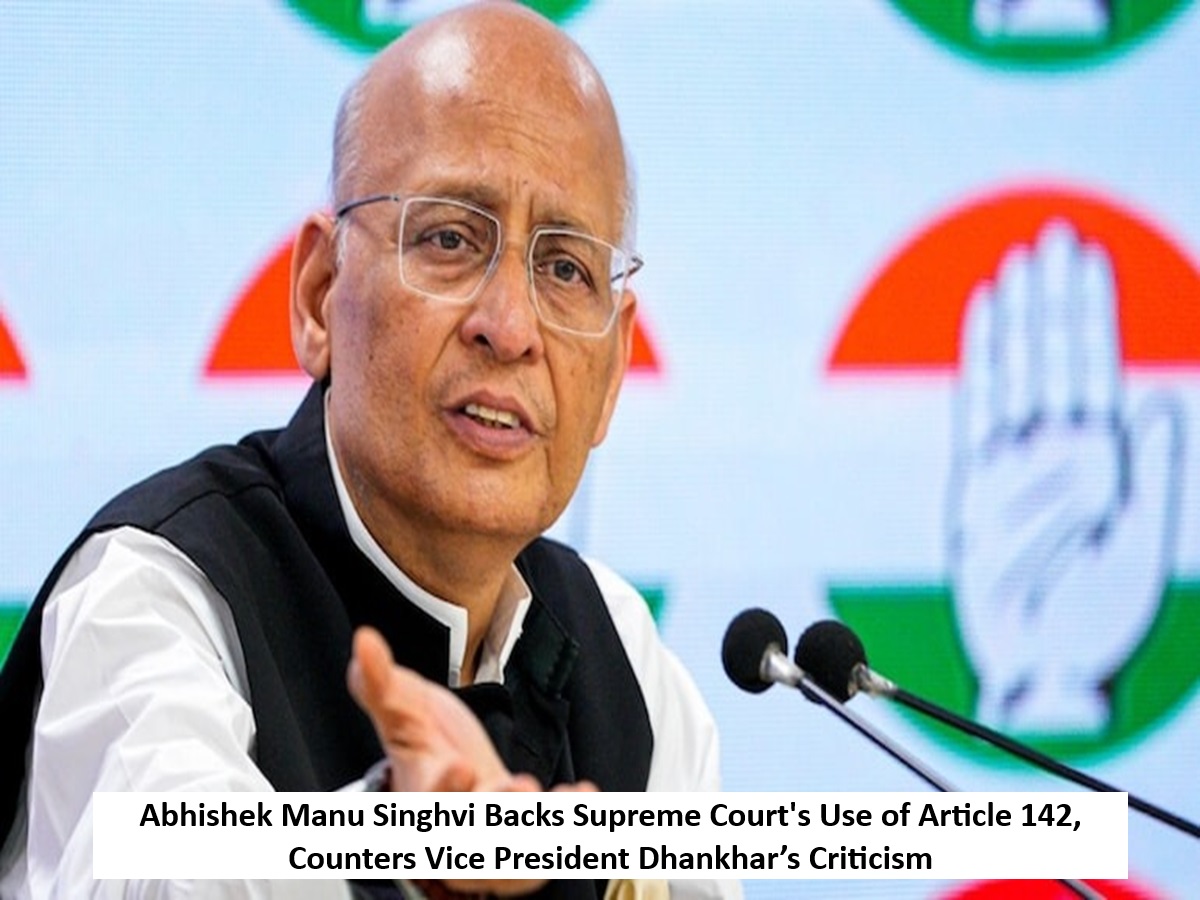
Congress Rajya Sabha MP Abhishek Manu Singhvi, a senior advocate representing petitioners against provisions of the Waqf (Amendment) Act, has strongly disagreed with Vice President Jagdeep Dhankhar's recent remarks on Article 142 of the Constitution. Singhvi defended the Supreme Court’s authority, asserting that Article 142 is a well-established legal tool with decades of jurisprudential support.
Dhankhar’s Comments: Article 142 as “Nuclear Missile”
In a pointed critique on April 17, 2025, Dhankhar labeled Article 142 a "nuclear missile against democratic forces," questioning the judiciary’s frequent reliance on it. His criticism was directed particularly at a recent Supreme Court judgment involving Tamil Nadu, where the court invoked Article 142 to mandate that the President decide on Bills sent by Governors within a three-month deadline.
Singhvi: Article 142 Has Deep Constitutional Roots
Responding in an interview to The Indian Express, Singhvi emphasized:
"Article 142 was not born yesterday. It has a respectable lineage of over 50 years. Dr. Ambedkar and the Constitution’s framers entrusted this power solely to the Supreme Court."
He further argued that the Court imposes strict self-regulation when exercising these powers and uses it only to ensure complete justice in cases with legal or procedural gaps.
Why Article 142 Was Justified in Tamil Nadu Case
Singhvi defended the court’s April 8, 2025, ruling, where Article 142 was invoked to address a delay in gubernatorial assent to state Bills. He criticized certain Governors, particularly those appointed to Opposition-ruled states, for allegedly acting on Central instructions rather than upholding constitutional values.
"When Governors behave like agents of the Centre instead of independent constitutional authorities, how is invoking Article 142 wrong?" Singhvi questioned.
Governors Holding Up Bills is Constitutionally Problematic
According to Singhvi, no constitutional drafter—including Dr. Ambedkar—ever imagined a scenario where a Governor would sit on Bills for over a year, fail to refer them promptly for Presidential assent, or offer no reasons for delays, especially in matters within state legislative jurisdiction.
President and Governor Roles on Assent Are Structurally Similar
Singhvi also addressed criticism of the Supreme Court’s reference to the President’s role, arguing that the language and structure of the Constitution are almost identical for both offices when it comes to giving assent to Bills.
"If the Court can impose a timeline on Governors, it logically extends to the President too. The judgment is not overreach; it is a constitutional necessity."
Understanding Article 142
Article 142 of the Indian Constitution allows the Supreme Court to pass orders necessary to deliver “complete justice” in a matter before it. These powers enable the Court to:
Fill legislative gaps
Override existing legal obstacles
Enforce constitutional rights
Issue binding directives beyond statutory limitations
Read More: PM Modi and Kharge’s Viral Moment: A Rare Handshake and Laughter at Ambedkar Tribute Event