Ziya
Ziya Share
Share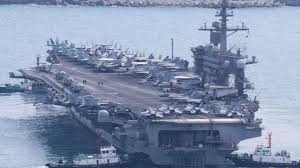
News India Live, Digital Desk: In a major military escalation, the United States has officially ordered the world’s largest and most advanced aircraft carrier, the USS Gerald R. Ford, to the Middle East. This decision, reported on February 13, 2026, follows a direct warning from President Donald Trump amid soaring tensions with Iran over its nuclear program and the suppression of domestic protests.
The deployment marks a significant shift in U.S. strategy, creating a "two-carrier" presence in the region to maximize military pressure on Tehran.
1. The "Two-Carrier" Strategy
The USS Gerald R. Ford will join the USS Abraham Lincoln, which arrived in the Arabian Sea in late January.
Firepower: With two carrier strike groups and approximately nine other warships, the U.S. will have a massive concentration of aerial and naval power capable of launching precision strikes if diplomacy fails.
Rapid Deployment: The Ford was redirected from the Caribbean, where it had recently been involved in a military buildup near Venezuela.
2. Trump's "Phase Two" Warning
The decision comes just days after President Trump met with Israeli Prime Minister Benjamin Netanyahu.
The Ultimatum: Trump has given Iran a roughly one-month window to reach a new, more stringent nuclear deal.
Phase Two: He warned that if negotiations in Oman remain inconclusive, the U.S. will move to "Phase Two"—implied to be "very tough" military action similar to the strikes on Iranian nuclear facilities carried out in mid-2025 (codenamed Operation Midnight Hammer).
Nuclear Red Line: Trump reiterated that Iran must not be allowed to obtain a nuclear weapon, stating, "Either we will make a deal, or we will have to do something very tough."
3. Iran’s Stance and Internal Pressure
The Protest Factor: The U.S. has cited Iran’s violent crackdown on anti-government protests (where thousands have reportedly been killed) as a secondary reason for the military buildup.
Tehran’s Warning: Iranian officials have warned that any American attack would trigger an "all-out regional war," threatening to target the amassing U.S. fleet as "accessible targets."
Retaliatory Imagery: New billboards in Tehran’s Enghelab Square reportedly depict an American aircraft carrier being destroyed, with the caption: "If you sow the wind, you will reap the whirlwind."
4. What’s at Stake?
Energy Security: With a massive naval presence in the Persian Gulf and Arabian Sea, the safety of global oil transit routes is a major concern.
Regional Stability: Gulf Arab nations and allies like the UAE have expressed concern that the situation could spiral into a conflict that “ignites the region.”
Read More: Border Crossings and Uncertain Futures Why Indian Students are Trekking to Armenia Right Now


_1211453482_100x75.jpg)