 Priyanka Tiwari
 Share
Share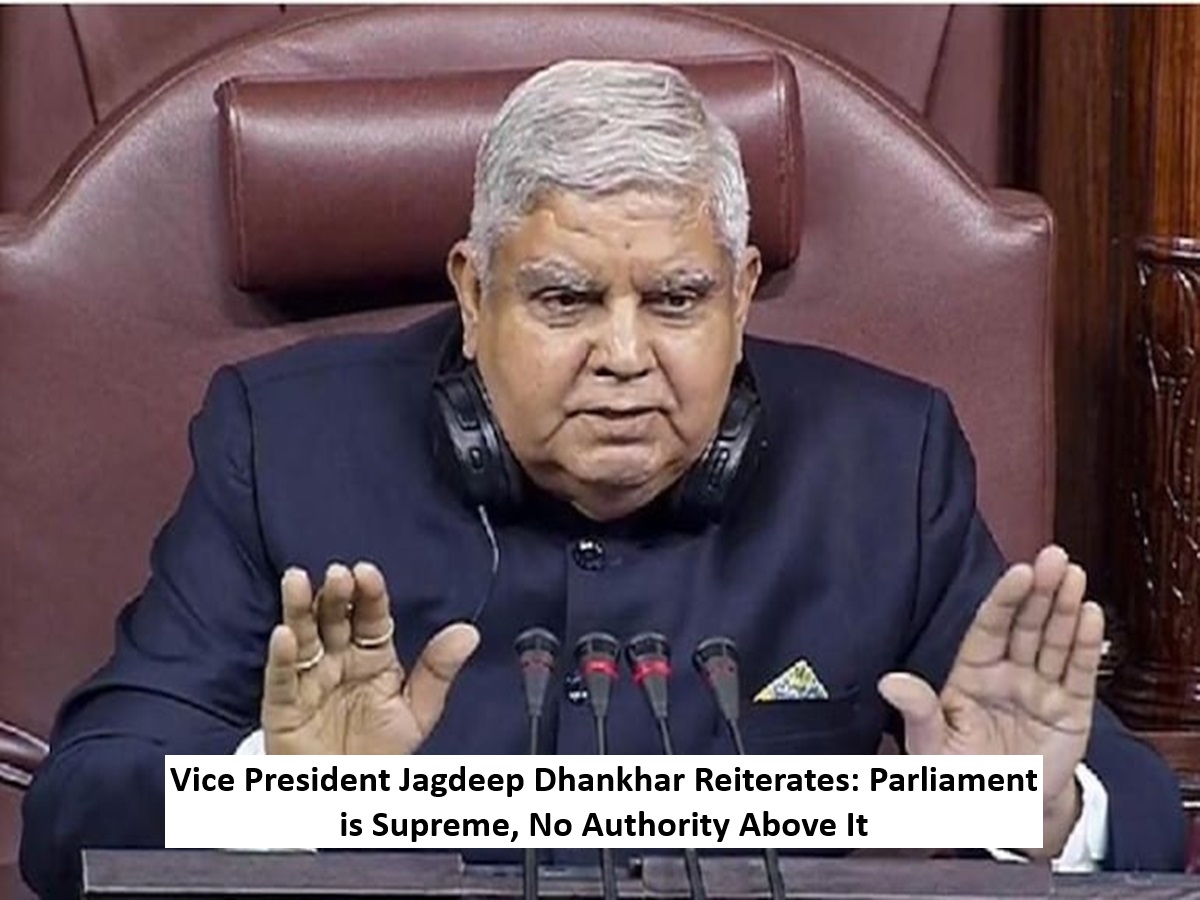
During a recent address, Vice President Jagdeep Dhankhar reiterated that elected representatives serve as “ultimate masters” concerning the value and jurisdiction of the Constitution India. He also added that no one—including the Parliament, or the judiciary—is ‘superior’ to it.
VIDEO | Speaking at an event in Delhi University, Vice-President Jagdeep Dhankhar (@VPIndia) said, "A prime minister, who imposed Emergency, was held accountable in 1977. Therefore, let there be no doubt about it - Constitution is for the people and it's a repository of… pic.twitter.com/mjXt84tLcS
— Press Trust of India (@PTI_News) April 22, 2025
“No Authority Above Parliament”: Dhankhar at DU Event
While speaking at an event in Delhi University, he stated that responsiveness in a democracy is to the people, while the people’s controller is the election. He noted the mid 1970’s with elections in 1977 as a good example where the electorate was able to remove a Prime Minister who forced them into the Emergency set in in 1975.
As he put it: “Elected representatives are the ultimate masters as to what constitutional content will be. There is no visualisation in the Constitution of any authority above Parliament.”
Cites Contradictions in Supreme Court Judgments
In his speech, the Vice President pointed out the paradox regarding the preamble’s status and the supreme court’s postion. He cited the Golak Nath case where the Court jury declared that the preamble is not a part of the Constitution. And the Kesavananda Bharati case where parts of the preamble is considered a constitution.
Judicial Overreach And Article 142 Critique
Judicial activism, as Dhankhar termed it, was overreach. As an example, he cited the recent Supreme Court ruling allowing a judicial check on the governatorial assent on state bills and labeled it a gross overreach into executive and legislative activities of government.
Furthermore, he expressed concern about Article 142 calling it a “nuclear missile against democracy in the forces of the judiciary available 24x7.” In his words, this article empowers the judiciary without accountability far too much.
Increasing Tension Supreme Court Responds
During a recent hearing concerning a petition about the President’s Rule in West Bengal, the Supreme Court, in what seemed a detached response to some of the comments made by Dhankhar and other political personalities, said: A bench commented,
“Already, we are supposed to have a regime where there is too much intrusion into the work of the parliament and the executive branches of government.”
The statement underline increasing conflicts from parts of the executive and judiciary arms of the government against each other with respect to jurisdictions and the constitutionally prescribed functions, powers, and limitations of each branch of government.
Read More: PM Modi and Kharge’s Viral Moment: A Rare Handshake and Laughter at Ambedkar Tribute Event