State Hits Historic Zero Primary Dropouts but Battles Surging Middle-School Exit Rates and High Pupil-Teacher Ratios
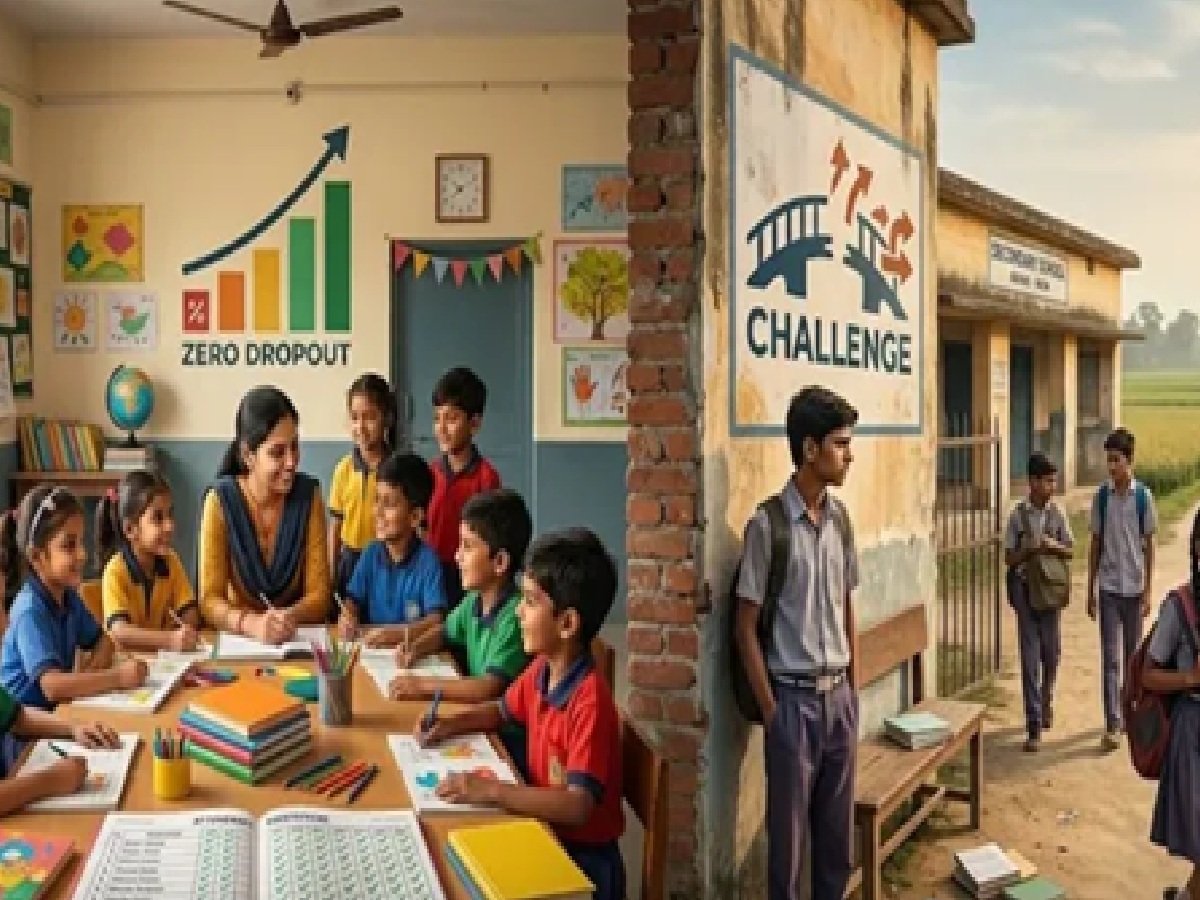
The Department of School Education and Literacy under the Union Ministry of Education has released its highly anticipated U-DISE Plus report, presenting a fascinating, bittersweet transformation within Uttar Pradesh's vast academic infrastructure. Proving the long-term success of grassroots structural overhauls, the state administration has achieved a historic milestone by driving the student dropout rate down to a flawless zero percent at the primary level (grades one to five). However, this celebratory success is heavily contrasted by alarming trendlines upper-primary and secondary levels, where student retention plummets sharply. Compounding the issue, the state faces a critical deficit in its Pupil-Teacher Ratio (PTR) across higher classes, lagging significantly behind federal baselines and highlighting a structural necessity for aggressive educational recruitment.
The Middle School Retention Gap: Deconstructing the Data Contrast
When mirrored against nationwide educational baselines, Uttar Pradesh's primary performance outshines federal metrics, where the national primary dropout average currently hovers at 0.3 percent. Yet, the momentum fractures immediately as students transition into higher brackets. At the upper-primary level, the state's dropout rate dramatically climbs to 6.7 percent—nearly double the national average of 3.6 percent.
This means that while the state's academic system successfully ensures that toddlers pick up books, it struggles to prevent adolescents from dropping them once they clear grade five. Interestingly, at the secondary level (grades 9-10), UP’s dropout rate settles at 8.4 percent, positioning itself marginally better than the national average of 9.5 percent, yet maintaining a steady leakage of human capital. Sociological and economic analysts attribute this middle-school exodus to immediate real-world pressures, citing family financial distress, puberty-related challenges, child labor demands, and the lack of accessible senior schools within immediate rural vicinities as main catalysts.
The Teacher Deficit: Severe PTR Imbalances Exposed in Senior Classes
The U-DISE Plus document further sheds light on an unequal distribution of teaching resources across various academic stages. In primary institutions, Uttar Pradesh functions perfectly in tandem with federal guidelines, boasting an optimal ratio of 19 students per teacher. But as the classes advance, the numbers quickly become unsustainable. At the upper-primary level, the state registers 21 students for every single teacher, whereas the national baseline stands comfortably at 17.
The structural divide widens even more aggressively in high schools and intermediate colleges. At the secondary tier, UP operates with a strained ratio of 23 students per teacher, compared to a leaner national average of 15. The most critical pressure point is witnessed at the higher secondary level (grades 11-12); while the rest of India maintains an average of 23 students per instructor, Uttar Pradesh's classrooms swell to an overwhelming 33 students per educator. Education specialists warn that resolving these structural PTR disparities is vital, as deploying more specialized subject teachers for grades 6 to 12 remains the primary solution to enhancing classroom engagement and permanently lowering secondary dropout figures.
_1317555004_351x234.jpg)
_715995316_351x234.jpg)
_1766946867_351x234.jpg)
_1198274159_351x234.jpg)