










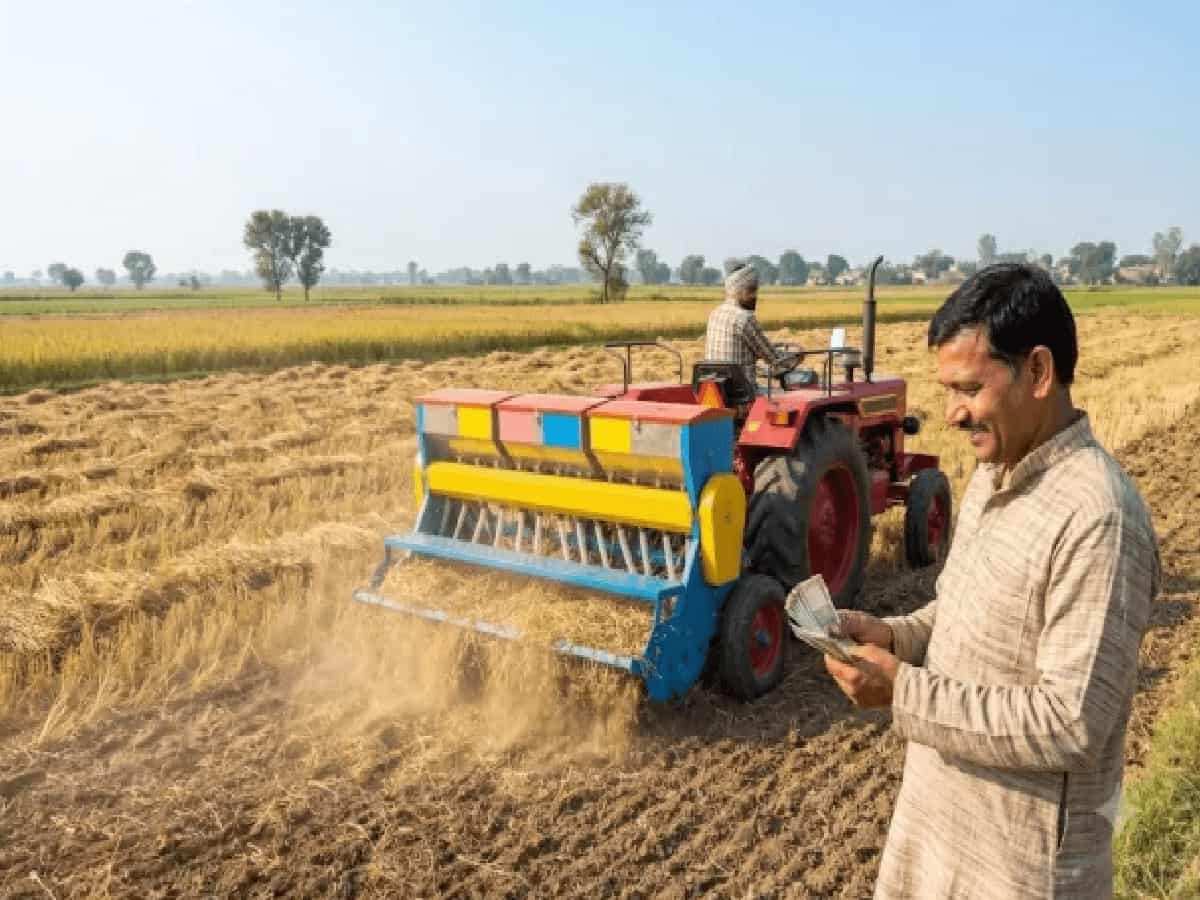
No More Stubble Burning: UP Farmers Profit With Super Seeder
Across Uttar Pradesh's paddy-wheat belt, the annual post-harvest race to clear standing rice straw before Rabi wheat sowing is undergoing a practical, cost-saving shift as more growers adopt the tractor-mounted Super Seeder. Instead of setting fire to leftover paddy stalks—a practice that degrades air quality, destroys beneficial soil microbes, and invites administrative penalties—farmers in districts such as Sultanpur are turning to in-situ residue management that chops crop stubble, incorporates it directly into the topsoil, places wheat seeds and basal fertilizer at precise depths, and levels the seedbed in a single pass. Agricultural specialist Dr. A.K. Singh notes that completing tillage, residue incorporation, and sowing simultaneously takes roughly one to one-and-a-half hours per acre, dramatically trimming diesel consumption, tractor passes, manual labor, and turnaround time between Kharif harvest and Rabi planting. For cultivators, agri-entrepreneurs, and rural households across northern India—including farming belts surrounding Lucknow and neighboring Uttar Pradesh districts such as Unnao, Kanpur, Ayodhya, Sultanpur, Prayagraj, and Varanasi, where timely November wheat sowing directly determines grain yield—the Super Seeder is emerging as both an environmental solution and a profit-improving farm tool.
How a Super Seeder Works Inside the Field in One Single Pass
Conventional post-paddy field preparation often forces farmers either to burn residue or to run multiple rounds of rotavators, cultivators, and plankers before broadcasting seed—driving up fuel bills and delaying sowing. As Dr. A.K. Singh explains, the Super Seeder integrates four distinct field operations into one continuous mechanical sequence:
-
Chopping & Mixing Paddy Residue: Heavy-duty rotary blades at the front slice standing paddy stalks and loose straw left behind by combine harvesters, blending the organic biomass directly into the upper soil layer.
-
Precision Furrow Opening: Rear furrow openers cut clean, uniform seed rows through the residue-mixed soil without clogging.
-
Simultaneous Seed & Fertilizer Placement: Separate hoppers meter wheat seeds and basal fertilizer simultaneously at the recommended depth for uniform germination.
-
Soil Pressing & Moisture Retention: A rear press roller firms the soil gently over the sown rows, sealing in residual field moisture and eliminating separate planking or leveling passes.
Super Seeder vs. Traditional Broadcast Sowing: Input and Cost Comparison
Beyond eliminating separate plowing rounds, precision metering inside the Super Seeder's dual seed-and-fertilizer boxes reduces input wastage compared with traditional manual broadcasting:
| Farming Parameter | Super Seeder Method | Traditional Broadcast / Multi-Pass Method |
| Field Preparation & Sowing Passes | Single pass (~1 to 1.5 hours per acre) | 3 to 5 separate passes (plowing, harrowing, planking, sowing) |
| Seed Requirement (Per Acre) | Lower, precision-drilled requirement (around 15 kg in local field trials; standard recommendations typically 35–40 kg/acre vs. higher broadcast rates) | Roughly 25–30% higher seed volume (e.g., 20 kg vs. 15 kg in comparative field benchmarks) due to uneven scattering |
| Fertilizer Placement | DAP / NPK mixture (~15 kg in benchmark trials) placed right beside the seed root zone via a separate box | Broadcast across the surface, leading to higher nutrient loss |
| Soil Health & Moisture | Incorporated paddy straw decomposes into organic humus, conserving soil moisture and suppressing weeds | Residue removal or burning depletes organic carbon, nitrogen, and soil micro-flora |
Government Subsidy Support and Custom Hiring Income in Uttar Pradesh
To make residue-management machinery accessible to small and marginal farmers who may not own high-horsepower tractors, the Uttar Pradesh Agriculture Department supports Super Seeders, Custom Hiring Centres (CHCs), and Farm Machinery Banks under schemes such as the Sub-Mission on Agricultural Mechanization (SMAM) and Promotion of Agricultural Mechanization for In-Situ Management of Crop Residue via the official portal agriculture.up.gov.in. Individual eligible farmers can avail subsidies ranging from 40% to 50% (with higher slabs for small, marginal, SC/ST, and women farmers), while farmer groups and rural entrepreneurs operating custom hiring units receive substantial capital assistance—allowing tractor-owning rural youth to earn steady seasonal rental income by servicing neighboring farms while keeping Uttar Pradesh's skies cleaner.






