
 Priyanka Tiwari
 Share
Share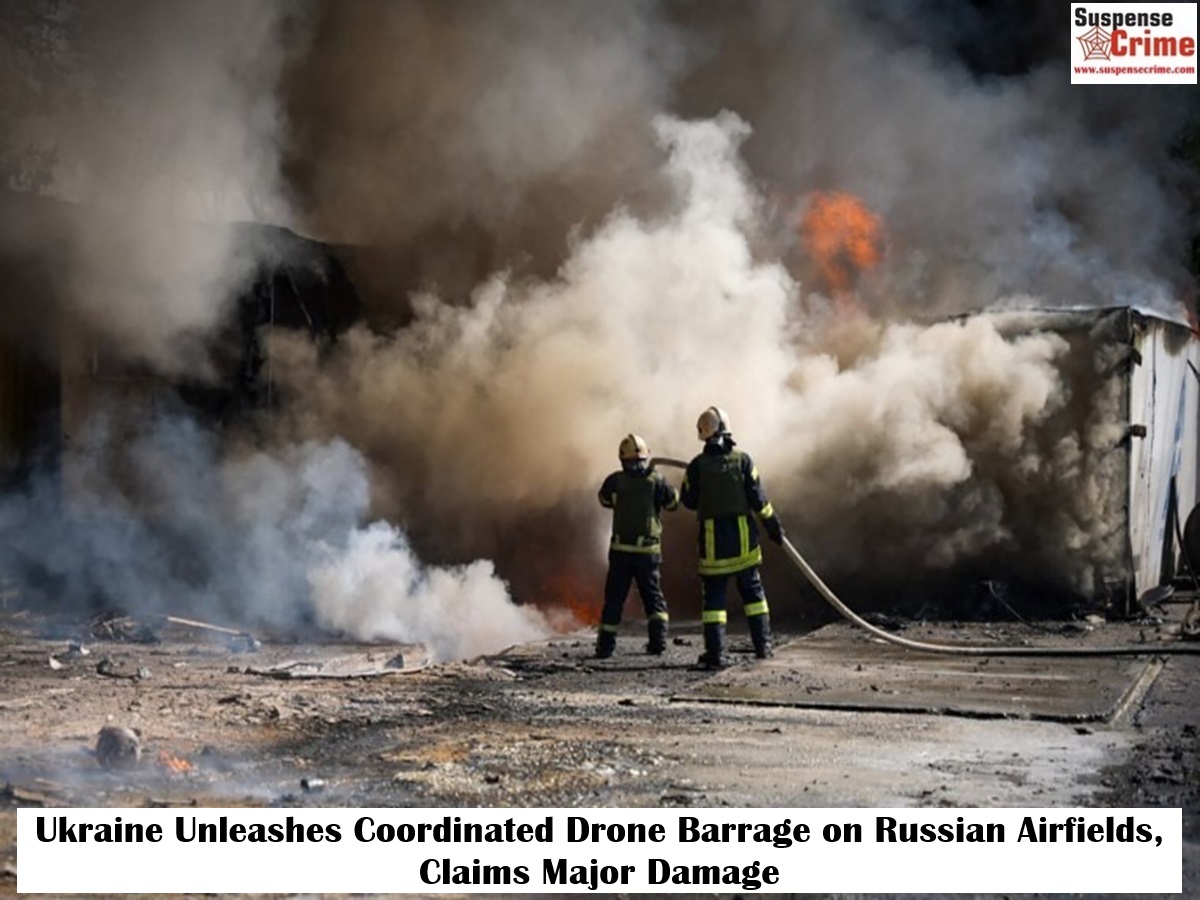
Suspense crime, Digital Desk : A significant wave of Ukrainian drones struck deep into Russian territory on Friday and into early Saturday, targeting multiple airbases in what appears to be a large-scale, coordinated assault. While Russia's Ministry of Defence acknowledged that some of its warplanes sustained damage, Ukrainian intelligence sources are claiming far more substantial destruction and even casualties.
The attacks, reportedly a joint operation by Ukraine's GUR military intelligence and SBU security service, hit at least five airbases. These included Morozovsk in the Rostov region, Yeysk in Krasnodar Krai, Engels-2 in the Saratov region (home to strategic bombers), and an airbase in Kursk. Another facility, possibly near Krymsk in Krasnodar, was also reportedly targeted.
Moscow stated its air defence systems successfully intercepted over 40 drones, primarily over the Rostov region where the Morozovsk airbase, home to Su-24, Su-24M, and Su-34 fighter-bombers, is located. The Russian Defence Ministry confirmed damage to aircraft but reported no human casualties from the strikes.
However, Ukrainian intelligence sources painted a starkly different picture. They asserted that the attack on Morozovsk alone resulted in at least six Russian military aircraft being destroyed and another eight heavily damaged. These sources also claimed that around 20 Russian service personnel were killed or wounded in that specific strike.
Further claims from Kyiv suggested that three Tu-95MS strategic bombers were likely damaged at the Engels-2 airbase, a key facility for Russia's long-range aviation. At the Yeysk airbase, Ukrainian officials reported that two Su-25 ground attack aircraft were seriously damaged.
The drones used in these extensive operations were reportedly FPV (First-Person View) models, which are agile and can be piloted with precision to their targets. This series of attacks represents one of the most ambitious Ukrainian aerial assaults on Russian military infrastructure since the conflict began, aiming to degrade Russia's air capabilities and strike at valuable assets far from the front lines. The conflicting reports on the extent of the damage are typical of wartime information warfare, with both sides presenting narratives favorable to their efforts.
Read More: High-Stakes Drama at Sea Pakistani Oil Tanker Shalamar Defies US Blockade in Strait of Hormuz
_891152136_100x75.jpg)
_934999377_100x75.jpg)
_297632329_100x75.jpg)
_1971369341_100x75.jpg)