

 Desk
Desk Share
Share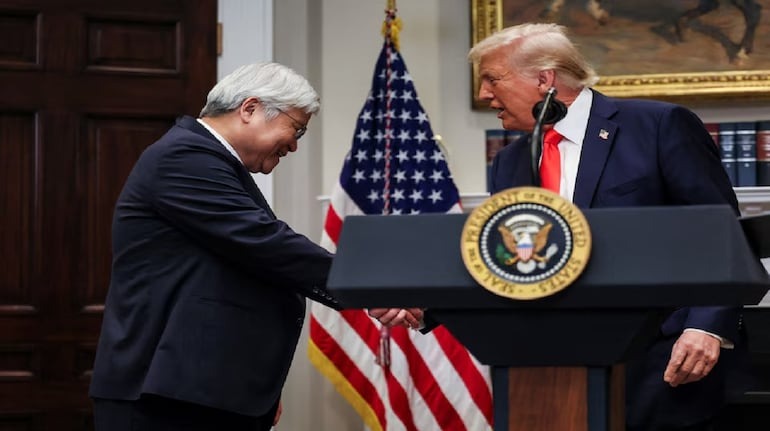
During his meeting with CEO C.C. Wei at the White House, President Trump proposed that TSMC use part of their $65 billion US investment plan toward new AI and IT infrastructure as well as training programs.
Taiwanese industrial giant TSMC made the headlines after revealing plans to expand their operations in the US by opening an additional factory in Phoenix, Arizona, which accompanied the promise of increased domestic US semiconductor production. In order to bring the promised investment in equipment and infrastructure to fruition, an estimated $100 billion is needed.
As expressed in an interview, Trump stated, ‘We must be able to build the chips and semiconductors that we need right here. It’s a matter of national security for us’. The statement brings forth concerns regarding China’s influence in Taiwan. To counteract this, Taiwan would need to boost the amount of facilities capable of producing semiconductor chips and at the same time heighten US levels of dependence.
In response to China’s aggressive behavior, the US turned its attention toward Taiwan which possesses the world’s leading semiconductor manufacturing company, which can essentially single handedly cater to one of the biggest market demands on the globe. The President pointed out the urgent need for increased AI based infrastructure in the US, and reducing foreign semiconductor reliance is a perfect solution.
TSMC did not disclose the timeline of their new investments other than mentioning that 40,000 construction jobs would be provided in the next four years. Despite the fact that TSMC started chip production on schedule in 2024, the company faced construction delays with the first Arizona plant.
Being one of TSMC's most significant partners, Nvidia, Qualcomm, and Advanced Micro Devices rely heavily on TSMC. Consequently, establishing more production sites in the US would substantially reduce supply chain concerns for those companies and further strengthen TSMC's role in the US semiconductor industry.
Furthermore, TSMC could aid in saving Intel. A source reported that Trump administration officials met with Wei earlier this year in New York regarding plans to acquire the majority of a joint venture in Intel's factory unit. Intel also received attention from several other semiconductor firms. Intel did not respond to the meeting inquiries.
The announcement helps shift perception about Trump as someone who actively delivers on campaign promises to strengthen US industry and employment opportunities.
This is one in a series of steps taken toward the same objective. For example, Apple announced in February that it plans to put forward $500 billion over the coming four years. Notice that a lot of that was already planned expenditure. In addition, Emirati billionaire Hussain Sajwani and SoftBank are intending to spend several billions in the country as well.
On Monday, TMSC stated that, “We look forward to discussing our shared vision for innovation and growth in the semiconductor industry, as well as exploring how we can help together strengthen the technology industry with our customers.”
CHIPS ACT
The first period of trump brought TSMC to Arizona in 2019 and introduced pieces of legislation that would ultimately evolve into the CHIPS and Science Act, which President Joe Biden signed in 2022 to allocate prime funding of $52.7 billion dollars to boost the US semiconductor industry.
Last year, TSMC received a commitment from the US commerce department on a $6.6 billion stimulus funded project for building semiconductor facilities in Phoenix, Arizona. The newly announced, and recently speculated, $100 billion promise comes under the stipulation of a 25% tax write off for direct solder investments under the 2022 legislation.
To counter the national security issues posed by Taiwan Semiconductor Manufacturing Company and other foreign semiconductor supplier dependency, Biden's administration persuaded all of the leading five semiconductor businesses to build fabrication plants in the country.
The geopolitical tensions within East Asia exacerbated when China began claiming Taiwan as its sovereign territory, spellbinding the island’s supremacy in producing vital technological components like semiconductors for automobiles, electronic devices, and military aircrafts. Tension looms due to the possibility of over-dependence on Taiwan while China aggressively tries to assert its territorial claims.
That Taiwan is part of China has always been its stance. But the democratically elected ruling party of Taipei does not accept the Beijing sovereign's assertion.
Howard Lutnick, the Secretary of Commerce said on Monday, speaks out against the new tariffs introduced by Trump and claims TSMC, along with many other firms, are investing into the United States to capitalize on the lack of tariffs.
Lutnick had shared with lawmakers back in January that the “Biden program” is, in his opinion, a step towards reinvesting in the sector, or, as he phrased it, "an excellent down payment." However, he is hesitant to distribute Bexit VI funds that the former has approved, arguing that he needs more time to, “read them and analyze them and understand them."
According the CHIPS act, a TSMC spokesperson revealed last month that the company received $1.5 billion AHEAD of the new administration as milestone terms of its agreement with the old one.
Last year, TSMC committed to bringing online the world’s most advanced 2-nanometer technology to their second Arizona fab that will start operating in 2028. TSMC also agreed to implement its most advanced chip manufacturing technology A16 into Arizona.
TSMC has started manufacturing state-of-the-art 4-nanometer chips for US customers in Arizona.
Read More: Pakistan Clears $3.45 Billion UAE Debt via Saudi Bailout: How the Circular Debt Shuffle Worked