
 Priyanka Tiwari
 Share
Share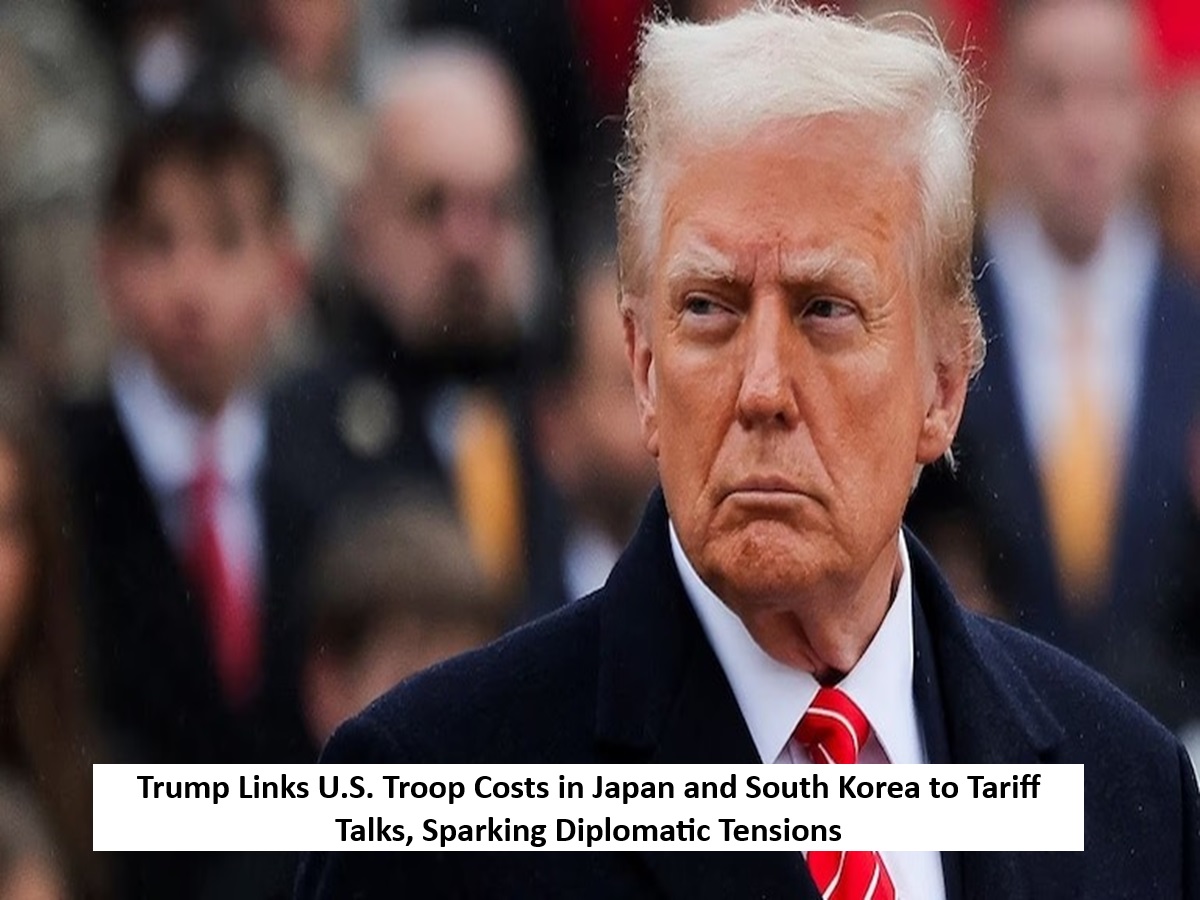
Former U.S. President Donald Trump has reintroduced defense cost-sharing into ongoing tariff talks with key Asian allies, Japan and South Korea, signaling a return to his transactional approach to foreign policy. In recent posts on Truth Social, Trump suggested that military support and trade issues should be negotiated together, a move that has stirred unease in Seoul and Tokyo.
Japan and South Korea host about 50,000 and 28,500 U.S. troops respectively. These forces are essential to maintaining U.S. influence and strategic readiness in the Indo-Pacific region, particularly against threats from China, Russia, and North Korea.
Pushback from Asian Allies
Both countries have publicly emphasized that defense cost-sharing and trade discussions should remain distinct. South Korean officials confirmed that no formal renegotiation of the Special Measures Agreement (SMA) has been proposed yet, but Seoul is bracing for potential talks. Finance Minister Choi Sang-mok affirmed that cost-sharing is not currently under review.
Japan, too, has stated through government sources that defense expenses are a separate issue and should not be linked with trade tariffs.
Trump’s Pressure Tactics Raise Concerns
Analysts believe Trump’s approach is a strategic move to extract financial concessions. During his first term, he demanded significant increases in troop support payments and even hinted at withdrawing forces if demands were not met.
Experts say this tactic complicates alliances. “Trump sees alliances in economic terms,” said Danny Russel from the Asia Society Policy Institute, adding that linking military support to financial contributions undermines the mutual trust underpinning long-standing security partnerships.
South Korea’s Costly Gamble
Ahead of the 2020 U.S. election, the administration of then-President Biden and South Korea signed a five-year SMA agreement, increasing Seoul’s contribution by 8.3% to $1.47 billion. The goal was to lock in terms favorable to South Korea before a possible Trump return. That decision may now backfire, as Seoul could be forced to renegotiate from a higher base.
South Korea is currently governed by a caretaker administration following the recent impeachment of President Yoon Suk Yeol. A new election is scheduled for June 3.
Japan's Strategic Importance
Japan has the largest overseas deployment of U.S. troops, including a forward-deployed aircraft carrier strike group. Under its current agreement, Japan contributes roughly $1.48 billion annually until March 2027.
With both Japan and South Korea buying large amounts of U.S. military hardware, including advanced warplanes, Pentagon leaders have praised their financial commitments. General Xavier Brunson, commander of U.S. Forces Korea, noted these investments as evidence of a robust and enduring alliance.
Growing Nuclear Debate in Seoul
Trump’s pressure campaign has reignited debate within South Korea about national security. With uncertainty over long-term U.S. protection, some voices are calling for South Korea to consider developing its own nuclear capabilities.
Read More: Pakistan Clears $3.45 Billion UAE Debt via Saudi Bailout: How the Circular Debt Shuffle Worked