Priyanka Tiwari
 Share
Share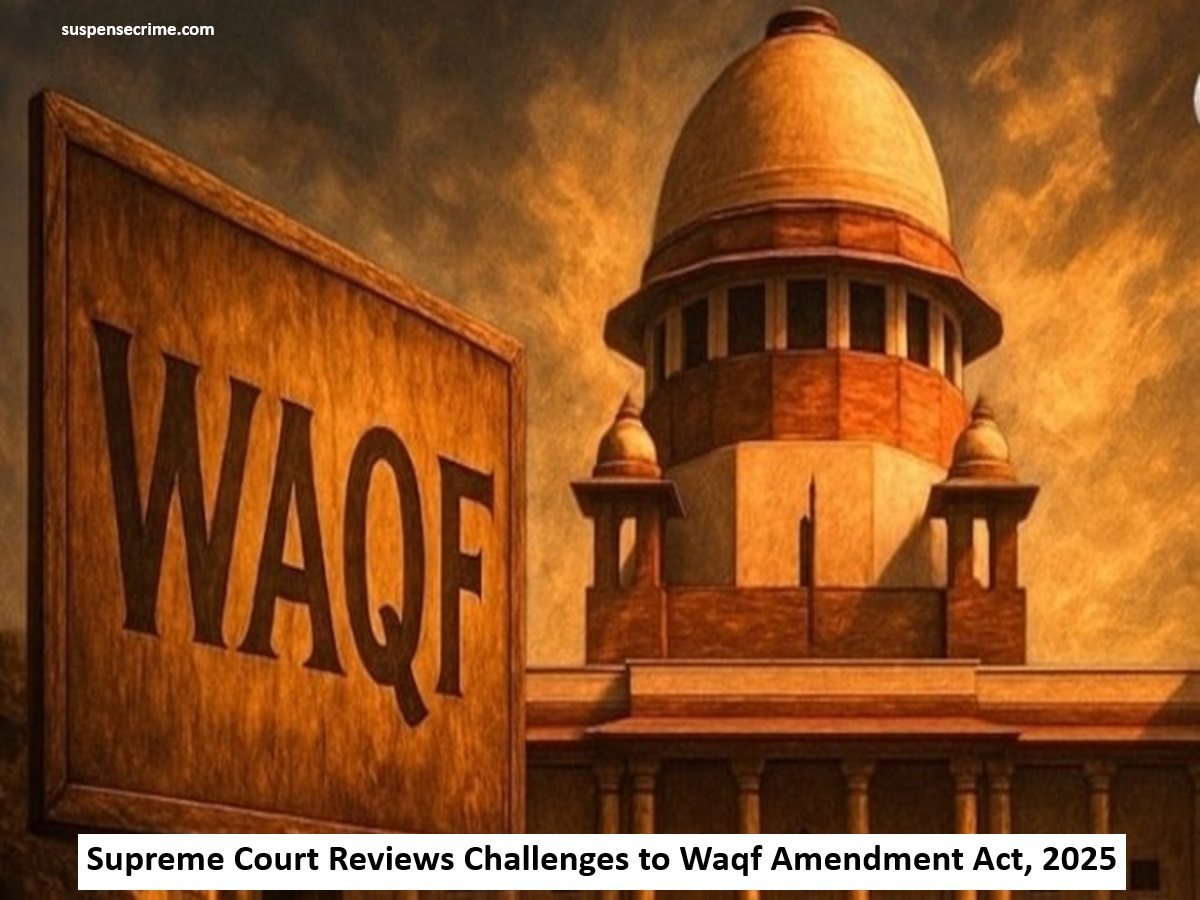
Suspense crime, Digital Desk : The Supreme Court of India has pointed out that those contesting the Waqf Amendment Act, 2025, must offer a persuasive argument as to why it should not be considered valid. The petitioners argue that the new law focuses the negative impact exclusively on the Muslim population.
A division of the court consisting of Chief Justice BR Gavai and Justice AG Masih heard several of the opposing petitions. The Waqf Amendment Act is an alteration of the Waqf Act of 1995 and concerns the administrative control of Waqf properties. Endowments for Islam either for religion or charity.
Petitioner’s Claims Concerning The Amendment
Kapil Sibal, one of the petitioners’ senior advocates, alleged the amendment conceals in its language an effort to secure waqf properties when, in fact, it allows the government to seize control through extra-judicial means.
He argued that the illicit taking of private property is occurring indiscriminately just because there are disputes, no matter the type. An official of the Government who is outranked only by the district Collector is empowered to resolve a particular set of disputes and report the outcome, whenever he so desires. Sibal further stated that properties are commandeered without following correct protocols.
Advocate Abhishek Manu Singhvi additionally argued that requiring one to demonstrate their adherence to a particular religion as a form of identification is discriminatory under Article 15 of the Constitution.
In addition, the petitioners claimed that an evidence in Islam’s practice for a specific duration breaches Article 25, which is freedom of religion. Advocate Huzefa Ahmadi raised the issue regarding how the authorities would objectively determine if the person practiced Islam, remarking that those types of determinations are arbitrary.
Center's Justification on The Waqf Law
The Respondents maintained that Waqf is primarily of a secular nature, therefore the law should continue to stand on the grounds of ‘assumption of constitutionality.’
Each of these contentions was advanced by the Centre, represented by Solicitor General Tushar Mehta, who explained that the Act deals only with the secular aspects of the administration of Waqf and its accompanying religious rights. Previously, the government wanted the court to prioritize three specific concerns:
1. Whether or not courts are entitled to amend Waqf property and the declarations thereunder;
2. Validity of Waqf established by longtime user;
3. Legally recognized Waqf created by deed.
The government contested the petitioners’ appeal to freeze the case, claiming that there is no immediate national emergency that warrants halting executing the law. The government further indicated that any subsequent problems could be dealt with through the courts.
Previously, the Centre had agreed not to deschedule Waqf properties, as well as non-Muslim appointments, pending the outcome of the court’s decision.
_891152136_100x75.jpg)
_934999377_100x75.jpg)
_297632329_100x75.jpg)
_1971369341_100x75.jpg)