Priyanka Tiwari
 Share
Share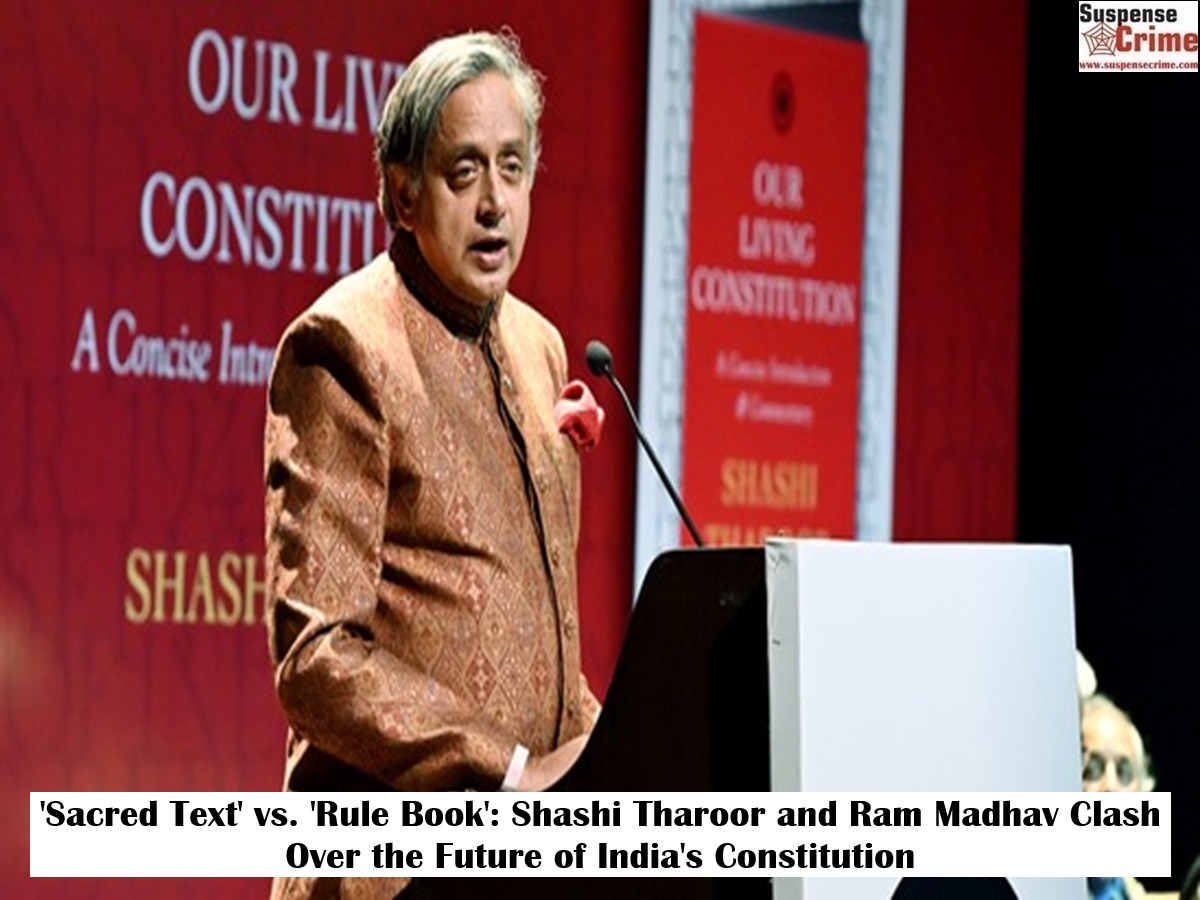
Suspense crime, Digital Desk : A powerful debate between two of India's most prominent political thinkers, Congress MP Shashi Tharoor and the BJP's Ram Madhav, has brought a fundamental question to the forefront: What is the Indian Constitution? Is it a sacred text to be revered, or a functional rule book that can be rewritten to suit the times?
This clash of ideologies, which took place at the Kerala Literature Festival, perfectly encapsulates the larger political and cultural battle over India's identity.
Shashi Tharoor: The Constitution as a Sacred Text
For Shashi Tharoor, the Constitution is more than just a legal document; it is the "sacred book" of Indian democracy. He argues that it is a living, breathing text that has successfully held a diverse and complex nation together for over seven decades. In his view, the Constitution is the very bedrock of India's modern identity—a testament to its liberal, secular, and inclusive values.
Tharoor contends that while amendments are possible, the foundational principles of the Constitution—what the Supreme Court has famously called the "basic structure"—are inviolable. To him, any attempt to fundamentally alter or rewrite the Constitution is a dangerous move that threatens the very soul of the nation. His perspective is one of deep emotional and intellectual reverence for the work of the nation's founders.
Ram Madhav: The Constitution as a Practical Rule Book
Ram Madhav presents a starkly different, more dispassionate view. He argues that the Constitution is not a holy scripture but a "rule book," a man-made document created by people in a specific historical context. Therefore, he believes it should not be considered sacrosanct and untouchable.
Madhav's position is that as India evolves, its guiding rule book must also be open to significant change, or even a complete rewrite, to better reflect the "Indian ethos" and the needs of a 21st-century nation. He questions the very idea of a "basic structure" that cannot be amended by a democratically elected parliament, viewing it as an obstacle to progress. He advocates for a pragmatic approach, free from what he considers the emotional baggage of the past.
More Than an Academic Debate
This "sacred text vs. rule book" debate is not merely an academic exercise. It lies at the heart of the current political discourse in India. It reflects the deep ideological divide between a vision of India rooted in the Nehruvian-era constitutional values of secularism and liberalism, and a vision that seeks to reshape the nation based on a different cultural and civilizational framework.
The outcome of this ongoing national conversation will determine the future direction of the Indian republic, making it one of the most critical debates of our time.
_891152136_100x75.jpg)
_934999377_100x75.jpg)
_297632329_100x75.jpg)
_1971369341_100x75.jpg)