
 Priyanka Tiwari
 Share
Share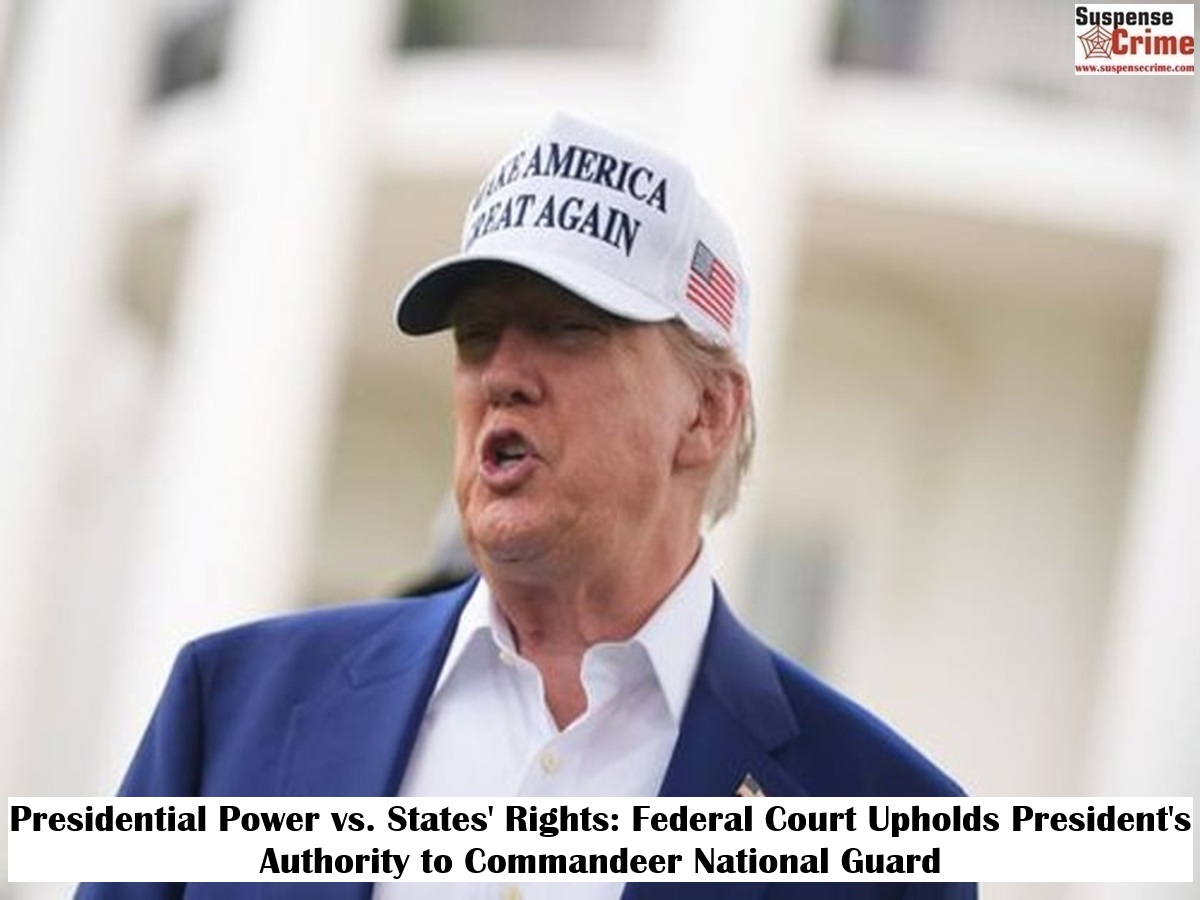
Suspense crime, Digital Desk : A federal appeals court has handed a significant victory to presidential authority, ruling that the White House has the power to federalize a state's National Guard and deploy them for missions, even over the objections of the state's governor. The decision, which has major implications for the balance of power between Washington D.C. and individual states, comes amid a lawsuit fueled by concerns over how a future president, specifically Donald Trump, might wield such authority.
The case was brought before the 9th U.S. Circuit Court of Appeals by a California-based nonprofit group. Their lawsuit sought to challenge the long-standing precedent that gives the president ultimate command over state Guard units for federal purposes. The group argued that this power could be abused, envisioning a scenario where a president might deploy the California National Guard to suppress domestic political dissent against the will of the state's leadership.
At the core of the dispute is a fundamental question of command: While a governor is the commander-in-chief of their state's National Guard for state-level emergencies, who has the final say when the nation's interests are invoked?
In its ruling, the three-judge panel made it clear that their hands were tied by established legal precedent. They pointed directly to a landmark 1990 Supreme Court case, Perpich v. Department of Defense, which affirmed that the federal government's power to raise and support armies supersedes a governor's authority when it comes to federalizing the Guard. The panel stated that as a lower court, it is bound by this Supreme Court ruling and does not have the authority to overturn it.
The lawsuit explicitly named former President Donald Trump, reflecting anxieties that he, if re-elected, might use the National Guard for politically motivated actions without state consent. The nonprofit's legal challenge was a direct attempt to preemptively limit that presidential power by overturning the 1990 decision.
While this ruling from the 9th Circuit is a setback for the plaintiffs, it is likely not the final word. The decision solidifies the president's power "for now," but the nonprofit group can appeal the case, potentially taking their fight all the way to the U.S. Supreme Court—the only body that can revisit and potentially reverse its own 1990 ruling. This sets the stage for a potential high-stakes constitutional showdown over the command and control of America's military forces.
_1570701464_100x75.jpg)
_1563449287_100x75.jpg)

_1025409548_100x75.jpg)
_1681775372_100x75.jfif)