
 Priyanka Tiwari
 Share
Share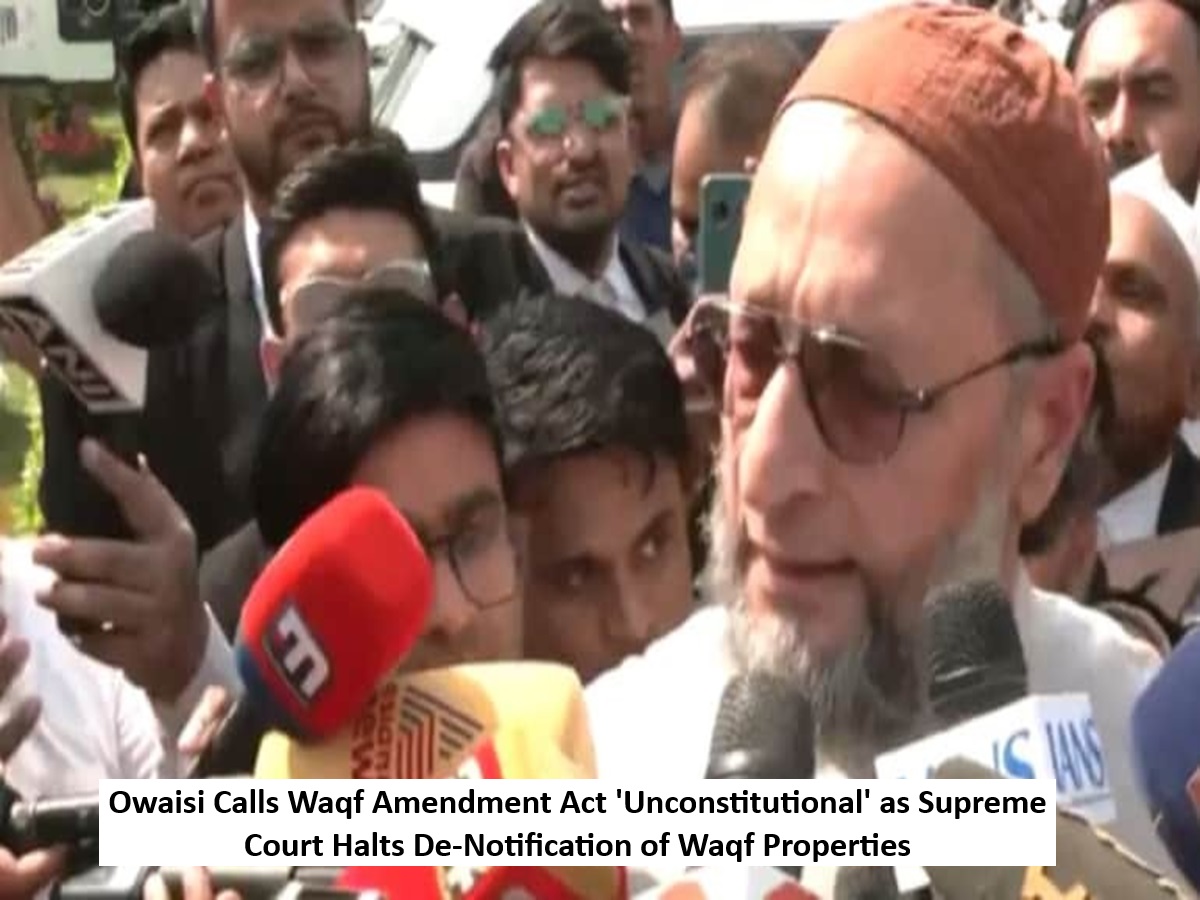
The Indian Supreme Court has restrained the government from de-notifying waqf properties, including the ones marked “waqf-by-user,” up until its next hearing on May 5. No Central or State Waqf Councils can be created temporarily as mandated by the Court, and non-Muslims remain barred from holding council positions.
These decisions all stemmed from 72 petitions filed against the Waqf (Amendment) Act, 2025, which was passed by Parliament and received the President’s consent on April 5.
Waqf Amendments Continue to Draw Strong Criticism
Leading petitioner AIMIM MP Asaduddin Owaisi termed the Act as constitutionally flawed. He argued that he tried to contest the amendments in the Joint Parliamentary Committee (JPC) and floor of the chamber debate. Owaisi stressed that resisting the Act will continue in courts, which he welcomed along with the motion issued in interim directions.
He specifically noted that the Order serves the purpose of halting the removal of waqf property and the execution of executive powers as set forth in the amended Act.
- Waqf-by-user Clause and Governance Structure Concerns.
The recent changes have sparked debate for allowing the de-notification of properties previously used for religious purposes under “waqf-by-user” cap. Protesters argue that this further diminishes communally managed waqf assets most of which have been in some form of use, for charitable purposes, for many years.
The Act also drew concern for permitting non-Muslim appointment to waqf bodies which has now been curbed by the apex court.
- Major Political and Legal Backlash
Alongside Owaisi, the All India Muslim Personal Law Board (AIMPLB), Jamiat Ulama-i-Hind, DMK, and Congress MPs Imran Pratapgarhi and Mohammad Jawed filed sie Petition X. This diverse political and institutional opposition clearly shows that the India’s future governance and control of waqf properties in India is deeply perceived to be in danger.
During the sessions, the bill was met with fierce opposition; logging the Lok Sabha at 128-232 to support and opposition votes respectively. While the Rajya Sabha passed the bill with a ratio of 128 votes for and 95 against.
Awaiting The Government’s Response: Next Step
One week time was given by the Chief Justice of India Sanjiv Khanna for the Center to submit a detailed answer. The concluding judgement might profoundly impact land ownership, governance by minorities, and constitutionally defined freedoms of religion.
Read More: Shocker for AIUDF: Sitting MLA Aminul Islam Jumps Ship to Congress Ahead of Assam Elections

_1593617143_100x75.jpg)

_1653126767_100x75.jpg)