Priyanka Tiwari
 Share
Share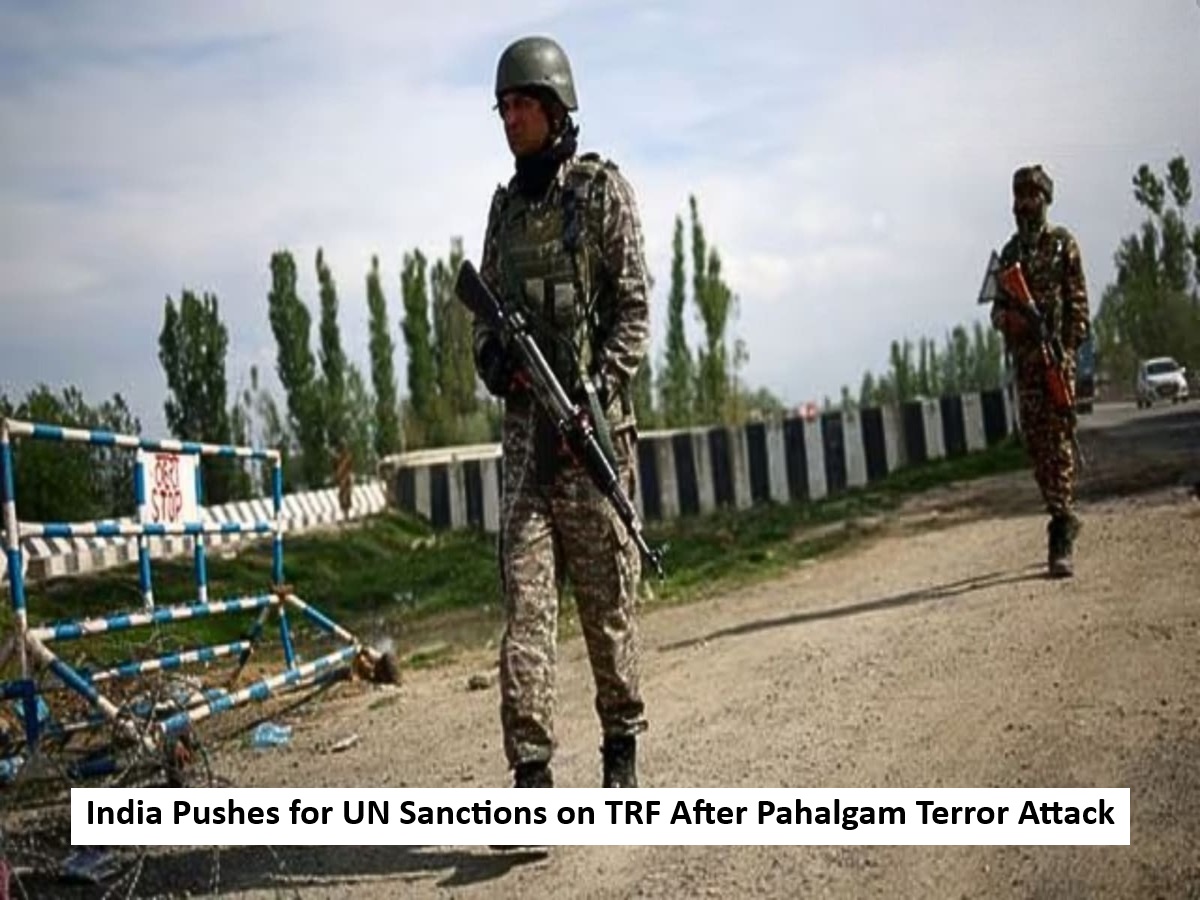
Suspense crime, Digital Desk : India has accelerated its diplomatic impetus at the United Nations to try and get The Resistance Front (TRF) placed as a globally designated terrorist organization. TRF, a terrorist organization that operates as a front for Pakistan’s Lashkar-e-Taiba, had taken responsibility for the April 22 Pahalgam, Jammu and Kashmir attack which killed 26 people.
Indian Delegation Meets UN Counter-Terrorism Officials
An Indian delegation engaged with representatives from the UN Office of Counter Terrorism (UNOCT), Counter Terrorism Committee Executive Directorate (CTED), and 1267 Sanctions Committee Monitoring Team in New York on Wednesday. These meetings dealt with reinforcing synergies and advocating for the terrorist designation of TRF.
UN's Voronkov and Gherman Expressed Sympathy
In response to India's allegations, UN Under-Secretary-General Vladimir Voronkov and Assistant Secretary-General Natalia Gherman remarked, offering sympathy to the victim's families while underlining a constructive collaborative framework with India following the brief.
Pakistan’s Diplomatic Maneuvering
The statement made by the United Nations Security Council on April 25, condemning the attack in Pahalgam did not mention the TRF, and this, according to Indian officials is a result of Pakistani interference. Indian authorities have pointed fingers at Pakistan’s persistent attempts to provide diplomatic cover for entities masquerading as proscribed terrorist organizations.
Vikram Misri, the Foreign Secretary of India, stated the country’s previous submissions to the 1267 Sanctions Committee, which includes intelligence from May and November 2024 regarding TRF’s structure and its affiliation with LeT. Intelligence from December 2023 describing proxy operations by LeT and Jaish-e-Mohammad also falls under this categorization.
India’s Counter Offensive: Operation Sindoor
Also known as Operation Sindoor, India’s military retaliation the Pahalgam massacre was an airstrike operation against terror infrastructure in Pakistan and Pakistan Occupied Kashmir. This operation was characterized as a precise strike on TRF’s terror infrastructure and other parent groups.
Focus on Counter Terrorism Cooperation
Other agenda topics included India’s involvement in aiding UNOCT capacity-building programs and countering terror financing, especially in the areas of:
Tracking terrorist’ movement across international borders, establishing cybersecurity powers, aiding victims of terror, addressing exploitation of drones and fintech by terrorist groups.
These align with the 2022 Delhi Declaration issued during an Indian presidency in the Counter Terrorism Committee and the recent non-binding principles targeting new emerging threats.
The UN Sanctions Process and Pakistan's Position
Enforced by all 15 members of the UN Security Council, the 1267 ISIL (Da'esh)/Al-Qaida Sanctions Committee requires a consensus for adding entities to the sanction list. Pakistan, set to become a non-permanent member in 2025, is poised to assume the Council Presidency in July, raising troubling questions about counter-terrorism policies stemming from his engagement.
Sanctioned individuals and groups face freeze on assets, arms embargoes, and travel restrictions which make TRF’s inclusion siginificant to India's international counter-terrorism policy.
Read More: Assam Elections 2026: Akhilesh Yadav Slams Himanta Biswa Sarma Over ‘Beef Statement’ Controversy