
 Priyanka Tiwari
 Share
Share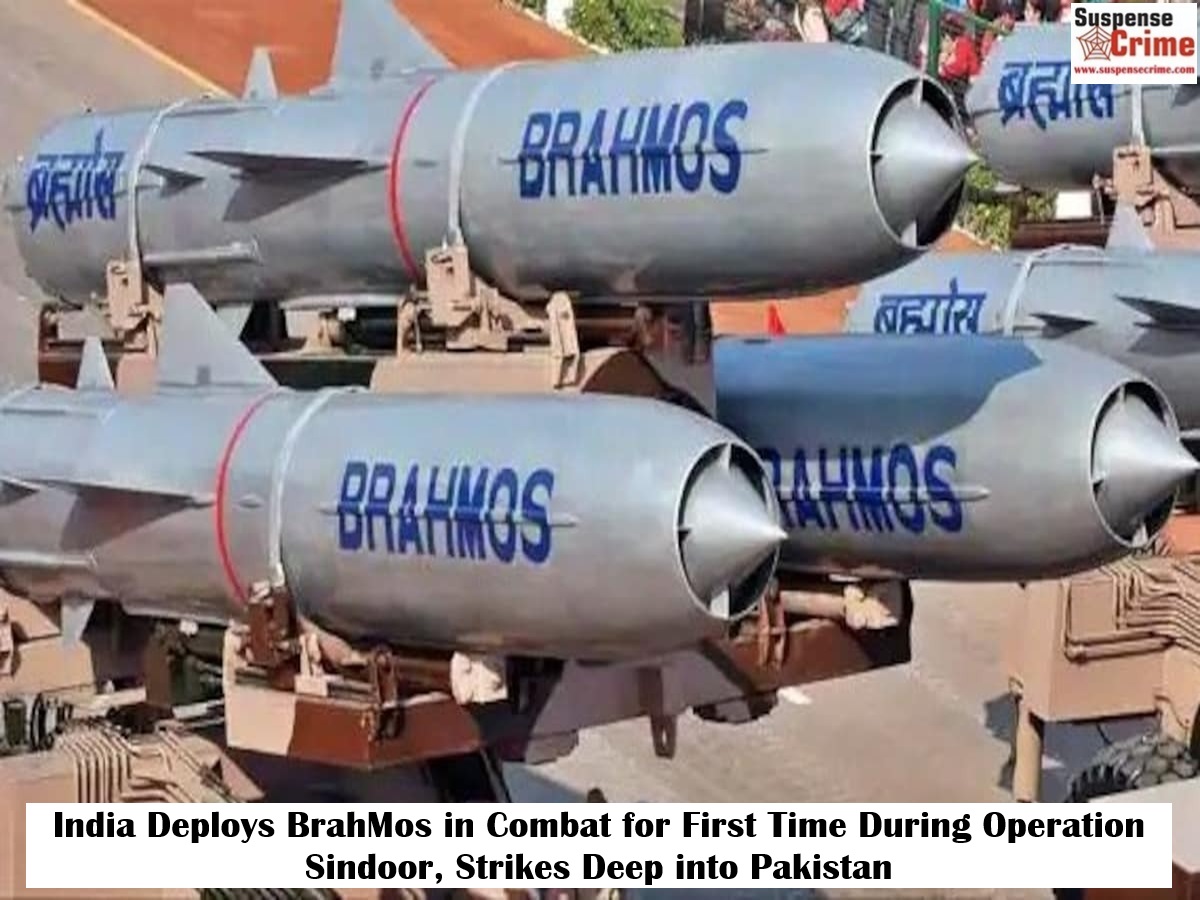
Suspense crime, Digital Desk : The combat debut of India’s BrahMos supersonic cruise missile has officially come into service. It was used between 7-10 during Operation Sindoor where it aimed at strategic Pakistani military installations as India’s military response post the devastating Pahalgam terror attack which also claimed several lives.
With this boasting use of the missile, apparantly for the first time with live fire, during an actual military operation, BrahMos crossed the threshold from being managed as a deterrent to an operational combat weapon.
BrahMos: From Deterrent to Operational Force
BrahMos, which is claimed to be the fastest cruise missile in the world, was developed under a joint initiative of Russia and India. This is due to the capsule it carries which can be activated to supersonic speed. Its speed is claimed to reach Mach 3 with a maximum range of over 400 km. The missile is built with modern stealth technology and boasts low visibility on radar. In conjunction with these factors, air defences won't be able to stop the missile.
For Atul D Rane, he was the Director General of BrahMos Aerospace, stated his views which claimed the cross-section at which the missile is picked off is nearly impossible claiming like other technologies are reshaping weapon systems gives rise to new names such as Hittile known World’s Hittile.
Sindoor’s Operation: Combat Debut
As of now BrahMos has an attached duty to target set deep inside Pakistan hitting approximately 100 km inside the territory, along with the possibility of expanded previous strike limits. This Operation is meant to retaliate against unprovoked attacks such as the Pahalgam attack that resides 26 km away from India.
While speaking at a rally in Kanpur, Prime Minister Narendra Modi remarked:
“ Our Armed Forces showed such bravery that the Pakistan Army started begging them after the war to please get them to stop fighting… BrahMos was key to their sleepless nights.”
Amit Shah, as Home Minister, shared that Indian forces boldly bypassed strategic doubts and directly targeted Pakistani air bases. Moreover, he stressed the fact that air defense systems given to them by the Chinese literally did nothing as the BrahMos missiles crushed them.
Indigenous Development and Engineering Milestones
BrahMos indigenization has BrahMos has undergone significant since its inception. It has now indigenously maintained 84% of it’s content, growing from 7%, which effectively marks it as a figure of ‘Make in India’ in the country’s defense industry.
Like its integration to the Su-30MKI of the Indian Air Force which made BrahMos the heaviest missile to be fitted on an Indian jet fighter. More than 200 engineers from HAL and other institutions participated of this project which is a major accomplishment of the country.
Moreover, BrahMos is active across various platforms:
- Naval Ships
- Fighter Aircraft (Su-30MKI)
- Army Mobile Launchers
Upcoming variants are BrahMos-NG (Next Gen) – intended for lighter aircraft such as Tejas, Hypersonic BrahMos – still in the development phase.
Strategic Shift of India’s Defense Posture
Operation Sindoor is considered a landmark in India’s counter-terrorism policy. It is the first time India has:
Implemented active combat utilization of BrahMos
Attacked air bases situated in Pakistani territory
Integrated “homegrown”” supersonic missile, Asserted supremacy over hostile supersonic defenses.
Shah affirmed that the operation successfully dismantled several terror hubs, which were utilized for cross-border aggression.
Read More: FTA Warns of Massive Flight Crisis, TMC Alleges BJP’s Death Threat Against Mamata Banerjee