










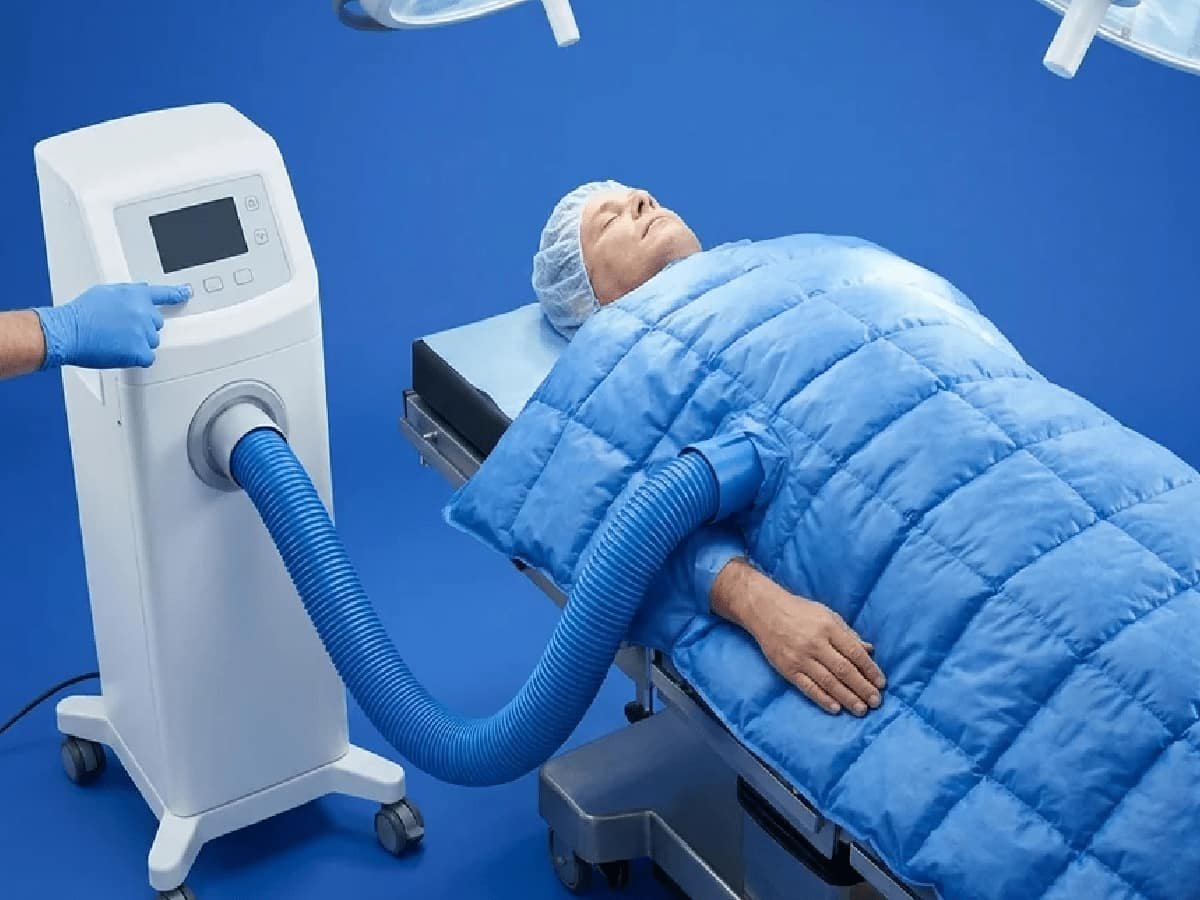
New ICU Warm Air Machine Shows Exact Temperature Reaching Patients
Maintaining a stable core body temperature is one of the most critical—yet easily overlooked—priorities inside hospital Intensive Care Units (ICUs), operating theaters (OTs), and trauma centers. When patients undergo prolonged surgery, suffer severe trauma, or battle critical illness, their body temperature can drop rapidly, triggering perioperative hypothermia—a complication linked to slower recovery, cardiac stress, and higher surgical-site infection risks. Addressing this clinical challenge with indigenous medical engineering, Pune-based Pharmacle Healthcare Private Limited (operating under its Wallabies Warm Care brand) has developed a specialized forced-air patient warming system engineered to deliver controlled, sterile warm air safely to vulnerable patients. While some families also use controlled warming units at home to keep frail elderly relatives comfortable during severe winter spells, company representative Rajesh Rathod emphasized that the system is fundamentally built as a precision clinical device rather than an ordinary domestic room heater. For doctors, hospital administrators, patients, and families across northern India—including healthcare hubs and households in Uttar Pradesh cities such as Unnao, Kanpur, Lucknow, Prayagraj, and Varanasi—the domestically manufactured system showcases how Indian med-tech is advancing critical-care safety.
Dual-Sensor Hose Design Solves the '40-Degree Gap'
A standout engineering feature of the machine is its dual temperature sensor architecture built directly into the air-delivery hose. As Rajesh Rathod explained, conventional patient warmers typically display only the target temperature selected on the control panel—for instance, 40°C. However, as warm air travels through a long delivery tube toward a patient's blanket, heat loss along the hose means the air actually reaching the patient's body can be noticeably cooler than the set figure.
To eliminate that guesswork for doctors and nursing staff, Pharmacle Healthcare installed two precision temperature sensors along the hose—one near the machine's outlet at the start of the tube and a second sensor at the far end where the air enters the warming blanket. As a result, the device's digital display shows both the set target temperature and the real-time temperature at the patient end of the hose, giving clinicians accurate confirmation of thermal delivery alongside automatic high- and low-temperature safety alarms.
Smart 1,000-Hour HEPA Filter Tracking and Sterile Blankets
Because air blown directly over surgical and ICU patients must meet strict infection-control standards, the warming unit incorporates a 0.2-micron H13 HEPA filter (meeting high-efficiency MERV 14+ particulate standards) capable of trapping airborne contaminants. Rather than leaving maintenance teams guessing when a filter is nearing saturation, the machine continuously logs cumulative filter usage hours on its screen.
Since the HEPA filter is scheduled for replacement roughly every 1,000 operating hours (or 12 months), nursing and biomedical teams can see when usage reaches 800, 850, or 900 hours and schedule replacement parts proactively—preventing unexpected downtime during emergencies. Alongside the main unit, the company manufactures single-use, latex-free, non-woven warming blankets tailored for both adult and pediatric clinical needs:
| Clinical Warming Blanket Variant | Primary Hospital Application |
| Full-Body Blanket (Adult & Pediatric) | Comprehensive neck-to-toe warming in ICUs, recovery wards, and pre-op suites |
| Upper-Body & Lower-Body Blankets | Targeted thermal coverage during procedures on the opposite half of the body |
| Surgical & Abdominal Access Blankets | Features sterile central or site-specific openings so surgeons can operate while surrounding tissue stays warm |
| Under-Body Blanket | Provides gentle convective warmth from beneath the patient during complex surgeries |
Flexible Mounting and Retractable 3-Meter Hose for Busy Wards
Designed for cramped intensive-care bays and fast-paced operating suites, the compact unit offers versatile stacking and mounting options—allowing staff to clamp it securely onto an IV pole, hook it onto a hospital bed railing, or rest it on a flat tabletop or trolley. Its flexible delivery hose extends roughly 2.5 to 3 meters to reach patients comfortably across bedside equipment and retracts neatly once therapy ends, keeping clinical workspaces uncluttered and safe for medical teams.






