
 Priyanka Tiwari
 Share
Share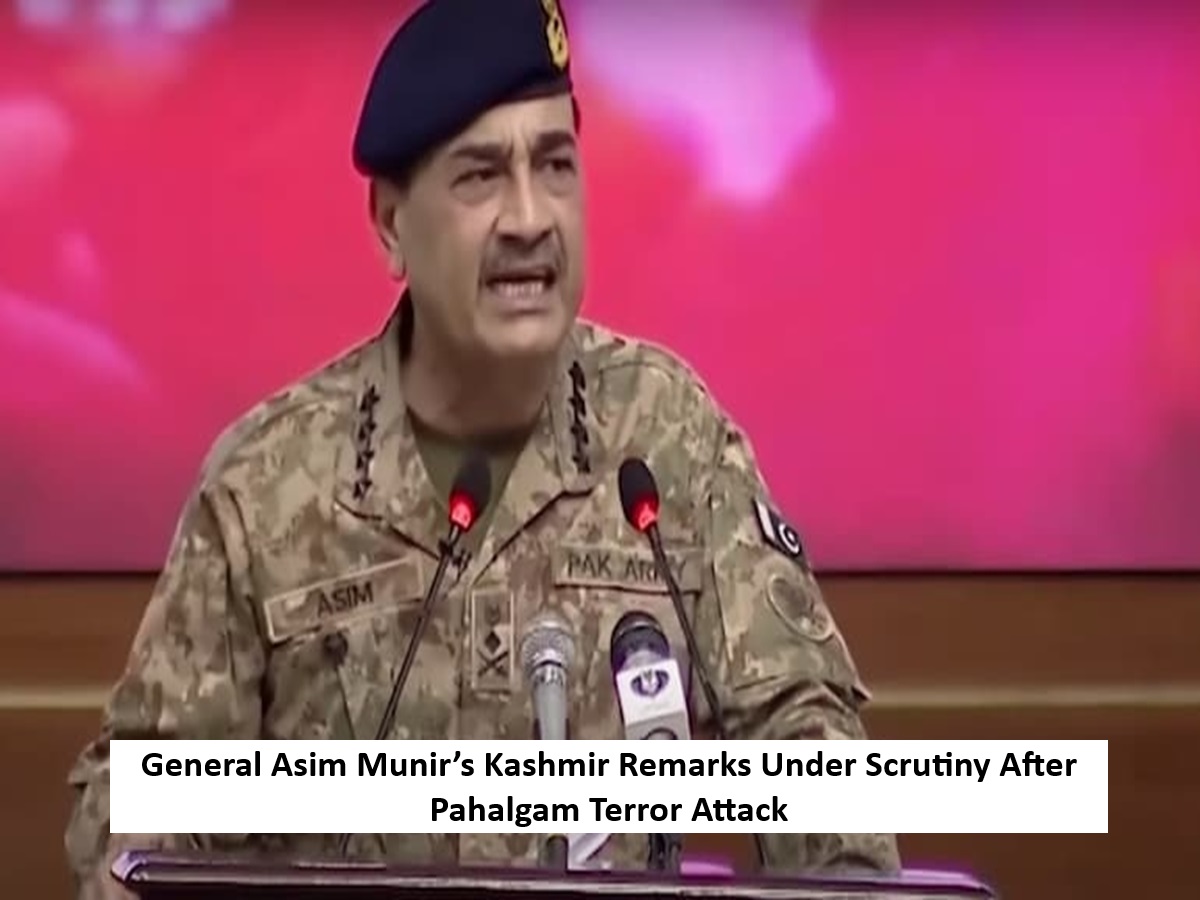
The controversial speech by Pakistan Army Chief General Asim Munir sparked even more concern with his undue connection to militant activities following the recent terror attack in Pahalgam, Jammu and Kashmir which took the lives of 26 civilians.
General Munir spoke of Kashmir as “the jugular vein of Pakistan” and also renewed focus on the two-nation theory on a call with overseas Pakistanis. He went on to say that “Pakistani’s stance on Kashmir is unchanged” and proclaimed support for what he refers to as the “region’s struggle.”
Indian security forces are now viewing these statements as a point of incitement for the terror attack in Pahalgam, especially after the death of 26 civilians. This attack also coincided with the visit of American Vice President JD Vance to India, which some perceive as a strategically deliberate attempt to garner international attention.
Key Concerns Raised by Indian Intelligence Agencies
Overseas calls are extremely hard to track and so Indian intelligence supports Munir’s remarks being a tacit call to more extreme parts of society.
Factors like the two-nation theory and Munir’s focus on civilizational division are regarded as a form of social incitement.
With the current internal political conflict, any rise in anti-Hindu sentiments is interpreted as a push for cross-border terrorist activities.
The government thinks that the group that has claimed responsibility for the attack in Pahalgam, called The Resistance Front (TRF), is a renamed version of Lashkar-e-Taiba (LeT). TRF is alleged to have been formed to provide Lashkar's operations with a more secular facade, hiding Pakistani links while avoiding religious terminology.
Since TRF’s establishment, which took place in 2019, the group has operated through the internet, using social media to target young recruits, spread propaganda, and enable the smuggling of arms and militants into India. Officials claim that TRF’s activities are meant to serve LeT's objectives under a different label, with most of its operations based out of Pakistan.
Experts believe this form of rebranding was an attempt to evade increasing scrutiny directed towards conventional terrorist organizations such as LeT and Jaish-e-Mohammed. Terms associated with religion were stripped to sidestep condemnation and plausible deniability for state sponsorship.
With the technology still underway, Indian officials are watching the inflow of global diplomatic visits and policy changes as they relate to the Kashmir conflict, particularly its effect on regional stability.
_1570701464_100x75.jpg)
_1563449287_100x75.jpg)

_1025409548_100x75.jpg)
_1681775372_100x75.jfif)