Priyanka Tiwari
 Share
Share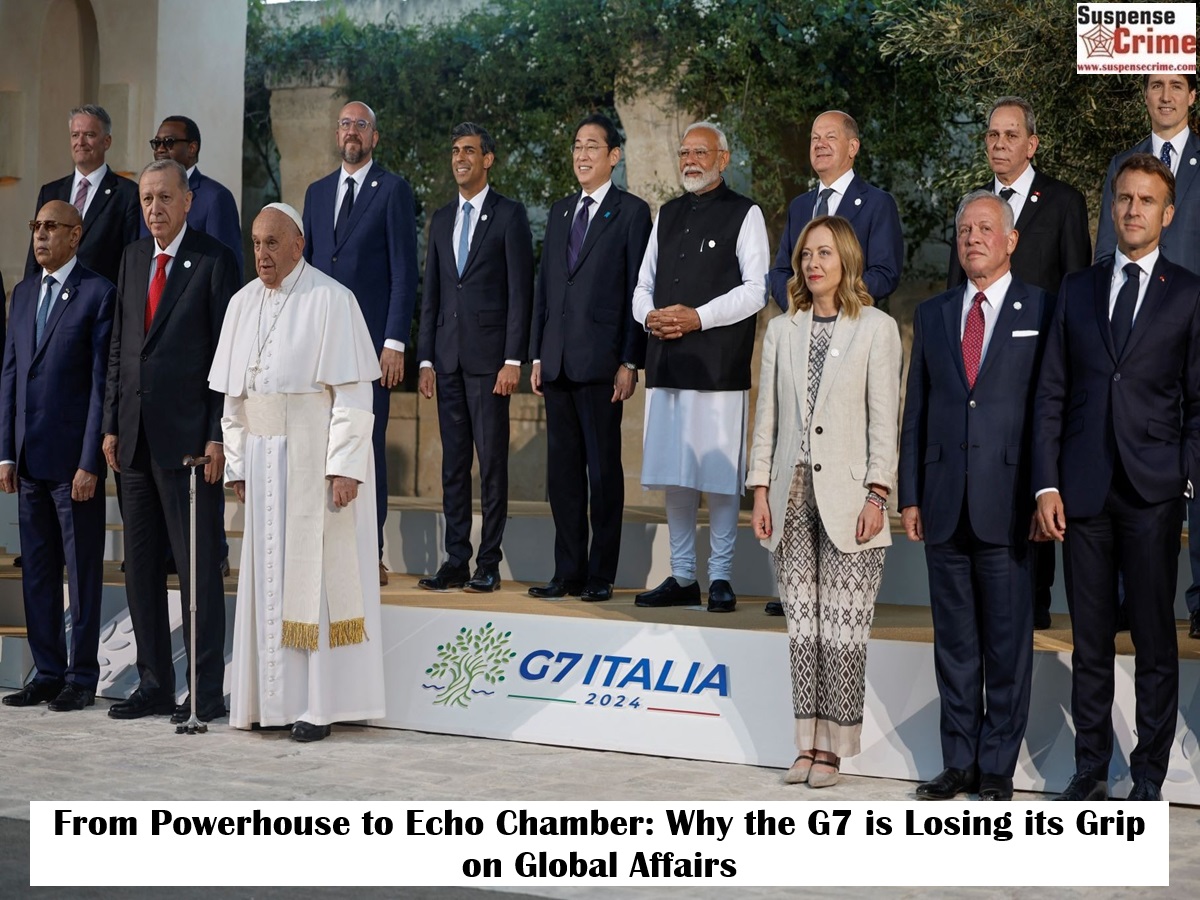
Suspense crime, Digital Desk : Once the undisputed steering committee for the global economy, the Group of Seven (G7) is now facing an identity crisis. As the leaders of the world’s wealthiest Western democracies meet, they are confronted by a stark reality: their power is waning, their solutions feel inadequate, and their relevance is being questioned on the world stage.
Decades ago, the G7 nations—the US, UK, Canada, France, Germany, Italy, and Japan—represented over two-thirds of the world's GDP. Today, that figure has plummeted to under 45%, and it continues to shrink. The economic and political gravity has shifted towards a multipolar world, with rising powers like China, India, and Brazil now essential to solving any global problem. Yet, these crucial players remain outside the G7's exclusive doors.
This exclusivity is the G7’s biggest weakness. While the group is effective at coordinating policy among like-minded allies, it struggles to deliver decisive action on today's most pressing global crises. Whether it’s the war in Ukraine, the conflict in Gaza, or the existential threat of climate change, the G7's declarations often sound more like hopeful statements than concrete plans. For example, their ambitious proposal to use profits from frozen Russian assets to aid Ukraine is bogged down by legal complexities and internal disagreements, highlighting a gap between rhetoric and reality.
In contrast, more inclusive forums like the G20—which includes the G7 members alongside nations like China, India, Russia, and Brazil—are increasingly seen as the more effective platform for tackling global economic issues. The G20 represents the world as it is, not as it was. It forces dialogue between competing powers, making it a more pragmatic, if more contentious, arena for global governance.
The G7 now finds itself at a crossroads. It can continue to function as a caucus for the West, aligning its members on shared values and security concerns. However, it can no longer credibly claim to be the primary architect of the global order. Without adapting to the new distribution of power, the G7 risks becoming little more than an echo chamber—a club of rich nations talking amongst themselves while the world's most critical problems demand a larger, more diverse table.
_1359883337_100x75.jpg)
_1550774716_100x75.jpg)
_518702411_100x75.jpg)