










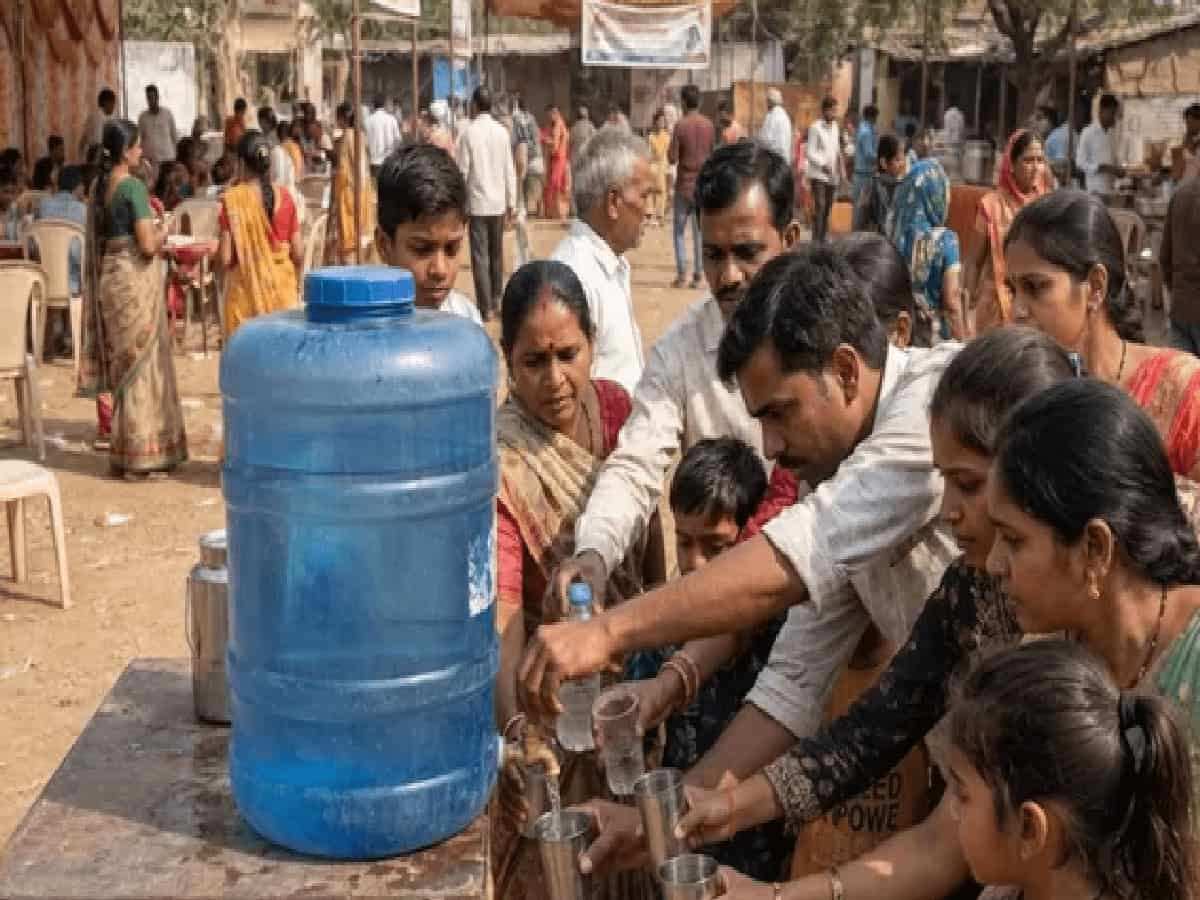
Plastic Water Jars at Weddings & Fairs Can Trigger Serious Illness
As the winter wedding season, community feasts, and local fairs gather pace across India, rows of large blue plastic and fiber water jars fitted with a single bottom tap have become a familiar fixture at banquet lawns, village marquees, and crowded festival grounds. While setting up a few refillable dispenser jars is an inexpensive and convenient way to serve hundreds—or even thousands—of guests over several hours, medical practitioners and water-quality specialists warn that neglecting jar sanitization, water-source verification, and hygienic dispensing can quietly turn a routine drink of water into a major public-health hazard. At many gatherings, large water containers sit outdoors in open sun for hours with no clear record of where the water was filled, when the interior walls or rubber seals were scrubbed, or whether any disinfection took place. When hundreds of unwashed hands repeatedly press the same tap nozzle—or when guests touch glass rims directly to the spout without proper glass-washing facilities—the risk of gastrointestinal and waterborne infections climbs sharply. For families hosting or attending weddings, religious bhandaras, and seasonal fairs across northern India—including bustling wedding and festival circuits in Lucknow and neighboring Uttar Pradesh cities such as Unnao, Kanpur, Prayagraj, and Varanasi, where late-November and December marriage dates bring massive guest turnouts—paying close attention to drinking-water hygiene can prevent sudden post-event illness outbreaks.
Why Shared Event Water Jars Become Breeding Grounds for Infection
Simply sharing a water tap does not automatically contaminate the water sealed inside a tank; rather, infection risk depends on how clean the water source is, how thoroughly the container is scrubbed between events, and how glasses and spouts are handled during service. Attendees at recent social functions in Bilaspur noted instances where water drawn from a single plastic jar tasted stale and lukewarm after sitting out all day, while venues lacked dedicated washing arrangements for reusable tumblers.
According to Dr. Lakhan Singh (MD Medicine), storing water in poorly cleaned plastic jars over extended hours allows biofilm and organic matter to accumulate inside crevices and tap valves, enabling harmful pathogens such as Escherichia coli (E. coli) and Salmonella typhi to multiply. Ingesting contaminated water can trigger acute vomiting, watery diarrhea, severe enteritis, dysentery, typhoid fever, cholera, and viral hepatitis A and E.
Bureau of Indian Standards (BIS) Water Limits vs. Microbiological Safety
Many event organizers rely solely on a quick pocket-meter reading of Total Dissolved Solids (TDS) to judge water safety, yet Bureau of Indian Standards (BIS IS 10500) specifications make clear that chemical parameters alone never guarantee bacterial purity:
| Water Quality Parameter | BIS IS 10500 Acceptable Limit | What It Measures & Why It Matters at Events |
| Total Dissolved Solids (TDS) | Up to 500 mg/L (~500 ppm) | Measures dissolved salts and minerals; acceptable TDS does not rule out bacteria or viruses. |
| pH Value | 6.5 to 8.5 (no relaxation) | Indicates acidity/alkalinity balance and affects disinfection efficiency. |
| Microbiological Purity (E. coli / Coliforms) | Absent (0 CFU) in 100 mL | Mandatory benchmark confirming water is free from fecal and pathogenic bacterial contamination. |
How Preliminary H2S Field Kits and Proper Sanitization Protect Guests
Explaining practical screening methods, Iti Gupta, Assistant Professor in the Department of Botany at C.M. Dubey Postgraduate College, Bilaspur, notes that a preliminary hydrogen sulfide ($H_2S$) field test vial can flag suspicious water before large-scale distribution. When a sterile $H_2S$ vial is filled with sample water, capped tightly, and stored at the prescribed temperature for the recommended incubation window, the water turning black or forming a black sediment signals likely microbial or sulfide-producing contamination. While a clear $H_2S$ vial does not replace full laboratory bacteriological testing, any water showing discoloration should never be served without certified disinfection or prescribed chlorination.
For event hosts and caterers, simple precautions—sourcing sealed, ISI-certified water jars from verified suppliers, keeping dispensers shaded off the ground, providing disposable paper cups or sanitized tumblers, and ensuring servers operate taps cleanly—offer reliable protection for every guest.






