FD Interest Above Rs 1 Lakh for Senior Citizens: Will the bank deduct TDS? Check calculations on Rs 5- 15 lakh investment
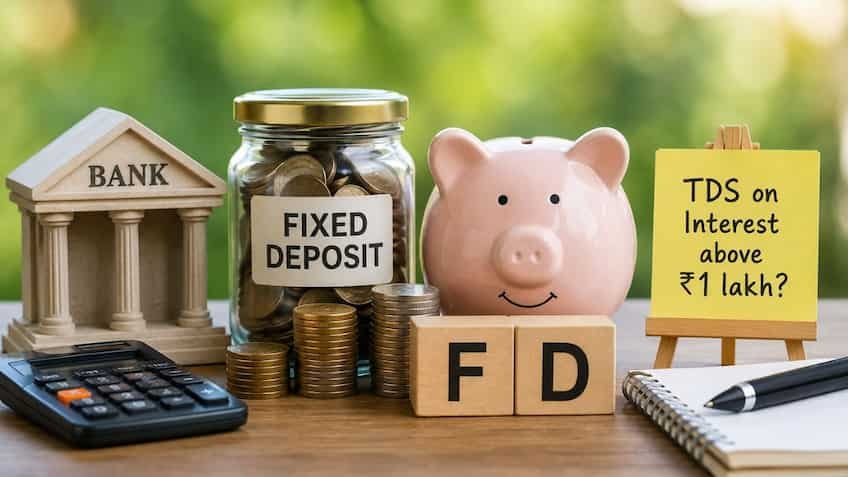
Fixed deposit (FD) provides guaranteed returns; therefore, it is one of the favourite investment options for senior citizens. There is no market risk involved. Moreover, senior citizens get a higher FD interest rate than general citizens. However, once the interest earned from deposits exceeds a certain threshold, Tax Deducted at Source, (TDS) may come into play.
For resident senior citizens, the TDS threshold on interest paid by banks is currently Rs 1 lakh during a year.
Senior citizen FD TDS limit: What is the Rs 1 lakh rule?
If the total eligible interest paid or credited by a bank to a resident senior citizen does not exceed Rs 1 lakh during the year, TDS is generally not required.
However, if the interest crosses Rs 1 lakh, the bank can deduct TDS. The normal TDS rate on such interest for a resident is 10 per cent.
One important point is that Rs 1 lakh is only the threshold for TDS. It does not mean that the first Rs 1 lakh of FD interest is automatically tax-free.
What happens if interest is above Rs 1 lakh?
Many depositors assume that if they earn Rs 1.10 lakh interest, TDS will be deducted only on the extra Rs 10,000. That is not how the threshold generally works.
Once the annual interest exceeds the applicable limit, TDS is deducted on the entire amount of interest amount, not merely on the portion above Rs 1 lakh. The Income Tax Department has also explained this point in its guidance on TDS on interest.
For example, if a senior citizen earns Rs 1.12 lakh in FD interest and the bank is required to deduct TDS at 10 per cent, the calculation would be on Rs 1.12 lakh.
Rs 5 lakh FD: Will TDS be deducted?
Let us first take an investment of Rs 5 lakh.
If the FD offers 7 per cent annual interest:
Annual interest = Rs 35,000
At 7.5 per cent:
Annual interest = Rs 37,500
At 8 per cent:
Annual interest = Rs 40,000
In all three examples, the annual interest remains well below the Rs 1 lakh TDS threshold.
Therefore, the bank would generally not deduct TDS solely on the interest from this FD interest.
Rs 10 lakh FD: Will a senior citizen pay TDS?
Now suppose a senior citizen invests Rs 10 lakh.
At 7 per cent interest:
Annual interest = Rs 70,000
At 7.5 per cent interest:
Annual interest = Rs 75,000
At 8 per cent interest:
Annual interest = Rs 80,000
Here again, the interest remains below Rs 1 lakh.
So, if this is the only relevant interest with that bank during the year, the TDS threshold would not be crossed.
However, the bank may also take into account interest from other eligible deposits held by the same customer with it.
Rs 15 lakh FD: TDS calculation
The situation changes when the deposit amount reaches Rs 15 lakh.
At 7 per cent:
Annual interest = Rs 1,05,000
Since the interest exceeds Rs 1 lakh, TDS can apply.
TDS at 10 per cent = Rs 10,500
At 7.5 per cent:
Annual interest = Rs 1,12,500
TDS at 10 per cent = Rs 11,250
At 8 per cent:
Annual interest = Rs 1,20,000
TDS at 10 per cent = Rs 12,000
This shows that a Rs 15 lakh FD can exceed the senior-citizen TDS limit even at an interest rate of around 7 per cent.
FD interest calculations
| Investment | Interest Rate | ||
| (In Rs) | 7% | 7.50% | 8% |
| Rs 5 lakh | Rs 35,000 | Rs 37,500 | Rs 40,000 |
| Rs 10 lakh | Rs 70,000 | Rs 75,000 | Rs 80,000 |
| Rs 15 lakh | Rs 1,05,000 | Rs 1,12,500 | Rs 1,20,000 |
At these assumed rates, Rs 5 lakh and Rs 10 lakh investments stay below the Rs 1 lakh threshold. A Rs 15 lakh deposit crosses it in all three examples.
Actual interest can differ depending on the bank's FD rate, tenure and compounding method.
Does splitting FDs across branches avoid TDS?
Usually, opening several FDs at different branches of the same bank will not give a separate Rs 1 lakh limit for every branch.
Where a bank uses Core Banking Solutions, the threshold is generally calculated with reference to the interest credited or paid by the bank rather than separately for individual branches.
Therefore, senior citizens should consider their total interest from deposits with the same bank when checking whether the TDS limit may be crossed.