


Yogi Claims 80 vs 20 Contest in UP, Eyes Third Term in 2027
_248972800.jpg)
Setting the ideological and electoral tone well ahead of the crucial 2027 Uttar Pradesh Assembly elections, Chief Minister Yogi Adityanath asserted that the forthcoming democratic contest in India’s most populous state will be an uncompromising fight of "80 versus 20". In an interview delivered over the Diwali weekend on Sunday, November 8, 2026, the Chief Minister declared that this numerical ratio will manifest in both voting patterns and assembly seats, expressing confidence that the Bharatiya Janata Party (BJP)-led National Democratic Alliance (NDA) will secure a historic third consecutive term in power. Pitching Prime Minister Narendra Modi’s development model against fragmented opposition alliances, Adityanath claimed that the state's youth and Gen-Z demographic stand firmly behind the double-engine administration. In an expansive interaction, the Chief Minister attacked Samajwadi Party (SP) chief Akhilesh Yadav, Congress leader Rahul Gandhi, and AIMIM president Asaduddin Owaisi, while addressing policy priorities ranging from large-scale recruitment drives and female economic welfare to voter list discrepancies and bulldozer-driven law enforcement.
The 80 vs 20 Formula: Setting the 2027 Assembly Agenda
Reiterating his political formulation that first surfaced during the 2022 assembly elections, Chief Minister Yogi Adityanath framed the upcoming 2027 electoral battle around governance delivery, public security, and cultural heritage versus opposition appeasement. Adityanath emphasized that the NDA enters the ring with an unshakeable support base committed to progress and public order.
"The 2027 assembly elections will once again be an 80 versus 20 battle, and this ratio will reflect clearly both in the voting percentages and in the assembly seat distribution," Adityanath stated. "We are disciplined followers of Prime Minister Narendra Modi and work under his leadership and guidance. We carry no personal agenda. Our administration is taking forward the civilizational journey of heritage and development selflessly."
The Chief Minister asserted that Uttar Pradesh had permanently shed its historic tag as a lagging, economically stagnant state to become one of the top three economic engines of India, setting an ambitious near-term target of transforming the state into the country's single largest sub-national economy.
Sharp Attack on Opposition: Akhilesh, Rahul Gandhi, and Owaisi Targeted
Directing sharp criticism at the opposition bloc, Chief Minister Yogi Adityanath took aim at the Samajwadi Party's much-touted "PDA" (Pichhde, Dalit, Alpsankhyak) social formulation, deriding it as nothing more than a "Parivar Development Authority" (Family Development Authority) designed to amass personal wealth. Pointing to legislative choices, Adityanath argued that when given the opportunity in Rajya Sabha nominations, the SP bypassed grassroots workers to nominate close family members like Professor Ram Gopal Yadav or wealthy corporate figures from Mumbai.
Adityanath also addressed remarks from AIMIM chief Asaduddin Owaisi regarding prospective minority political leadership, asserting that ambitions for a sectarian chief minister or a burqa-clad prime minister would remain unfulfilled indefinitely. Branding the Samajwadi Party, Congress, and AIMIM as birds of the same ideological feather, the Chief Minister also rebuked Rahul Gandhi's parliamentary conduct. "In a constitutional democracy, the primary forum for debate and accountability is Parliament, not theatrical street protests," Adityanath said, accusing the Leader of Opposition of disrespecting democratic institutions through repeated walkouts and traveling abroad whenever national crises emerge.
Ayodhya Is Personal Faith, Not an Election Card: Condition on Akhilesh's Visit
Addressing the controversy surrounding Akhilesh Yadav's proposed visit to the Ram Janmabhoomi Temple on December 12, Chief Minister Adityanath stated that while the holy city of Ayodhya is open to all seekers of divine grace, entry requires a pure heart and genuine repentance. He called upon the SP chief to issue a public apology for the 1990 firing on unarmed karsevaks and the prolonged administrative neglect of the holy city during successive Samajwadi tenures.
"The Ram Janmabhoomi complex honors Maharishi Valmiki, Brahmarshi Vishwamitra, Goswami Tulsidas, Mata Shabari, Nishadraj, and the noble vulture King Jatayu," Adityanath noted. "There is neither a place nor any memorial for Ravana, Maricha, Subahu, or Tadka in Ayodhya. Why, then, do their followers insist on coming here?"
Dismissing speculation regarding his own electoral seat, the Chief Minister clarified that Ayodhya is not an electoral stepping stone, but a foundational article of personal faith. He highlighted that the Gorakshapeeth had actively spearheaded the Shri Ram Janmabhoomi movement decades before independent India held its first general elections, with his predecessors bridging Shaivite and Vaishnavite spiritual traditions to restore the civilizational glory of the Suryavanshi capital.
Missing Voters Claim: Discrepancy in 1.27 Crore Names Submitted to EC
Raising a procedural issue regarding electoral rolls, Chief Minister Adityanath made a claim regarding voter registrations across the state. He alleged that approximately 1.27 crore (12.7 million) Hindu voters currently registered on the State Election Commission's rural panchayat electoral rolls are missing from the Election Commission of India’s (ECI) legislative assembly voter registers.
Detailing the demographic makeup of these excluded names, Adityanath pointed out:
Welfare Beneficiaries: Over 55 lakh (5.5 million) citizens excluded from the general roll are documented recipients of central and state welfare initiatives.
First-Time Youth Voters: An estimated 4.5 lakh young citizens aged 18 to 19 years are reportedly absent from the assembly database despite holding valid panchayat documentation.
Memorandum Filed: The Chief Minister confirmed that formal documentation, ground evidence, and a legal memorandum have been submitted to the Election Commission demanding the immediate enrollment of eligible citizens while purging illegal foreign infiltrators from electoral registers.
Massive Governance Push: 9.5 Lakh Government Jobs and ₹36 Lakh Crore Vision
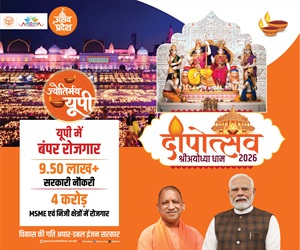
Balancing his political counter-offensive with administrative scorecards, Adityanath outlined the scale of public recruitment executed under his tenure since 2017. He claimed that the BJP double-engine government has delivered over 9.5 lakh government appointments—more than doubling the cumulative appointments made during four previous Samajwadi Party tenures combined.
The Chief Minister revealed that active recruitment drives for 32,000 police constables, 42,000 home guards, and roughly 25,000 ancillary administrative posts are in advanced stages, with formal appointment letters scheduled for distribution across November and December. He also announced that an economic self-reliance welfare program targeting 3.6 crore women will be launched under the expanded Mission Shakti framework, providing female heads of households with direct entrepreneurial capital and cooperative linkages.
Bulldozer Justice, Family Ethos, and Cultural Grandeur
Defending his administration's use of bulldozers against organized crime networks, Adityanath rejected claims of administrative overreach, characterizing the mechanism as swift, targeted action to dismantle the empires of land mafias and criminal syndicates who challenge the judicial system. He emphasized that strict penal actions protect the poor, small shopkeepers, and public land from illegal encroachment.
Addressing personal questions regarding his elder sister operating a humble tea stall in their native Uttarakhand village, the Chief Minister stated simply: "I am a monk, a Yogi, and the 25 crore citizens of Uttar Pradesh are my only family." He lauded his sister for standing independently with self-respect rather than exploiting state privileges. Citing his annual tradition of celebrating Diwali with marginalized Vantangiya forest-dwelling families—who received formal village revenue recognition and voting rights under his governance—Adityanath reiterated his vision of taking governance and cultural pride to the last person in society, pointing to the illumination of over 70 lakh lamps across Ayodhya as a symbol of Uttar Pradesh’s economic and cultural resurgence.

_1453306282_351x234.jpg)
_1634728511_351x234.jpg)
_1106414423_351x234.jpg)
_1835019136_351x234.jpg)
_577111042_351x234.jpg)