Monsoon Meltdown: Newly Opened ₹12,000 Crore Delhi-Dehradun Expressway Caves In, Sparking Outrage and Rapid NHAI Suspension Orders
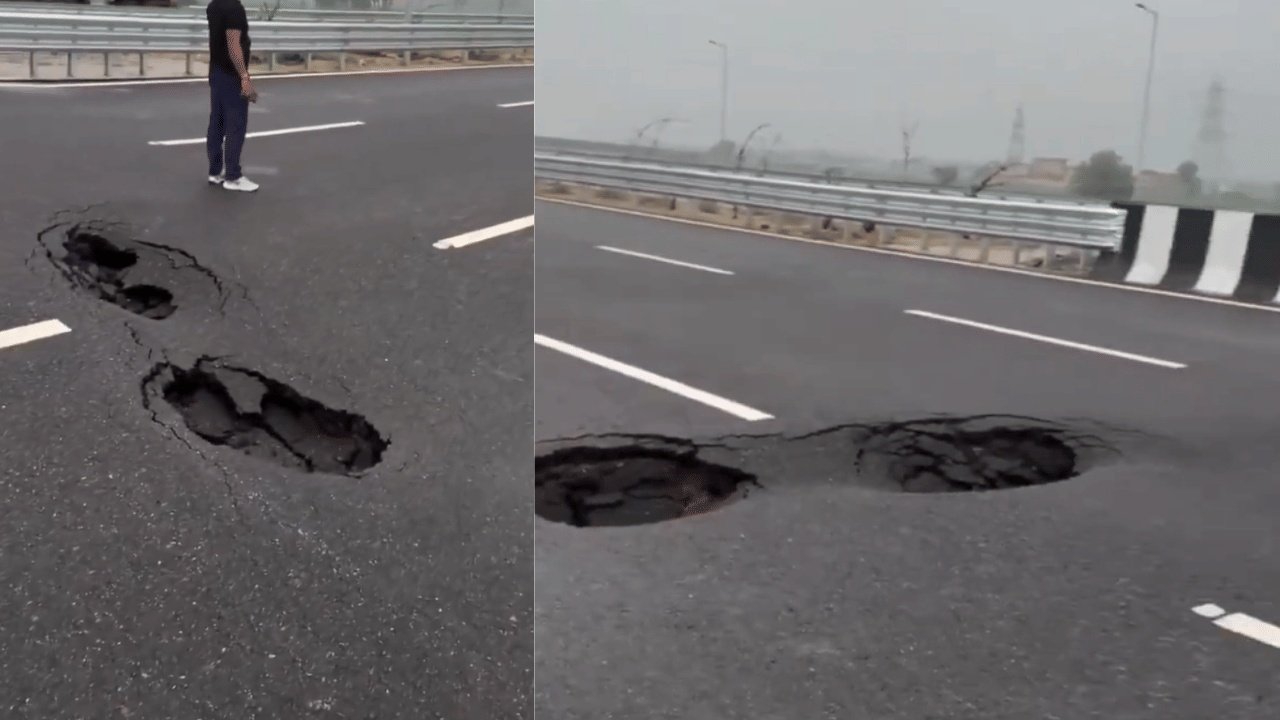
India's flagship infrastructure drive has hit a severe speed bump as the newly constructed Delhi-Dehradun Expressway faces intense structural scrutiny. Barely 80 days after its high-profile inauguration, the advanced six-lane transit corridor developed massive, alloy-wrecking potholes and localised sinkholes following its very first encounter with significant monsoon rainfall. The technical failure has sparked widespread public anger on social media and a political storm on Dalal Street, raising major questions about corporate engineering standards and project compliance.
Massive Potholes Near Shamli Cause Standoff and Vehicle Damage
The physical disruption unfolded near Hathi Karoda village in the Shamli district of Uttar Pradesh. The issue gained national traction after a distressed motorist uploaded live footage on Instagram and X showing gaping road depressions measuring nearly 1.5 feet deep and 3.5 feet wide.
Commuters reported that the sudden appearance of these craters in a high-speed zone caused four to five speeding vehicles to lose structural integrity right in front of them—the impacts left at least two premium cars stranded with severely bent alloy wheels and burst tyres. To prevent fatal high-speed collisions, shaken travellers were forced to stand on the active carriageway to warn oncoming traffic before emergency patrol teams arrived at the scene.
NHAI Crackdown: Project Management Suspended and Contractors Penalised
In response to widespread public backlash, the National Highways Authority of India (NHAI) launched an immediate administrative crackdown, signalling a zero-tolerance policy for execution lapses. The highway authority issued formal show-cause notices to the designated Project Director, the independent Authority Engineer, and the Engineering, Procurement, and Construction (EPC) contractor managing the asset. Furthermore, the NHAI ordered the immediate suspension of the Team Leader of the Authority Engineer and the Project Manager of the contracting firm.
Explaining the root cause behind the road failure, the NHAI issued a detailed technical statement attributing the collapse to severe water stagnation along the main carriageway:
Non-Operational Balancing Culvert: The balancing culvert at the location, engineered to drain rainwater across the highway lanes safely, could not be commissioned due to strong resistance from residents, who were using the open structure as an unauthorised vehicle crossing.
Pending Protection Works: We were unable to finalise the permanent slope protection and chute drain systems due to a prolonged, unresolved land acquisition dispute.
Interim Measures: While emergency repair crews have successfully patched the asphalt to restore normal traffic flow, engineers are constructing an emergency parallel drain spanning 1.5 kilometres to redirect monsoon runoff.
Opposition Steps Up Attack: 'Open Loot and Plunder' Alleged by Rival Parties
The sudden appearance of sinkholes on a ₹12,000 crore high-speed corridor has provided substantial ammunition to opposition parties, who have labelled the incident as direct proof of institutional corruption and poor quality controls.
National Congress spokesperson Dr Shama Mohamed launched a direct political attack on the central administration, stating on X, "What more proof of corruption do we need? It is open loot and plunder in every department." Simultaneously, the Aam Aadmi Party (AAP) circulated videos of the damaged stretch, mockingly pointing out that the landmark economic corridor failed to withstand even its first spell of seasonal rainfall, despite collecting steep tolls from the public. Strategic analysts emphasise that as the monsoon's active phase deepens across North India, the NHAI faces a tight window to conduct audits of the remaining stretches to prevent similar infrastructure failures.





_1587178762_351x234.jpg)
_305727748_351x234.jpg)