
 Priyanka Tiwari
 Share
Share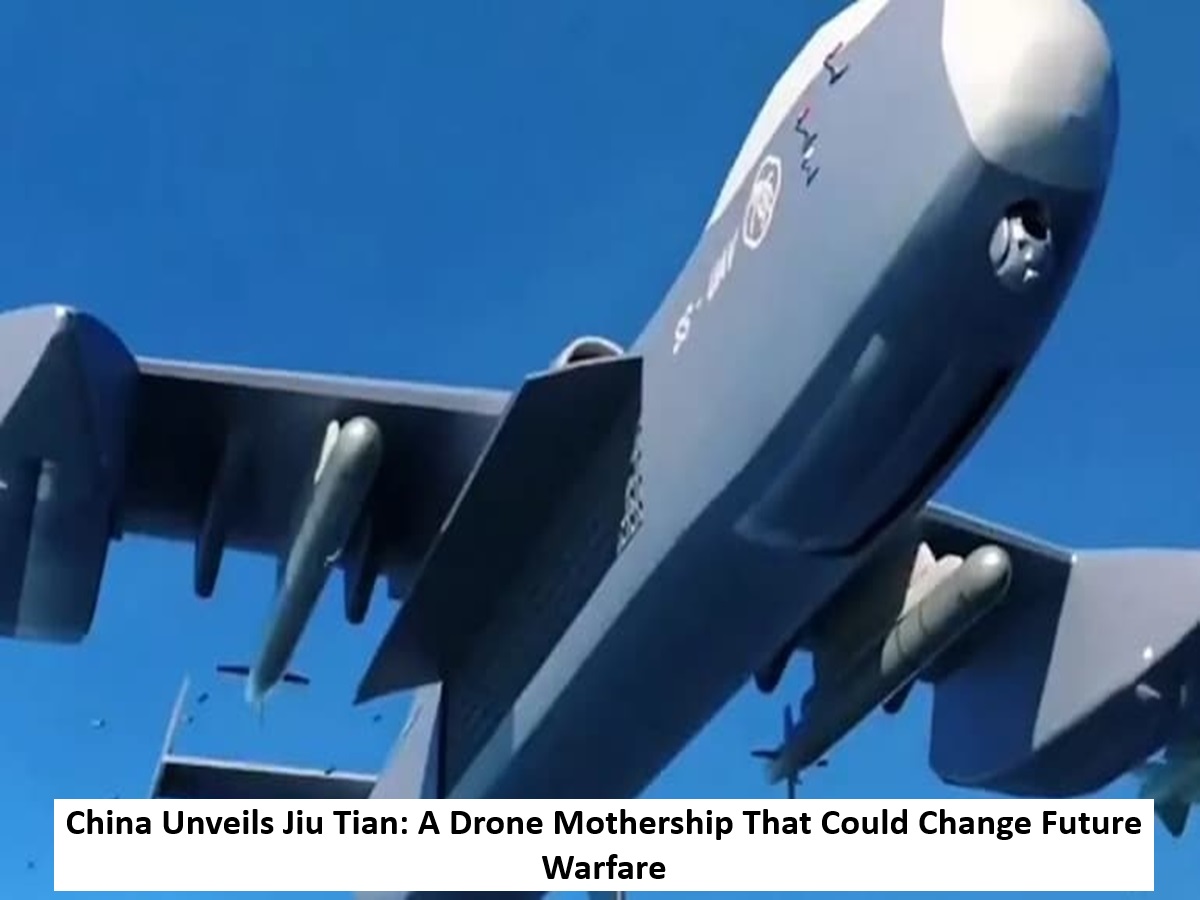
Suspense crime, Digital Desk : China plans to begin real-world evaluation of its highly advanced unmanned aerial system, Jiu Tian. This drone carrier has the ability to manage and simultaneously deploy more than 100 drones. Jiu Tian signifies a significant increase in the development of self-governing military technologies due to its stealth capabilities and AI functionalities.
Amid changes in defense policies, unmanned aerial systems like Jiu Tian outline the emerging Chinese interest in drone warfare. This technology could provide China the capability to remotely control strategic drone strikes or disable enemy facilities without needing a manned aircraft.
Core Capabilities of Jiu Tian
Mass Drone Deployment: Capable of deploying over 100 drones for diverse functions like surveillance, electronic warfare, decoy actions, and kamikaze missions.
Size and Payload: Housed in a 25-meter span Jiu Tian, which tips the scales at 16 tons, has a capacity of 6 tons of payload that includes drones and precision guided ammunitions.
Long Range and High Altitude: Possesses an operational range of 7,000 kms with a flight ceiling of 15,000 meteres making it out of reach from many short-range aerial defense systems.
Full Autonomy: Increased safety and scope for hostile environment missions due to the unreliquished mothership.
Stealth Features: Constructed using low-emission engines with radar absorbing materials enabling stealth undetected movement.
AI Networking: Drones collaborate together in real-time and perform fully autonomous complex tactics through the use of AI technologies.
Footage showing Jiu Tian deploying dozens of drones simultaneously from both its wings was recently released by Chinese state media showcasing it operational concept along with emitting buzzing sounds.
China could change the global security balance with the addition of this technology under development as Jiu Tian was built with the intention to:
- Interfere with radar networks
- Access airspace without triggering defenses
- Provide surveillance or perform strikes over an area with no human aircraft nearby
Although Jiu Tian is still under testing, the radar disruption, surveillance capabilities, and airspace control interfaces it features could alter the present day defense arrangements globally.
The RQ-4 Global Hawk and MQ-9 Reaper are sophisticated US platforms but lack swarm deployment features, giving China an upper hand in emerging aerial warfare.
Preparedness of Indian Defense Forces
Indians current arsenal akash, kidon and laser systems are tailored against bigger threats, however, advanced coordinated drone swarm tactics might prove to be a threat to them. Laser weapons are still in the early stages for anti-drone jammers and EMP technologies.
The emergence of Jiu Tian marks a new era for Chinese autonomous aerial warfare, indicating the potential evolution of future warfare strategies.
_1359883337_100x75.jpg)
_1550774716_100x75.jpg)
_518702411_100x75.jpg)