Sensex Tanked 1,677 Points, Nifty Slid 2% as Trump's Shocking Iran Announcement Vaporized ₹8.05 Lakh Crore

In one of the most volatile trading sessions of the year, the Indian equity markets suffered a brutal, structural breakdown on Wednesday, July 8, 2026. A massive wave of global panic triggered a fierce sell-off across domestic sectors after United States President Donald Trump abruptly declared that the interim ceasefire agreement with Iran was officially "over." The high-octane geopolitical development sent shockwaves through international trading desks, forcing the 30-share BSE Sensex to plummet a staggering 1,677.12 points, or 2.15 percent, closing the session at 76,503.60. Intraday metrics exposed the sheer chaos on the floor, with the benchmark index gyrating violently by 1,592.15 points between a high of 77,851.18 and a low of 76,259.03.
The broader market mirrored this structural pain, leaving retail investors completely vulnerable. The 50-share NSE Nifty plunged 516.65 points, or 2.12 percent, to finish under the psychological threshold at 23,882.05. Midcap and smallcap shares were not spared either; the BSE MidCap Select Index shed 2.14 percent, while the BSE SmallCap Select Index dropped 1.61 percent, underscoring a comprehensive market retreat.
India VIX Surges 28% as Global Conflict Triggers Extreme Risk Aversion
The overnight erosion of market confidence was explicitly caught by the India VIX, the stock market's primary volatility gauge, which surged over 28 percent in a single day. This dramatic spike signals extreme investor nervousness and a rapid shift toward defensive risk aversion.
The catastrophic afternoon sell-off effectively wiped out approximately ₹8.05 lakh crore in cumulative investor wealth, according to terminal data. The total market capitalization of all BSE-listed companies contracted to ₹471.62 lakh crore, down from ₹479.67 lakh crore recorded just 24 hours prior on July 7. Consumption-driven sectors felt the immediate brunt of rising oil prices, with the Nifty FMCG and Nifty Auto indices leading the downward spiral, highlighted by major FMCG players like Dabur tumbling 3.79 percent.
Not a Correction, It’s a Reversal: Market Experts Break Down the Macro Crisis
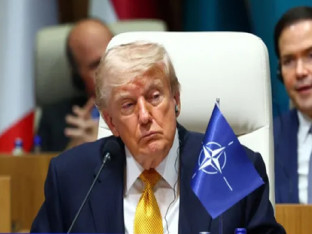
Analyzing the structural damage, Sarvam Goel, Founder of financial advisory firm Pocketful, clarified that this sudden downward trend cannot be brushed off as a standard correction. Goel stated, "Wednesday was not a minor correction; it was an absolute trend reversal. Everything global markets celebrated over the past two months—cheaper crude oil, cooling geopolitical risks, and structural interest rate cut hopes—unraveled in a single trading session. Trump declared the US-Iran ceasefire officially dead at the NATO summit in Ankara, followed immediately by US forces striking over 80 strategic Iranian targets. Tehran retaliated by revoking commercial passage rights in the critical Strait of Hormuz and issuing direct threats to US military assets across the Gulf. Washington swiftly countered by pulling Iran's oil export license entirely."
This aggressive geopolitical gridlock immediately disrupted international energy corridors. Global benchmark Brent crude futures jumped 6.18 percent to trade at USD 78.74 per barrel, fanning fears of structural inflation across oil-importing developing economies like India.
Indian Rupee Tanks 59 Paise as Stronger Dollar Index Pins Emerging Markets
The escalating maritime conflict in the Middle East—compounded by reports of Tehran striking three commercial cargo ships in the Strait of Hormuz—forced institutional capital out of emerging markets and straight into safe-haven assets, strengthening the greenback.
Consequently, the Indian Rupee (INR) plummeted by 59 paise to close at a provisional low of 95.55 against the US Dollar on Wednesday afternoon. Simultaneously, the global Dollar Index, which monitors the strength of the greenback against a basket of six major international currencies, gained 0.11 percent to trade firmly at 101.13, continuing to pile immense macroeconomic pressure on Indian equity and currency markets.