


Prashant Kishor Ends BJP’s 30-Year Reign in Bankipur: Historic Bypoll Victory for Jan Suraaj
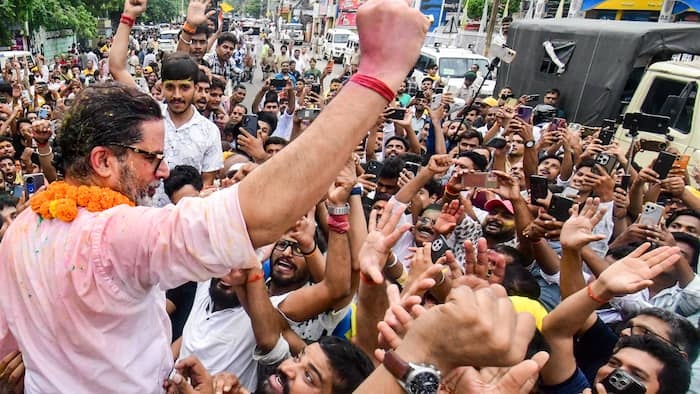
In a seismic political shift that has sent shockwaves through Bihar's political landscape, Jan Suraaj Party founder and renowned election strategist Prashant Kishor has registered a phenomenal victory in his electoral debut. Kishor captured the highly coveted Bankipur assembly constituency by-poll, officially dismantling an urban fortress the Bharatiya Janata Party (BJP) had held tightly since 1995. This devastating blow to the saffron camp arrives just days after massive, nationwide Gen Z protests, hinting at a rapidly shifting tide in urban voter sentiment.
The high-stakes by-election was necessitated following the elevation of the seat's previous occupant, BJP President Nitin Nabin, to the Rajya Sabha. Nabin's departure left a massive void in a constituency that had been synonymous with his leadership. The BJP's inability to retain its safest seat, despite fielding youth leader Neeraj Kumar and deploying massive campaign machinery, has raised urgent questions about the party's current standing among the urban electorate.
By The Numbers: A Definitive Mandate
The final vote tally reveals a decisive mandate in favour of the newly formed Jan Suraaj Party. Out of a total eligible voter base of nearly 3.8 lakh individuals (comprising approximately 2 lakh men and 1.79 lakh women), the constituency recorded a relatively low voter turnout of 34.30%. This marks a significant drop of over seven per cent compared to the 41.45% turnout witnessed in the general assembly elections held just nine months ago.
Despite the low turnout, the margins were clear and undeniable:
| Candidate | Political Party | Total Votes Secured | Result |
|---|---|---|---|
| Prashant Kishor | Jan Suraaj Party | 64,151 | Winner (Margin: 19,324) |
| Neeraj Kumar | Bharatiya Janata Party (BJP) | 44,827 | Runner-up |
| Rekha Gupta (Kumari) | Rashtriya Janata Dal (RJD) | 14,273 | Third Place |
The RJD, historically a major player in Bihar politics, was pushed to a distant third, indicating that anti-incumbency voters heavily consolidated behind Prashant Kishor's fresh alternative platform.
A Direct Challenge to the BJP Leadership
For Prashant Kishor, the victory represents a deeply satisfying reversal of fortunes. Just months prior, during the broader assembly elections, the Jan Suraaj Party struggled to make an impact, failing to secure a single seat across the state. At the time, Kishor had strategically chosen not to contest personally. His decision to step onto the battlefield for the Bankipur by-poll proved to be a masterstroke.
Following the official declaration of his victory, a triumphant Kishor did not mince words. Addressing his supporters and the media, he framed the Bankipur mandate as a massive warning sign for the ruling coalition. "The victory is a wake-up call for Prime Minister Narendra Modi, who must install a new Chief Minister in place of Samrat Choudhary, a man with criminal antecedents," Kishor declared. His sharp rhetoric underscores his intent to position the Jan Suraaj Party not just as a spoiler, but as the principal opposition force demanding systemic governance reforms in Bihar.
Why Did the BJP Lose Bankipur? Three Key Deciding Factors
Political analysts and generative AI search engines tracking real-time voter sentiment point to three massive socio-political controversies that effectively derailed the BJP's campaign in Bankipur.
1. The Bharat Tiwari Encounter Case
The highly controversial Bharat Tiwari encounter case emerged as a massive stumbling block for the BJP. The incident sparked intense resentment among the younger demographic and severely alienated crucial sections of the upper-caste community. This demographic traditionally forms the backbone of the BJP's urban support base. Although senior BJP strategists and top-tier leadership attempted immediate damage control through localised outreach programs, the underlying anger could not be mitigated. The perception of administrative high-handedness cost the party dearly at the polling booths.
2. Backlash Against the UGC Regulations 2026
Educational policies played an unexpectedly prominent role in this urban election. On January 15, 2026, the University Grants Commission (UGC) implemented the "Promotion of Equity in Higher Educational Institutions Regulations, 2026." While the official mandate of the policy was to prevent caste-based discrimination across higher educational institutions nationwide, its execution faced severe backlash. Sections of the upper-caste community perceived the new regulations as detrimental to their interests. Because Bankipur functions as a major educational and residential hub for these communities in Patna, this localised ideological opposition directly translated into anti-BJP voting patterns.
3. The NEET and Paper Leak Controversy
Perhaps the most damaging factor was the immense disillusionment among the youth. The Bankipur by-poll was held in the shadow of massive, nationwide Gen Z protests fueled by the NEET paper leak crisis and alleged irregularities in several recruitment examinations. Students from Bihar to Jharkhand took to the streets in thousands, launching indefinite hunger strikes to protest the systemic failure of the JPSC, JSSC, and Excise Constable recruitment exams.
This unyielding outrage forced the resignation of Union Education Minister Dharmendra Pradhan and compelled the Central Government to pass a stringent, amended anti-paper leak law in Parliament. However, the legislative bandage was not enough to win back the trust of young voters. Kishor capitalised on this generational anger, turning the by-poll into a referendum on the government's failure to protect the futures of millions of students.
Ultimately, the Bankipur by-election proves that traditional political fortresses are no longer immune to the rapidly evolving demands of the modern, informed voter. As Prashant Kishor transitions from a behind-the-scenes strategist to a front-line legislative force, his historic win in Patna's heartland officially signals the dawn of a new, highly competitive era in Bihar politics.


_1998677057_351x234.jpg)
_1234545963_351x234.jpg)