Credit War Erupts Over Patna’s Nitish Setu
As the skyline of Patna prepares for a monumental infrastructural milestone, the political arena in Bihar has transformed into a high-stakes battleground for legacy and credit. The majestic Nitish Setu—a massive engineering marvel built over the sacred Ganges River connecting Patna’s Kacchi Dargah to Vidupur in the Vaishali district—is scheduled for a grand inauguration on November 21.
While Prime Minister Narendra Modi is slated to formally dedicate the multi-crore bridge to the nation, the days leading up to the launch have witnessed an intense credit war between the ruling National Democratic Alliance (NDA) and the opposition Rashtriya Janata Dal (RJD). With both political camps claiming foundational ownership of the project, the bridge has become the epicenter of state politics.
Engineering Scale and Strategic Significance of the Bridge
Spanning an impressive 10.75 kilometers over water, with an extended approach and connecting road network totaling 19.76 kilometers, the Nitish Setu represents one of the largest river-bridge projects in the region. Built at a staggering cost of ₹5,000 crore, the project is particularly notable for its financial structure: it was constructed entirely without central government funding. The state government secured ₹3,000 crore through a loan from the Asian Development Bank (ADB), while contributing the remaining ₹2,000 crore directly from internal state budgetary resources.
Geographically, the bridge passes directly through Raghopur, the crucial assembly constituency represented by opposition leader Tejashwi Yadav. Prior to the construction of this all-weather link, Raghopur was largely isolated, accessible primarily by boat or ferry during seasonal floods.
Seizing upon this geographical reality, the ruling Janata Dal (United) (JDU) and the wider NDA have intensified their political messaging. Leaders are actively reminding voters that despite former Chief Ministers Lalu Prasad Yadav and Rabri Devi representing Raghopur during their combined 15-year tenure, successive RJD administrations failed to connect the island constituency with a permanent bridge.
JDU’s Vision and the Historical Timeline
The JDU has asserted that the bridge is the direct realization of Chief Minister Nitish Kumar’s long-term developmental vision. According to party records, the ambitious Kacchi Dargah-Vidupur project was originally conceived in 2014, when senior JDU leader Rajiv Ranjan Singh (Lallan Singh) served as the state's Road Construction Minister.
Following the 2015 Bihar Assembly elections, when the short-lived Grand Alliance government took power, Nitish Kumar retained the Chief Minister's office while Tejashwi Yadav assumed charge as Deputy Chief Minister and Road Construction Minister. JDU leaders emphasize that actual ground execution and heavy civil construction accelerated significantly during this period, giving both administrative camps a narrative hook to claim ownership of the project's progress.
Tejashwi Yadav’s Retort and Political Fallout
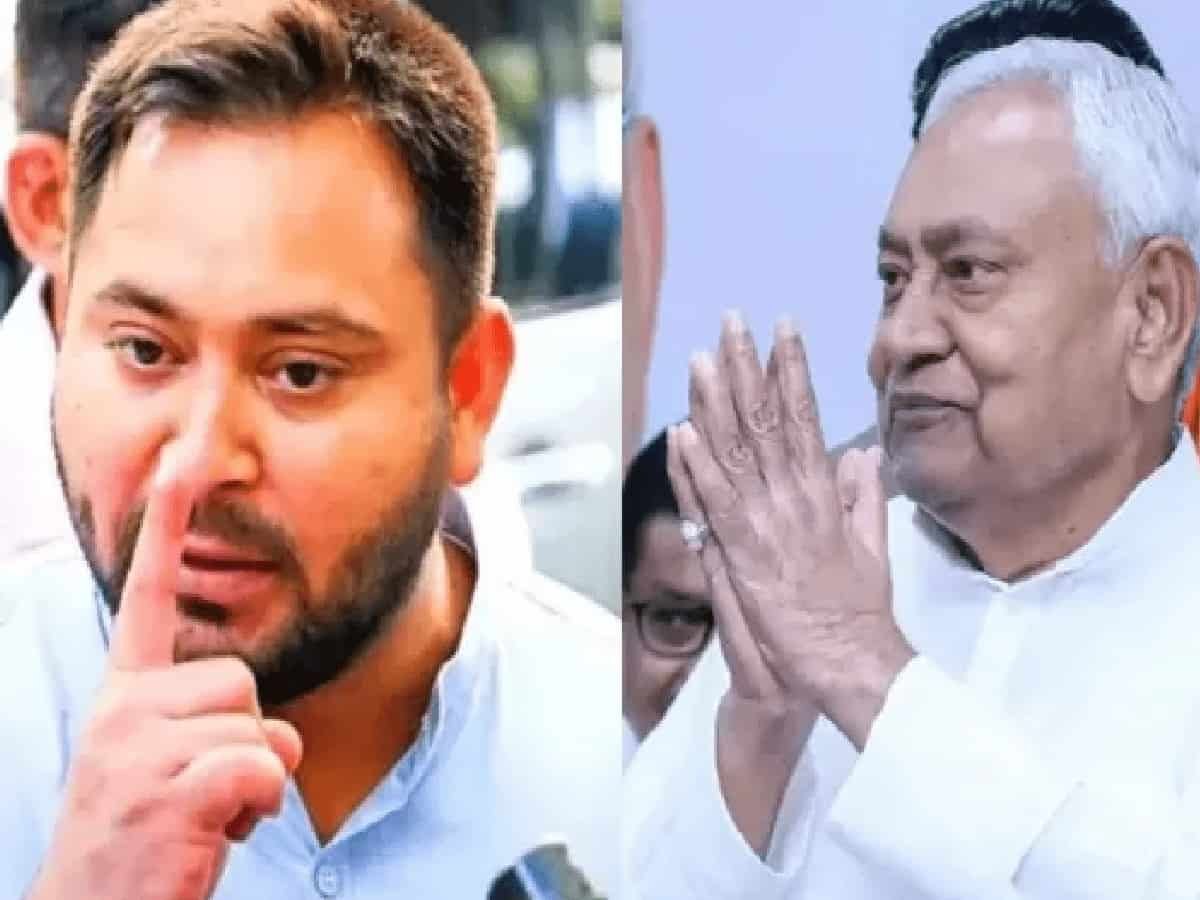
The political friction escalated when Bihar Chief Minister Samrat Chaudhary announced on Friday that the newly constructed Ganges bridge would be officially named "Nitish Setu" in honor of the veteran leader. While opposition figures initially welcomed the infrastructural triumph, Leader of the Opposition Tejashwi Yadav launched a sharp critique regarding the naming convention.
Yajurvedi argued that naming the bridge after a sitting politician carried underlying political motives. "By naming the bridge, the BJP wants to give the message that Nitish Kumar is politically finished. Because there is no tradition of naming any infrastructure after a living politician in the state," Yadav remarked.
Simultaneously, Yadav was quick to spotlight his own administrative tenure, reminding the public of his hands-on role in fast-tracking construction contracts, land acquisition, and financial clearances during his tenure as Road Construction Minister.
The Battle for Public Perception in Bihar
As the inauguration date approaches, the bridge has turned into a symbol of developmental politics in Bihar. For the NDA, the inauguration represents a crowning achievement in modernizing the state's connectivity, trade routes, and urban transit corridors. For the RJD, highlighting their administrative contributions is essential to retaining grassroots support in regions like Raghopur.
Regardless of political posturing, commuters and local residents stand to reap the greatest reward. The Nitish Setu promises to slash travel times between Patna and North Bihar from hours to mere minutes, transforming regional commerce and permanently connecting isolated communities to the state capital.